Guild has done something
unusual here. It’s released a trio of
competing Choral Symphony performances
from the years 1941-50. Each disc is
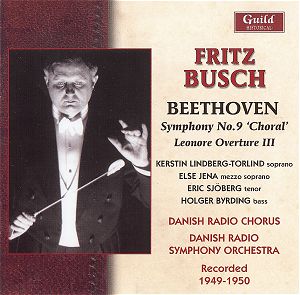
a separate entity. So the Busch recording
also takes its place in the fine restorative
work Guild is undertaking on behalf
of this still neglected musician. The
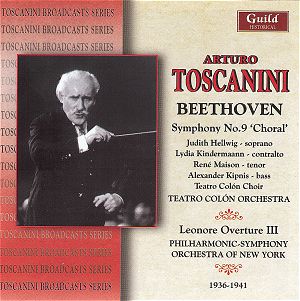
Toscanini meanwhile is one of the least
well known of his traversals, the live
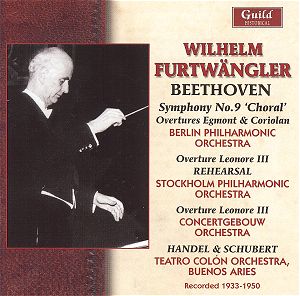
1941 Teatro Colón and the Furtwängler
is the Berlin performance given the
following year. Of course the primary
binary play-off is between the last
two.
But in many ways the
most impressive of the three performances
is the Busch. Those unused to Busch’s
conducting, who might otherwise presume
a link with his fellow countryman Furtwängler,
should be aware that this is very far
from the case. Both Fritz and his violin
playing brother Adolf Busch were very
much in Toscanini’s orbit; the conducting
Busch shared similar traits – clarity,
precision, articulation, rhythmic incision,
fast tempi, an avoidance of saturated
string tone. All these qualities are
demonstrated in this live 1950 broadcast,
made the year before Busch’s premature
death.
The linear sense of
dramatic lyricism is uppermost in this
performance. It sounds rather closer
to Toscanini’s post War 1952 performance
in fact than the 1941 one that Guild
has just released – but a caveat should
be noted. With Toscanini and indeed
his antipode Furtwängler a number
of performances have survived; with
Busch just this one, so it’s better
to exercise caution and to note that
on the basis of this one survival alone,
we can speculate that he tended to be
roughly aligned with Toscanini in questions
of tempo relation though to be slightly
broader in the first movement and quicker
than Toscanini in the second (though
Busch only takes the first of the two
repeats). What I think is undeniable
is that the tenor of the performance
derives from a different philosophical
tradition from Furtwängler’s own
– the spirit of innate dramatic lyricism
is one that lies at the buoyant, singing,
bracing and forward-pushing heart of
the conducting.
This has been out on
both Danacord and DG 453 804-2GCB6 –
the former as part of their Busch collective
sets, the latter in a ‘Historic Beethoven
Recordings’ box set. I can’t vouch for
the DG because I’ve not heard it; I
only know the Danacord in its LP guise
and can say that the constricted sound
to be heard there – maybe as a result
of the LP cutting process – has been
decisively overcome by Guild. This is
a forceful, very present transfer. It
makes one wish afresh that the post-War
commercial recordings that Busch left
of Symphonies No. 3, 7 and 8 had been
properly engineered.
In terms of absolute
timings there’s actually very little
between Toscanini and Busch. But in
matters of localised detail and broader
sweep there are obviously very real
differences. This is simply the most
galvanic performance of the Ninth I
have ever heard from Toscanini - but
in the most problematic sound. It’s
truly visceral from start to finish,
a passionate, occasionally even hectoring
performance of a symphony that even
his greatest admirers will admit Toscanini
found difficult to communicate successfully.
There are four NBC Symphony survivals,
and single examples from the BBC Symphony,
Philharmonic-Symphony Orchestra of New
York, La Scala and this one under discussion.
But the directional tension of this
1941 performance is volcanic and its
architectural sweep is often overwhelming
whether one responds to the nature of
the conducting or not. The problem of
the sound however will limit pleasure.
It’s mushy and constricted with, regrettably
a limited dynamic range. Guild has clearly
tried to do it can with it but it’s
still sonically compromised to a large
degree.
That’s not the case
with the last of the three, the 1942
Berlin Ninth. Furtwängler’s performance
stands at complete remove from Busch
and Toscanini. It is an Olympian, measured,
profoundly noble, unsettled and unsettling
reading. The deliberation, the fissures,
the massive power engendered at these
slower tempi might almost represent
not just a different philosophy but
a different time. The massive nature
of the reading comes as a result of
many things but one in particular –
the exceptionally wide dynamics Furtwängler
encourages. As with Toscanini Furtwängler
can be heard multiply in this symphony
from his 1937 London traversal to the
1954 Lucerne and others in between –
maybe the 1954 Bayreuth is the most
widely available. But as with the selected
Toscanini performance this 1942 reading
is possibly the most outstanding example
of the conductor’s way with it.
In its way it’s quite
as powerful a reading as Toscanini’s
though the means are very different.
I’ve not mentioned the quartet of soloists
so let me note that they’re good for
Busch, a better-known quartet for Toscanini
but far less audible. Furtwängler
had his regular bass Rudolf Watzke with
him. Only Tilla Briem disappoints. The
Furtwängler disc has some bonuses.
One of the features of this trio of
discs is that the Symphony is coupled
with performances of the Leonore III
overture. In this last however things
are taken beyond that. Furtwängler
is heard rehearsing the work in Stockholm
– a rare and fascinating insight into
the care he took, for example, over
tempi and evenness of phrasing. Then
he plays the whole thing with the Concertgebouw,
and then Coriolan and Egmont with his
Berlin Philharmonic. There’s a pleasing
Rosamunde and a stodgy Handel. Regarding
the last I know that Guild is aware
of its typo. It’s not the Concerto Grosso
Op.6 No.11 but No.10. This will be corrected,
I am sure, on subsequent pressings.
So this is one of those
‘compare and contrast’ set of releases.
I don’t know how many people will buy
all three – possibly very few – and
there’s really no imperative to do so.
But these are three important documents
and they have been worthily presented
here.
Jonathan Woolf

























 Danish Radio Symphony Orchestra/Fritz Busch

