“Every great artist does thousands of things for which we have
no method of writing on paper … We don’t know how to do that …
And we have to, through imagination, through feeling, through
– I don’t know what – some instinctive quality that some artists
have, we have to try to understand and reproduce and give to the
listening public what we consider was in the mind and soul of
the composer …” [Leopold Stokowski, speaking in 1969: from the
Teldec DVD The Art of Conducting].
In
1977, on the very day before he was to record nothing less than
Rachmaninoff’s Second Symphony for the first time, Leopold Stokowski
died at the age of 95. He turned out to be, however, one of
those fortunate artists whose reputations survive their own
lifetimes intact and this new disc will, I am sure, only add
to the number of his many admirers.
I
have recently been listening to – and reviewing on this website
– several other orchestral recordings made in the late 1920s
and early 1930s, yet nothing had prepared me for the way in
which those on this disc so triumphantly transcend the limitations
of the recording technology of the time.
Let’s
certainly give due credit to Mark Obert-Thorn whose re-mastering
of the original material is certainly up to his usual excellent
standards. But it is not only those transformational skills
that rivet you to your seat as soon as you put the disc into
the player. It is, rather, a unique combination of the musical
arrangements themselves and the sheer orchestral sound.
As
booklet writer David Patmore points out, as an organist the
young Stokowski was used to transcribing well-known orchestral
pieces for his instrument, so, once he had reached the conductor’s
rostrum, performing the reverse process came almost naturally
to him. But the transcriptions – and recordings - that he made
of Bach’s music were so inventive, so far beyond the obvious
and predictable, so possessed of a unique sonority and so intensely
alive, that they immediately took on an independent life
of their own.
Just
as important to the success of these recordings, though, is
the unique, lush “Philadelphia sound” that Stokowski famously
nurtured and honed during his long spell with that orchestra
(1912-1940). The sound was achieved partly by physical means
– rearranging the orchestra’s seating, for instance, as well
as encouraging free bowing by the string section and free breathing
by the brass – and partly by re-orchestrating a wide range of
repertoire to suit his own requirements. Quite fortuitously
– but very happily - the resulting rather bass-heavy sonic profile
turned out to be ideally suited to the new electrical recording
technology that was being introduced from 1925 onwards, with
its far greater ability to capture lower frequencies. In fact,
it may even be that the new technology actually encouraged
the development of the “Stokowski sound” further and faster,
for we find that, by the time of only his second electrical
recording (Tchaikovsky’s Marche Slave, May 1925), the
conductor was already augmenting his double basses in the recording
studio to achieve a more powerful sonic effect.
On
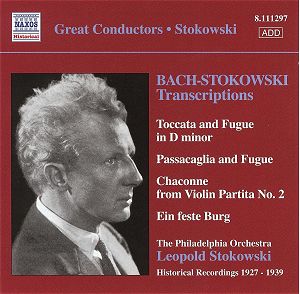
this particular disc, it is the three longer pieces – BWV 565
and, especially, BWV 1004 and BWV 582 – that make the greatest
impact. It is rather as if Stokowski’s performances, with their
characteristic cantabile violins and exquisite range
of tonal colours, exercise some sort of hypnotic effect that
makes an ever more cumulative and progressive impact as you
immerse yourself in it for longer and longer. That is not, though,
to denigrate the shorter pieces that are each, in their own
way small, perfectly-crafted jewels - the Ein Feste Burg
chorale prelude makes a particularly strong impact.
Even
today, Stokowski’s transcriptions – not just of Bach but of many
other composers – hold a place in the orchestral repertoire. In
the past few years his protégé José Serebrier has been recording
many of them for Naxos in the sort of state-of-the-art sound that
some CD buyers consider essential. There is, though, still a great
deal to be said for returning to the original versions themselves
and appreciating once again the unique mastery and magic that
Stokowski exerted over both the scores and his orchestra when
these superb recordings were originally set down.
Rob Maynard