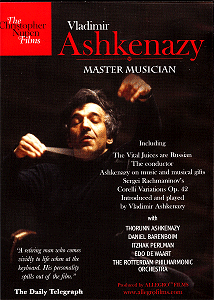
Part of this film came about by chance as many good things do.
Vladimir Ashkenazy (b. 1937) was playing the Op.42 Corelli Variations
by Rachmaninov (1873-1943) for the formal performance being filmed by Christopher
Nupen. As they were setting up, Ashkenazy started to talk about
the music, and what it meant to him. What he was doing was worth
capturing into a film on its own, as Ashkenazy, talking spontaneously,
was revealing the process by which a musician creates a performance.
This is far rarer than one might suppose, and is often taken for
granted. So here we have three films in one, the full performance,
the extempore conversation and a film from the archives, showing
how Ashkenazy, like Rachmaninov before him, came to terms with
being Russian in a new environment.
Needless to say, the
performance is very good, especially as it takes place in a small
auditorium with an appreciative audience. This makes a difference,
for it is intimate, introspective music, the composer’s last piece
for solo piano. As a pianist, he “spoke” with the piano more than
with any other instrument. He was also a man who believed firmly
that music should be, above all, emotionally resonant. So Ashkenazy
appreciates what it must have meant to the composer. Rachmaninov
was forced into exile by the Russian Revolution, and though he
had a successful career and moved in émigré circles, he never
really settled outside his homeland. His identity was so bound
up with being Russian that he never quite recovered from the shock
of being uprooted. Even the Russia he’s known was changed. It
was as if he were in mourning for a world abruptly destroyed.
As Ashkenazy says,
Rachmaninov’s early music was expressive and expansive. “He wants
to share with us his enjoyment of the joys of life, he’s generous
and open”. As he talks, Ashkenazy plays excerpts from other Rachmaninov
pieces, including the Second Symphony to illustrate his point,
entirely from memory. The Corelli Variations have “idiomatic eloquence”,
but the “Harmony closes in and becomes darker”, as if the composer
was drawing into himself rather than being exuberantly open. Ashkenazy
plays the main lyrical part, but even this ember of happiness
is tinged with melancholy. “There is not a shred of hope”, he
comments. The piece was inspired by a legend about a shepherd
committing suicide because he lost the one he loved. Perhaps for
Rachmaninov, exile was a kind of creative suicide.
Not
so for Ashkenazy, fortunately. He left
Russia in his youth, so in many ways
adjusted more easily. The archive film
shows him with his family in Iceland.
He’s bought a house, he plays with his
kids, all simple, normal things a man
does. But the difference is that he’s
always touring, and rarely settles.
Though his children are Icelandic, he’s
Russian to his soul. There’s a difference,
only moderated by the fact that Russia
itself has changed. What comes over
most, though, is his dedication to his
art. It’s worth all the sacrifices he’s
made, without question. Ashkenazy met
Christopher Nupen when he was only 19,
newly arrived in the west. He heard
one of Nupen's radio prgrammes and asked
him to make a radio programme about
Scriabin with him, invited him home,
and played him the entire Scriabin piano
works during the course of several evenings.
It was a spontaneous act of generosity,
in the spirit of Rachmaninov at his
happiest. No wonder he understands the
composer and plays him so well.
Anne Ozorio