Editorial Board
MusicWeb International
Founding Editor Rob Barnett Editor in Chief
John Quinn Contributing Editor Ralph Moore Webmaster
David Barker Postmaster
Jonathan Woolf MusicWeb Founder Len Mullenger
Piotr
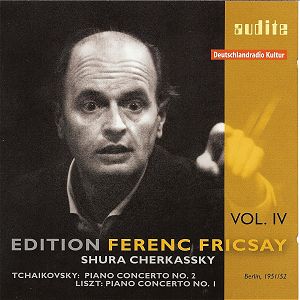
Il’yich TCHAIKOVSKY (1840-1893)
Piano concerto no.2 in G major, op.44 (1882) [35:36] Franz LISZT (1811-1886)
Piano concerto no.1 in E flat major, S124 (1856) [18:16] Shura
Cherkassky (piano)
RIAS-Symphonie-Orchester/Ferenc Fricsay
rec. unspecified studio, Berlin, 1951 (Tchaikovsky) and
unspecified concert hall, Berlin, 1952 (Liszt) AUDITE
95.499 [53:53]
There a few things about this disc that
might well strike you as a little strange.
Firstly, its positioning within this Edition
Ferenc Fricsay seems bemusing, to say the least.
After all, we’re only at the fourth volume and yet
already the conductor who’s the supposed focus is taking
not the central role but that of accompanist. Not that
there’s anything wrong with that, but you might well
have assumed that the Audite marketing team would want
to be establishing Fricsay’s musical credentials with
core orchestral repertoire in the earliest issues of
a continuing series.
Secondly, the sound, though actually extremely
clear and bright for its age, may strike some listeners
as a little odd in the Tchaikovsky. If you’re old enough
to recall the ubiquitous domestic record players of the
1950s or 1960s, usually made by Bush or Fidelity, you’ll
remember that they had only two controls over the quality
of the sound – a dial marked “bass” and another marked “treble”.
In this G major concerto recording the sound is very
reminiscent of those old LPs you played with “treble” turned
right up and “bass” turned right down, resulting in rather
screechy violins. Personally, I quite like it that way – and,
after playing this CD a few times, you’ll certainly get
used to it – but it will sound decidedly strange at first
to anyone who’s only familiar with high quality modern
recordings with a wide and realistic tonal range.
The third thing that will seem odd to some
listeners is the Tchaikovsky concerto’s overall running
time of only just over 35 minutes, compared to the 44
or 45 minutes that we might expect. That’s because nowadays
we usually hear the full uncut version of the andante
non troppo slow movement that clocks in at about
15 or 16 minutes, while here [and also in his later recording
with the Berlin Philharmonic Orchestra under Richard
Kraus, now available in Deutsche Grammophon’s The
Originals series] Cherkassky opts for the version
drastically edited by Tchaikovsky’s pupil Alexander Siloti.
Slashing the length of the slow movement by roughly half,
Siloti’s cuts create a completely different balance both
within the movement itself and in the concerto as a whole.
So, parking those points to one side, what
did I make of this CD? Well, especially in the case of
the Tchaikovsky, I enjoyed it immensely. Looking at my
notes, I see that the words I used most to describe the
first movement were propulsive and powerful,
with Cherkassky’s very obvious disinclination to linger
reflected in the overall timing of 19:53. That’s sprightlier
than any other account on my shelves - Gary Graffman
(20:50), Emil Gilels (21:03), Igor Zhukov (21:08), Sylvia
Kersenbaum (21:34) and Werner Haas (21:48), never mind
the plodding “unabridged original version” recorded by
Andrej Hoteev that comes in at a staggering 26:40. Even
Cherkassky’s own later recording with Kraus, at 20:00,
is marginally slower than this one.
This opening movement fully lives up to
its allegro brilliante designation. The orchestral
sound is very well balanced – both within the RIAS orchestra’s
own ranks, as we might expect from well-known orchestra
trainer Fricsay, and vis-à-vis the soloist. Moreover,
the dialogue between piano and orchestra is very well
maintained, with musical phrases and their responses
tossed between them most engagingly. Both Cherkassky
and Fricsay employ a notably wide dynamic range, but
even in the quieter, more reflective passages - where
Cherkassky frequently plays with especial delicacy and
sensitivity - the strong propulsive thrust is maintained,
resulting in a near-ideal combination of ruminative introspection
with rhythmic vitality and carefully controlled power.
Clever dynamic control and characteristic
touches of rubato are well to the fore in the
slow movement and make it clear that Cherkassky has considered
the significance of each individual note within a musical
phrase with some care. The violin and cello solos (neither
player is named) are beautifully played and a real plus,
even in Siloti’s truncated version, but are a little
more sonically recessed than we are used to in today’s
uncut recordings which naturally accord them a higher
profile. In yet another instance of his great skill,
Fricsay carefully controls the orchestra’s contribution
at the movement’s conclusion rather than just rounding
things off in a routine way: as a result, you really
do listen to it.
The strong propulsive thrust is back with
us at the opening of the finale and, while Cherkassky’s
delicacy and lightness of touch are still apparent in
the piano’s skittering opening phrases, the positivity
of the partnership with Fricsay is again evident in some
imaginative phrasing in the dialogue between piano and
orchestra. By this time, in fact, one has come to appreciate
the far stronger than usual contribution that the very
skilled RIAS (Rundfunk im Amerikanischen Sektor or Broadcasting
in the American Sector) Orchestra and its conductor
have made to the overall success of this performance – so
perhaps its high-profile placing in the Edition Ferenc
Fricsay can be justified after all.
Unfortunately, the Liszt recording - with
a live and occasionally chesty audience - did not grip
my interest to the same extent. In part, that reflects
a concert hall acoustic that is far less sharp and clear.
That said, listeners who habitually preferred to turn
up the “bass” control on those old Bush record players
may enjoy it more than I did. The balance between soloist
and orchestra is also less carefully managed than in
the Tchaikovsky studio recording. Perfectly acceptable
for long stretches, it deteriorates on occasion when
Cherkassky at full power can drown out some important
orchestral detail.
Cherkassky’s approach to the Liszt concerto
is notably less propulsive and even dreamier than in
the Tchaikovsky. That is especially apparent at the opening
of both the initial allegro maestoso and the succeeding quasi
adagio where his finely controlled playing is exceptionally
beautiful. There are some moments of genuine excitement
where you would expect them - the conclusion of the allegro
animato sees soloist and conductor upping both tempo
and volume to good effect – but, for me, the overall
combination of comparatively dull sound and a not so
striking performance relegates this recording to the
status of a filler … and, given the CD’s total timing
of 53:53, a rather short one at that.
If, however, the Tchaikovsky is your main
point of interest – and if you are prepared to accept
the Siloti butchery – then I think that, like me, you’ll
enjoy this disc a great deal.
Rob Maynard
Please support our advertisers below by clicking on the logos for further information.

























 Shura
Cherkassky (piano)
Shura
Cherkassky (piano) 
