|
EXPLORE
Musicweb - CLICK
------------------
Message Board
Announcements
Twitter @MusicWebINt
------------------
RECORDING
OF THE MONTH
Shostakovich Symphony 8
RCO, Nelsons

HALLÉ WALKURE
4+1CDs £22 post free
RECORDING
OF THE MONTH

Complete Orchestral Works

EMI Complete Ferrier

Storyteller

Mahler
Symphony 7
Bamberger Symphoniker
Jonathan Nott
................
RECORDING OF THE MONTH

Simone Young
RECORDING OF THE MONTH
Italia Nicola Benedetti

Only complete set
on the Market
35CDs £67

RECORDING
OF THE MONTH
Momentous!
BARGAIN
OF THE MONTH

Italian Cello Concertos
and Sonatas
3CDS £10.95

Brahms Symphonies Zinman
£26.85
RECORDING
OF THE MONTH
Beethoven Symphonies
Thielmann


Magic Moments of Opera
10 Operas Arthaus £95

Brilliant Classics 40CDs

Brilliant Classics 60CDs

9 Symphonies Chailly
£31.90

9
Symphonies C Davis
£18.70
BARGAIN
OF THE MONTH
Absolutely marvellous!
£5.99 post free

Bruch VC1 Gluzman
Quite the finest performance of the Bruch concerto
I have ever heard.

The best opera DVD of the year so far [ST]

Mahler Song Cycles
Katarina Karnéus
Available
again
The Raga Guide
4CDs + 196 page book
£33 post-free world-wide
15,000 copies sold
Editorial
Board
Classical Editor
Rob Barnett
Seen & Heard
Editor Emeritus
Bill Kenny
Editor in Chief
Stan Metzger
MusicWeb Webmaster
Len Mullenger
Assistant Webmaster
David Barker
|
 |
 |
|
|
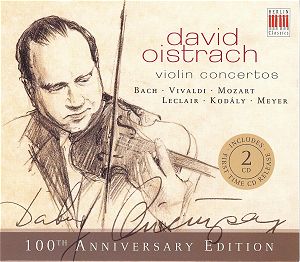
David Oistrakh – 100th Anniversary
Edition
CD 1
Johann Sebastian BACH (1685-1750)
Concerto for two Violins in D Minor BWV 1043 [17:14]
Antonio VIVALDI (1678–1741)
L’Estro Armonico Op. 3 – No.8 (1711) [13:04]
Wolfgang Amadeus MOZART (1756-1791)
Violin Concerto No. 5 in A major, K219 Turkish (1775)
[30:04]
Jean-Marie LECLAIR (1697-1764)
Violin Sonata in D major [12:58]
Zoltán KODÁLY (1882-1967)
Three Hungarian folk dances [4:32]
CD 2
Ernst Hermann MEYER (1905-1988)
Violin Concerto (1963-64) [36:19]
David
Oistrakh (violin)
Igor Oistrakh (violin) (Bach, Vivaldi)
Leipzig Gewandhaus Orchestra/Franz Konwitschny (Bach,
Vivaldi)
Staatskapelle Dresden/Franz Konwitschny (Mozart)
Staatskapelle Berlin/Otmar Suitner (Meyer)
Naum Walter (piano) (Leclair, Kodaly)
rec. 1954-65 (Kodály, Leclair) 1954-55 (Mozart), 1957
(Bach, Vivaldi) and 1965 (Meyer)
BERLIN
CLASSICS 0184612BC [77:52 + 36:19]
|
|
|
There
are some familiar recordings in this two-disc collection
and one very much less well known item. That is devoted
to Ernst Hermann Meyer’s Concerto, which occupies the
second disc, which as a consequence only lasts thirty-six
minutes. Of that rarity in Oistrakh’s discography more
later.
The
centenary of Oistrakh’s birth has produced a welcome
number of reissues, ranging from EMI’s huge box set of
Oistrakh’s recordings for the company (to be reviewed
by me soon) to more modest single disc. This sits at
the more modest end of the spectrum in terms of bulk – but
not necessarily in terms of quality. Oistrakh and Konwitschny
(‘Con-Whisky’ to British orchestral players) forged a
sympathetic relationship and made a number of mid-fifties
recordings together in Leipzig and Dresden.
For
the first two concertos David is joined by his son Igor.
I tend to favour the more seraphic, the more rapt partnership
between Oistrakh and Menuhin in the Bach Double but there
is certainly no doubting the immaculate and expected
rapport between father and son nor the ensemble between
them. The separation of the two voices is well judged;
in fact despite the muddiness of the lower strings the
actual solo violin distribution in the sound stage is
fine. The Vivaldi concerto derives from L’Estro Armonico
and finds the two Oistrakhs in sturdy and masculine form.
The highlight of the performance is the sense of noble
desolation they manage to convey in the slow movement.
For
the Mozart we move from Leipzig to Dresden. His later
performances – principally the self-directed Berlin Philharmonic
cycle – are much better known than this one and more
often reissued. But there is something about this mid
50s performance that is compelling. For one thing he
has a conductor and rigidity is avoided and for another
his tone retains its youthful verve avoiding the slightly
bloated feeling that crept into his performances in his
last years. The warmth and fluidity of phrasing in the
slow movement is a marvel and the Janissary episodes
of the finale are so well unleashed that the whole movement
stands as a unity as it so often doesn’t in less acutely
perceptive readings.
Leclair
and Kodály offer evidence of Oistrakh’s
association with pianist Naum Walter. The former is every
romantic violinist’s favourite Leclair sonata, the one
from which so many extracted the Sarabande and Tambourin.
Needless to say Oistrakh is a warm-hearted player in
this kind of repertoire and he has a very unbashful colleague
to hand. The Kodaly dances are exciting and dashing.
Ernst
Hermann Meyer is best known to Anglophones for his pioneering
book English Chamber Music. He was born in Berlin
in 1905, trained originally as a bank clerk and then
switched to musicology and composition (with Hindemith).
He also knew Hanns Eisler. He emigrated to England in
1933 – he was a Jew and a Communist – and lived there
until 1948 whereupon he returned to the paradise of East
Germany. There he quickly took a prestige position as
Professor of the Sociology of Music at Berlin Humboldt
University and fitted into the hierarchy of the GDR apparatus.
He rose to high office in the musical and political world.
His Concerto has a strong profile; the opening shares
something of Prokofiev’s mordant lyricism; there are
portentous brassy passages and plenty of strenuous surge.
Oistrakh himself apparently called it ‘a symphony with
violin obbligato’ which gives one an appreciation of
the nature of the scoring. But Meyer can organise things
adeptly; the way the opening movement slows down with
ruminative wind writing and the fireside curlicues of
violin smoke is truly evocative. The heart of the concerto
is the central movement. The booklet notes are equivocal
about the ‘official’ elements implicit in it – that’s
to say the political moments - and about its ‘affirmative’ tone
drowning out Meyer’s own, truer lyric voice. Well, maybe.
But there are still some highly charged ‘mysterioso’ passages – spectral
and finely contrasted with the bombast elsewhere. I’d
call it Socialist Realist Sturm und Drang. The finale
defiantly picks up where the second movement ended – a
welcome touch of bloody mindedness. There are more hints
of Prokofiev and some isolated bars wouldn’t be out of
place in the Bloch or the Barber either. The work ends
equivocally, unresolved. It’s difficult to gauge the
work but the fact that I’ve given it so much space indicates
that – whilst no masterpiece – it has a brooding power.
Brilliantly played.
The
documentation is good, the package attractive. I suspect
that this release offers some gap-filling opportunities
even for strong Oistrakh admirers.
Jonathan Woolf
|
|
Advertising
Rates
Visitor
stats
MusicWeb
International
has over 40,000 Classical CD reviews on offer
Discs
received
Having a problem
Donating?

Gerard
Hoffnung Concerts &
The
Bricklayer Story
New
Releases

New
Releases


MusicWeb
sells the Polish
catalogue CDAccord
£10.50 post free W-W

MusicWeb sells the
Arcodiva catalogue
£12.00 post free W-W

£11.75
post-free world-
wide
MusicWeb
can now offer
you discs from the following catalogues:
Prices include postage
Musicweb
Special
Offers
Monthly
Best Buys
Google
Ads - for information about privacy matters, click here.
Amazon Musicweb International is a participant in the Amazon
EU Associates Programme, an affiliate advertising programme designed to provide
a means for sites to earn advertising fees by advertising and linking to Amazon.co.uk
and Amazon.com
|