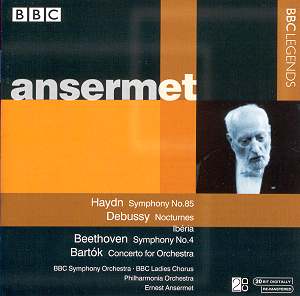
While the level of these performances isn't uniformly high, they
hold considerable discographic interest. Ernest Ansermet had the
good fortune to record extensively for Decca from the immediate
postwar period well into the 1960s, thus assuring that his name
and his work would become well-known. Less fortunately, most of
those recordings featured L'Orchestre de la Suisse Romande, the
Geneva radio ensemble which Ansermet essentially built - they
could sound sparkling and stylish in French and Russian music,
but they were hardly a world-class ensemble. The present release
allows us to appreciate his work, as rendered by top-of-the-line
London-based orchestras.
Thus, this performance of the Haydn symphony immediately scores over
Ansermet's studio recording, because of the more solid orchestral
sound. This is big-orchestra Haydn, with a large string body
dominating the sonority, but Ansermet mostly keeps the textures
clear, so the winds aren't obscured in their supporting role.
The first movement is lively and buoyant, with the conductor
stressing the cantabile aspect of the themes. The Romanze,
after an awkward opening, settles into a relaxed, flowing account.
I enjoyed the minuet's stately bearing - there are some lovely,
delicate passages, particularly when the solo oboe is involved
- and the touch of exuberance in the finale, though a few bits
briefly turn opaque.
One had high hopes for the Debussy performances - Ansermet's studio
recordings of these scores weren't the best - but they leave
a mixed impression. Once past an awkward start, Nuages,
the first of the Nocturnes, has all the vibrant tone
and the surging ebb and flow missing from the strangely chilly
Decca account; even in monaural sonics, this sounds gorgeous.
Fêtes suffers from tempo misjudgments, but not the customary
ones. Many conductors begin at a rollicking pace, clumsily shifting
gears for the "distant procession"; Ansermet sensibly
sets a more restrained tempo at the start, maintaining it smoothly
through the procession episode, but then keeps braking during
the recapitulation! After yet another stiff beginning - were
the signals confusing? - Sirènes is persuasively shaped,
but the close perspective on the women's chorus militates against
the needed atmosphere.
Ibéria begins crisply, but coördination
is uncomfortable amid the second theme's rhythmic intricacies.
The phrasing in the rest of the performance is just as stiff
as in the complete studio Images, but the full-throated
orchestral playing - here by the Philharmonia - once again trumps
that of the rickety Suisse Romande forces.
The slow introduction to the Beethoven symphony has a nice hushed mystery,
along with a soggy landing at 0:34. After the slashing vigor
of the main Allegro, Ansermet's slowing for the second
theme-group sounds old-fashioned, though the woodwind soli evoke
a searching disquiet. The slow movement is well-proportioned
and sings expansively, but curiously disappoints - and what
on earth is the snare drum doing tagging along with the bassoon
at 5:30? The Scherzo goes with the requisite bounding
energy, the Trio sections relax, and, as sometimes happens,
the whole movement sounds one go-round too long. No complaints,
however, about the volatile finale, which achieves the desired
moto perpetuo effect at a tempo that keeps the running
figures clear.
Ansermet's performances of Stravinsky's music were noted for their
emphasis on its lyrical aspects - there's an eight-CD bargain
box on Decca, for those who wish to investigate - and he plays
Bartók in a similar manner, finding and drawing out the music's
singing line while underplaying its angularity, which, Lord
knows, is going to come through anyhow.
In this Concerto for Orchestra, such an approach particularly
benefits the third and fourth movements. The slow movement can
seem discursive and episodic, the stepchild of overtly virtuosic
performances; Ansermet shapes it in a single broad line. And
the conductor draws unusual expression out of the Intermezzo
interrotto: the oboe's opening theme is shapely; the clarinet
and then the horn probe for deeper expression, which intensifies
further with the broad string melody. The theme from Shostakovich's
Leningrad makes a lively contrast, and the trombone's "interruption"
is taken at face value, without overplaying.
The other movements are less distinctive, though unfailingly musical.
Comparatively relaxed pacing in the first movement allows the
oboe's sinuous second theme a measure of plaintiveness, at least.
Ansermet plays the Giuoco delle coppie ("game of
pairs") well, though with rather a serious demeanour; there's
a small trumpet glitch at 3:21, if that sort of thing bothers
you. Conductor and orchestra play the finale for expressiveness,
color, and rhythmic point, rather than for sheer kinetic drive.
And, once again, the Philharmonia responds with a technical
security that eluded the Suisse Romande players, who found this
sort of writing a struggle.
Robert Chesterman's 1969 radio interview with Ansermet fills out the
first CD, with the Haydn and Debussy performances. Their discussion
of Debussy holds some interest, more for the conductor's glimpses
of the composer's personality than for any insights into his
own interpretive manner.
Veteran collectors will want this set for the view it offers of the
conductor's artistry, in both its strengths and its occasional
weaknesses, unhindered by the shortcomings of his home ensemble.
I'll probably only return to the Haydn and the Bartók for sheer
pleasure, but all the performances will reward study. The monaural
sonics, by the way, sound grainy at the start of each CD, but
the ear quickly adjusts, and the winds register vividly.
Stephen Francis Vasta