Editorial Board
MusicWeb International
Founding Editor Rob Barnett Editor in Chief
John Quinn Contributing Editor Ralph Moore Webmaster
David Barker Postmaster
Jonathan Woolf MusicWeb Founder Len Mullenger
Adolphe
ADAM (1803-1856) Giselle (1841) Giselle – Alina Cojocaru
Count Albrecht – Johan Kobborg
Myrtha – Marianela Nuñez
Hilarion – Martin Harvey
Choreography by Marius Petipa after Jean Coralli and Jules Perrot
Production design and additional choreography by Peter Wright
Scenario by Théophile Gautier after Heinrich Heine
Designs by John Macfarlane
Original lighting by Jennifer Tipton recreated by Clare O’Donaghue
Staging by Christopher Carr
The Royal Ballet
Orchestra of the Royal Opera House/Boris Gruzin
A BBC production in association with The Royal Opera House Covent
Garden, directed for television by Ross MacGibbon
Recorded live at the Royal Opera House Covent Garden, London, January
2006
Picture format: NTSC/Colour/16:9
Sound format: LPCM Stereo/DTS Surround
Menu language: English; Subtitles in French, German, Spanish and
Italian
Booklet Notes in English, French and German OPUS ARTE OA0993D
[112.00]
Adam’s Giselle is
possibly, alongside Tchaikovsky’s Swan Lake and The
Nutcracker, the best known ballet in the world; one
that many people will be able to name even if they are
not interested in ballet at all. However, where Tchaikovsky’s
ballets are celebrated not only for the dance but also
for the wonderful scores, Giselle is more famous
for arguably inventing Romantic ballet, as it is known
today. Though Adam composed the music, the ballet itself
was a creation of the French poet and novelist Théophile
Gautier (1811-1870) who, in turn, was inspired by a poem
by German poet Heinrich Heine (1797-1856). The poem tells
of a legend from Eastern Europe related to a spirit called
the “Wili”. The “Wili”, also known as “Wally” is the
soul of an unmarried girl who died before her wedding
and who dances in the forest for all eternity, dragging
to their death the unfortunate men that might cross her
path. The special thing about the story of Giselle is
that her love is selfless and eternal. Even though Count
Albrecht lied to her, betrayed her with another and is
the cause of her madness and untimely death, when she
returns as a “Wili” and has her chance for revenge, she
protects and saves him instead. To me, this is the real,
ever-enduring appeal of the ballet. The other attraction
is the ethereal, ghostly “Wilis” in the forest; the supernatural
beings who died innocent and were wronged while alive.
This illusion of lightness, almost of being suspended
and floating through the air was technically created
by the great Italian ballerina Marie Taglioni who achieved
it through long hours of harsh, almost gruesome practice
under the direction of her father Filippo Taglioni. Marie
caused a sensation when she first appeared in 1827 in
France and forever shaped ballet and our general idea
of the ballerina. Her style was perfect for the kind
of story told in Giselle, particularly for the
ghostly “Wilis”. It was originally choreographed by Jules
Perrot and later revised by Marius Petipa who created
the version that is mostly performed and best known today.
Perrot commissioned Adolphe Adam to write the music and
the composer created one of his most recognisable scores.
Adam’s music to Giselle is sometimes dismissed
as inferior mainly because it was written for a ballet
and dance took centre-stage, not the music; serious composers
were not always keen to write for the ballet. However,
Adam’s score though perhaps not memorable is truly melodic,
lyrical, harmonious and serious. Nothing about it is
frivolous or monotonous; it is equally touching and beautiful
when one listens to it on its own as it is when accompanying
the dancers on stage.
This
Opus Arte DVD of Giselle is a BBC production in
association with the Royal Opera House Covent Garden.
It was recorded live at the Royal Opera House in January
2006, featuring principals and artists from the Royal
Ballet. It is a traditional production that beautifully
recreates Petipa’s choreography and the original scenario
by Théophile Gautier, directly based on Heine’s poem.
In this format, it was first performed by the Royal Ballet
in 1985. Its popularity continues to grow and its appeal
does not seem to falter; it fills the House and is invariably
sold out in advance.
Alina
Cojocaru, the wonderful Romanian dancer, a principal
with the Royal Ballet, follows in the footsteps of many
illustrious ballerinas before her who danced the title
role. The first Giselle was the great Italian Carlotta
Grisi at the Paris Opéra in June 1841. Since then, the
role has been and continues to be a testing ground for
all the leading ballerinas: from Fanny Elssler, who danced
it in London after Grisi originated it in Paris, to more
recent dancers such as Alicia Markova, Carla Fracci,
Natalia Makarova and Galina Ulanova, to name but a few.
Young Cojocaru’s performance does justice to her illustrious
predecessors. From a mere physical perspective, Cojocaru
is the perfect Giselle. Her slender, tiny, fragile figure
complemented by an innocent, expressive face brings the
character to life in a very believable manner. She is
endearing and enchanting in her innocent love for Albrecht,
poignant and moving in the famous mad scene and suitably
ethereal and unreal in the second act as the “Wili”.
Her physical attributes are matched by an impeccable
technique which makes every step, gesture or jump she
executes look incredibly easy, graceful and ghostly elegant.
Brilliant from beginning to end, she is a true joy to
watch. Denmark’s Johan Kobborg makes a great count Albrecht
to Cojocaru’s Giselle and the chemistry between them
is undeniable. Kobborg is brilliant when partnering her
and breathtaking in his solos, especially when he flawlessly
leaps across the stage, effectively defying gravity.
As Myrtha, the Queen of the “Wilis”, Argentina’s Marianela
Nuñez has a chance to display her virtuosity and powerful
dramatic skills. She is as ephemeral and unreal when
she makes her appearance in Act II as she is scary when
passing judgement on the unfortunate Hilarion, who does
not have the undying love of a Giselle to save him from
his fatal end. Martin Harvey dances the peasant Hilarion
convincingly, with great attention to detail and good
dramatic expression. The rest of the cast as well as
the corps de ballet from the Royal Ballet are
excellent throughout, in particular its female members
during the difficult, trying and beautiful second act.
The production is wonderfully and expertly accompanied
by the Orchestra of the Royal Opera House. Under the
baton of distinguished Russian conductor, Boris Gruzin,
they give a sensitive, tender and intensely lyrical interpretation
of Adam’s score.
There
is nothing new or revolutionary about this Giselle from
the Royal Opera House but it is a beautiful production,
superbly danced by a young, fresh-faced cast that dedicate
themselves with heart and soul to the performance. It
is expertly filmed and edited. The picture is liquid
and clear, with contrasting colours, capturing the moonlit
forest of Act II perfectly, wonderfully enhancing the
ghostly atmosphere. There are excellent close-ups of
the soloists, showing the detail of the steps, gestures
and facial expressions, and wonderful wide shots of the corps
de ballet that perfectly capture the impact of the
technically brilliant ensemble scenes. The sound is crystalline
and distinct, suitably cushioning the dancers and effectively
showing the quality of the orchestra’s interpretation
of Adam’s poetic, evocative score. To summarise, I truly
enjoyed this production of Giselle. It is not
innovative nor does it attempt to be but it certainly
is a delightful example of how to stage a romantic ballet
and a genuine feast for the eyes.
Margarida
Mota-Bull
Please support our advertisers below by clicking on the logos for further information.
























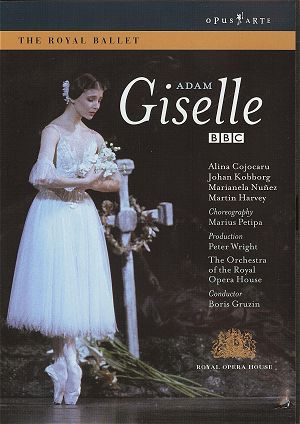

 Giselle – Alina Cojocaru


