Purchase Brilliant Classics from MusicWeb - "CLICK" here - Review of this disc

Daily Classical CD and DVD reviews. Classical Music Concert and Opera reviews, Jazz CD reviews, Interviews, Composer Profiles, Gerard Hoffnung

Classical Editor: Rob Barnett                               Founder Len Mullenger


CD REVIEW

Making a Donation to MusicWeb

Site Map

More Reviews

How to find a review

Classical CD Review Archive

Book Reviews

Film Music Reviews

Jazz CD Reviews

Nostalgia

Comment

Norman Lebrecht Weekly

Arthur Butterworth Writes

Phil Scowcroft's Garlands

Classical blogs

Reviewers Logs

Announcements

Don't Go Here!

Community

Bulletin Board

Web Ring

Reviewers

Helpers invited!

Resources

How Did I Miss That?

British Composers

British Light Music Composers

Other composers

Indexes
   Label
   Masterwork

Discographies

On-line Music
[Download sites]

Themed Review pages

Our Classic Classics

Online books
MWI Classical
     Encyclopaedia

Gilder Dictionary of
     Composers

MWI Pop
     Encyclopedia

Other Complete Books

Programme Notes


British Music Society
Performers
The BBC Proms
Musical links
Classical Music Online

Recording Companies and Retailers
Agents and Marketing
Publishers
Non-Classical Web pages
Orchestra Web Sites
Newsgroups
Web News sites etc


Editorial Board
Classical Editor
   
Rob Barnett
Seen & Heard
Editor and Webmaster
   Bill Kenny
MusicWeb Webmaster
   Len Mullenger
Assistant Webmasters
   Patrick Waller
   David J Barker

PotPourri
A pot-pourri of articles

MW Listening Room
MW Office
Helping MusicWeb
Advice to Windows Vista users  
Questionnaire    
Site History  
What they say about us
What we say about us!
Where to get help on the Internet
CD orders By Special Request
Graphics archive
Currency Converter
Dictionary
Magazines
Newsfeed  
Web Ring
Translation Service

Rules for potential reviewers :-)
Do Not Go Here!
April Fools

Would you like a hyperlinked weekly summary of the CDs we have reviewed?
Click for further details

Sample: See what you will get

alternatively
Classicsonline Crotchet


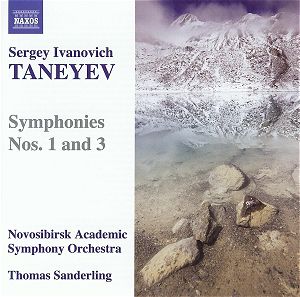
Sergei Taneyev (1856-1915)
Symphony No. 3 in D minor (1884) [42:05]
Symphony No. 1 in E minor (1874) [33:45]
Novosibirsk Academic Symphony Orchestra/Thomas Sanderling
rec. Studio of West Siberian Radio, Novosibirsk, Russia. 10-14 September 2006.
NAXOS 8.570336 [75:50]
Experience Classicsonline


This disc is the first in a promised series from Naxos of the complete orchestral music of Taneyev - also including the four cantatas. With the discs by Polyansky of the four symphonies, the Piano Concerto on Toccata and the re-release of the composer’s quartets and quintets from Northern Flowers - not to mention the promised quartets on Naxos - we seem to be living in a golden age of recordings for Taneyev enthusiasts. Even five years ago one would not have imagined competing discs of the symphonies - see Rob Barnett’s reviews of  the Polyansky versions of Symphonies 1 & 3 (see review) and 2 & 4 (see review).
 
On this disc the third symphony precedes the first, but we will follow the usual order. The Symphony No. 1 was written when the composer was 18 years old and already shows complete mastery of form and orchestration. It also shows that while influenced by his teacher Tchaikovsky, Taneyev was already developing a technical and musical personality of his own. The opening movement is quite serious and betrays the interest in counterpoint and linear development in general for which the composer would become known. Sanderling handles this movement in a more relaxed manner than Polyansky and I think it loses something therefore. While definitely Russian in feeling it also has a slight melancholy that reminds one of the composer’s contemporary Elgar. The Andantino is more like something from a Tchaikovsky ballet, but again there’s a lot more attention to counterpoint. Here Sanderling provides a smooth flow to the movement that is very appropriate. The scherzo is in mazurka rhythm and even the trio never completely strays from this time-signature. The last movement shows the young composer moving further and further away from his great teacher. In addition to the contrapuntal element already discussed, there is a big folk influence here. The development is well carried out, but overdone. Again I felt that Polyansky made it more exciting than Sanderling does.
 
The Symphony No. 3 was written ten years later and is the work of a fully mature composer with the contrapuntal and folkloric elements integrated with a full technical equipment and an occasional sense of whimsy. Sanderling does a good job of bringing out this particular aspect. The opening allegro is reminiscent of the same movement in the Symphony No. 2 and we see a very capable development of the basic material with subsidiary lines developed from the same. There are also serene moments along with serious and folksy. The scherzo shows wonderful writing for the winds followed by a charming trio deriving from the scherzo material. Most original is the slow movement. This continues the serenity of the previous trio with occasional Schumannesque undercurrents. I was reminded of the description of the composer at home in Bruno Walter’s autobiography. Like it’s counterpart in Symphony No. 2 the last movement is folk-inspired, almost dance-like, but with canonic devices to produce a segmental development that is very effective. Sanderling is not as forceful as Polyansky in this last movement.
 
Obviously, the main basis of comparison for this disc is the counterpart recording on Chandos. Polyansky is a more forceful conductor and has the benefit of better recording. Sanderling brings out more of the inner Taneyev in his performances - a side of the composer better-known to those familiar with his chamber music. In terms of recording the engineers at Chandos do a much better job - witness the high winds in the last movement of the Symphony No. 1. These are almost screeching on the Naxos disc, but not a problem on the Chandos. There are also reverberation problems on the Naxos recording. Similar issues occur with the Symphony No. 3. It must be pointed out that the Novosibirsk Academic Symphony Orchestra plays with a lot of enthusiasm and that their string section is first rate. Their winds are good too when the engineers allow them. Actually, the true fan will want to have both the Polyansky and Sanderling discs, others more concerned with recording quality will choose the former and those with budgetary concerns the latter.
 
William Kreindler

see also review by Dan Morgan


Advertising Rates
Visitor stats
MusicWeb International
has over 23,000 Classical CD reviews on offer


Gerard Hoffnung Concerts &
The Bricklayer Story

Naxos Classical

Purchase Brilliant Classics

Australian Eloquence CDs on Buywell.com


New Releases

Hyperion
New Releases


Guild Music


MusicWeb sells the Polish
catalogue CDAccord
£10.50 post free W-W


MusicWeb sells the
Arcodiva catalogue
£12.00 post free W-W


Price Reduction: £11.00
post-free
world-wide
Try it and see - Sale or Return


MusicWeb can now offer you discs from the following catalogues:
Prices include postage

[Acte Préalable £13.50]
[Arcodiva £12.00]
[Avie from £6.25]
Brilliant Classics
[British Music Society £13.49]
[CDACCORD from £10.50 ]
[ClassicO £12.50]
[Hallé from £11]
[Hortus £14.99 ]

[Lyrita ONLY £11.00 ]
LYRITA Sale or Return
[Onyx £12.00
]
ONYX Sale or Return
[REDCLIFFE £11 ]
[Tactus £11.50 ]
[Talent from £12.00 ]
[Toccata Classics £12.50 ]

MusicWeb Recommended Recordings 2008

DISCS OF THE YEAR 2008


Return to Review Index


Reviews from previous months
Join the mailing list and receive a hyperlinked weekly update on the discs reviewed. details
We welcome feedback on our reviews. Please use the Bulletin Board.  Please paste in the first line of your comments the URL of the review to which you refer..


You can purchase CDs and Save around 22% with these retailers: