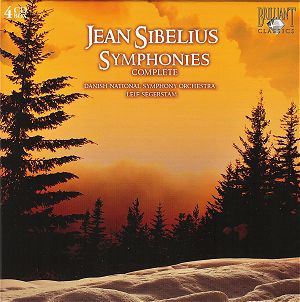
Most people in the classical music world now know these symphonies
so well and from so many different recordings. There is the danger
that everything can become so predictable when every footfall
is in its place and every stride perfectly timed. Music dies when
the illusion of spontaneity has ebbed away. I found that,
much to my surprise, when reviewing the Naxos coupling
of Koussevitsky in Symphonies 2 and 5 and in some parts of of
the Pittsburgh/Maazel cycle. At the other extreme are such inspirational
performances as: Barbirolli/Hallé
1 (EMI), Stokowski
1 (Desmar then Sony), Collins 1
LSO, Beecham
2 (BBC Legends), Barbirolli
2 RPO (Chesky), Ormandy
2 (Sony), Kamu 3 Finnish Radio Symphony Orchestra (DG), Oramo
6 CBSO (Erato), Ormandy
7 (Sony) and Mravinsky
7 (EMI, Olympia, BMG, Melodiya).
For years the Sibelian
mainstay of the Brilliant catalogue was Kurt Sanderling’s recordings
with the Berliner Sinfonie-Orchester. This was reviewed here
by Neil
Horner and myself.
Before that I had reviewed it in its Berlin
Classics livery.
Leif Segerstam (b.
1944) has delivered two recorded cycles of the Sibelius symphonies.
The most recent one is on Ondine with the Helsinki Philharmonic
Orchestra (Ondine ODE10752Q). In the early 1990s Chandos recorded
him in all the symphonies and much else with Danish Radio forces.
This was surely intended to replace their ageing set from Alexander
Gibson and the RSNO. Gibson’s track record reaches back to the
mid-1960s when he recorded a brace of Sibelius symphonies on
a Saga LP (XID5284). Ironically however the Gibson discs and
various permutations of them have survived in the Chandos catalogue
while Segerstam has not. True you can still get a Chandos Enchant
set of the very same performances featured here. You will also
find one of the original individual Segerstam discs listed.
Gibson however remains the triumphant survivor. He is still
there in comparative profusion while the Danish Radio sequence
has been remaindered and is now licensed out to the admirable
bargain-basement line from Brilliant. They in turn continue
to carry concurrently with the Segerstam their wonderful 1970s
analogue set of the Sibelius symphonies from Kurt Sanderling
which was originally on Berlin Classics. Segerstam has in the
meantime joined Berglund and Davis in allowing himself another
go – this time in the early 2000s with the Helsinki Phil on
Ondine. So what is the ‘catch’ with this ex-Chandos cycle?
Slow Sibelius can
be great Sibelius or at least good Sibelius - witness Colin
Davis’s very broad Kullervo on RCA. On the other hand
Okko Kamu’s Sibelius 2 on DG is just too much: flaccid and lacking
in dynamism. While there are variations at a micro level the
overall impression with Segerstam in these products of the Danish
Radio sessions is of a slow motion dissection. You will hear
episodes and close-up instrumental details you have not heard
before but this is at the expense of the underlying pulse. It
is just that that emphasis on pulse lends vitality to the readings
by Horst Stein (Decca), Beecham (BBC Legends, Symphony 2) and
my most recent discovery Van Beinum (Eloquence). In the First
Symphony Segerstam is certainly not aiming for tensile strength;
if he is he misses it by a good distance. His way appears to
be that of an architect of silences separating notes. The finale
is monumental to the point of being laboured and such is the
phrasing in the finale that more than usually one thinks of
Tchaikovsky. On the other hand one is struck by a superbly lucid
recording with wide natural channel separation. The Third is
not sharply accented and suffers accordingly. The Second Symphony
also tends towards a rather swimmy lethargy although there are
pleasures to be had from the husky warmth of the music-making.
The contrast between this and the interpretations by Ormandy,
Beecham and Barbirolli (RPO) tells against Segerstam. His Seventh
is characterised by great playing and by the glistening sable
weight of the violin tone. It’s one of the most successful of
the symphonies in this set and the primeval hieratics, although
not as strongly characterised as Mravinsky in Moscow in 1965,
are impressive (5:32). Taken at this pace strange resonances
float free of the texture – towards the end, for example, there
is a moment, in the aureate belling of the horns, that reminded
me very strongly of Nielsen’s Helios overture. The inward
aspects of the Fourth Symphony are given an exceptional tense
emphasis which is to the good. The second movement with filtered
Valse Triste echoes is memorable. In the finale the playing
and recording come together to produce really satisfying results
– witness the snarling edge to the brass at 7:48. Again the
Fifth Symphony is quite long drawn out but with sudden dramatic
italicisation such as the exciting accelerando at 14:05 in the
first movement. Its finale is taken at a slow speed which damagingly
drains off the power of this fine Symphony. On the other hand
those final off-beat hammer blows are rendered by players and
engineers with such transparency that it is as if one can pick
up out every stratum of the instrumentation. It’s a reading
that is magnificent in its moments but as an arching span it
is underwhelming. The Sixth, which is one of my real favourites
among the seven symphonies, is again too slow and reflective.
Everything is softened and light breezes replace passionate
gales – the exact opposite of Sakari
Oramo’s CBSO recording for Warners. The fillers are much
better although the rare In Memoriam is taken at such
a dawdle that it comes apart at the seams. It has a blunted
gummy bite – a sort of deconstruction of the march; the equivalent
in music of a dissection by Professor Gunther von Hagens. It
lacks the cracking power of the Lahti Vänskä Bis recordings.
The nine movements of suite no. 1 from the incidental music
to The Tempest are well judged and full of imaginative
choices such as the slow rocking motion of The Oak Tree,
the terrifying chasm that is Intrada and the Tapiola-like
gale of The Tempest episode with its roiling horns (3:20-3:31).
There are satisfactions
here and apprentice score readers will learn much with less
risk of losing their way. There are pleasures to be had from
this characterful and inexpensive set when you have tired of
the mainstream interpretations and want a radical change. Segerstam,
himself an astonishingly prolific composer, does not deliver
anonymous readings. It is just that his drum beats at a very
different and measured pace from most others.
It is a pity that
opportunity was not taken to mop up all the Segerstam Sibelius
on Chandos. The attractions of this set would have been enhanced
if Brilliant had included Kullervo, the two Scenes Historiques
and Pelleas and Melisande suites.
This is a handy set
which now emerges at an even handier price.
Rob Barnett
Segerstam’s Sibelius on Chandos (mostly deleted
now):
Symphony No. 4 in A minor, Op. 63. The Tempest,
Op. 109—Suite No. 1. Danish National Radio Symphony Orchestra
/ Leif Segerstam. Chandos ABTD1539: CHAN8943
Symphony No. 6 in D minor, Op. 104. Pohjola's
daughter, Op. 49. En saga, Op. 9. Danish National Radio Symphony
Orchestra / Leif Segerstam. Chandos ABTD1557; CHAN8965
Symphony No. 2 in D, Op. 43. Finlandia, Op.
26. Danish National Radio Symphony Orchestra / Leif Segerstam.
Chandos CHAN9020
Symphonies — No. 5 in E flat, Op. 82; No. 7
in C, Op. 105. Valse triste, Op. 44/1. Danish National Radio
Symphony Orchestra / Leif Segerstam. Chandos CHAN9055
Symphony No. 1 in E minor, Op. 39. In memoriam,
Op. 59. Danish National Radio Symphony Orchestra / Leif Segerstam.
Chandos CHAN9107
Symphony No. 3 Op. 52 / Tapiola Op. 112 / Scene
with Cranes Op. 44/2 - Danish National Radio Symphony Orchestra
/ Leif Segerstam CHAN 9083
Kullervo, Op. 7. Soile Isokoski (sop); Raimo
Laukka (bar); Danish National Radio Choir and Symphony Orchestra
/ Leif Segerstam. Chandos CHAN9393
Scènes historiques – Suite No. 1, Op. 25; Suite
No. 2, Op. 66. Pelleas and Melisande, Op. 46. Danish National
Radio Symphony Orchestra / Leif Segerstam. Chandos CHAN9483