Editorial Board
MusicWeb International
Founding Editor Rob Barnett Editor in Chief
John Quinn Contributing Editor Ralph Moore Webmaster
David Barker Postmaster
Jonathan Woolf MusicWeb Founder Len Mullenger
Henry
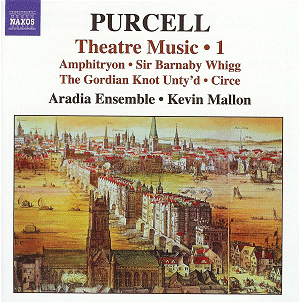
PURCELL (1659-1695) Theatre Music - Volume 1 Amphytrion, or theTwo Sosias, Z.572
[25:19] Sir Barnaby Whigg, Z.589 [3:49] The Gordion Knot Unty’d, Z.597 [17:00] Circe, Z.575 [13:25] Michelle Kettrick
(soprano); Andrea Jeffrey (soprano); Nicole Bower (soprano);
Giles Tomkins (bass); Roz Mcarthur (alto);
Neil Aronoff (bass); Peter Mahon (counter-tenor); Brian Duyn
(tenor)
Aradia Ensemble/Kevin Mallon
rec. 25-29 April 2006, Grace Church on-the-Hill, Toronto, Canada. DDD NAXOS 8.570149 [59:32]
Kevin Mallon and his Canadian Aradia (not ‘Arcadia’,
it’s
to be noted) Ensemble have set expectations high in recent
releases: his Charpentier Masses and Christmas CDs (also
on Naxos, 8.557229 and 8.557036)
are exemplary and satisfy the most demanding listener. Just
as elegant and full of poise is their Music for the Sun
King (Naxos 8.554003). Here is Volume 1 (one hopes of
a series) of selections from the music for theatre that Purcell
wrote, mostly towards the end of his life.
There
are four pieces on a CD that lasts just under an hour with
somewhat scanty liner-notes - but a first class recording
of highly charged and melody-rich music played with great
style and originality by Mallon’s forces.
Two
changes stand out across the divide during which theatres
in Britain were closed at Puritan insistence: women’s parts
were taken by male actors; and the stages of Shakespeare’s
day were mostly outdoor venues.
Indeed
the later, Restoration, plays – and this music - took advantage
of the new availability of women. This is fair, airy and
upbeat music for the most part. And, although serious, not
weighty.
By
Purcell’s time theatres’ acoustics were more contained, more
controllable and sufficiently different from those of the
Elizabeth and Jacobean eras for some new effects to be common – and
to be welcome. Playwrights to whose work the composer responded
could experiment with effects, machinery, spectacle. Indeed,
it was to this additional dimension that opera from Monteverdi’s
time appealed as well.
These
pieces (none is longer than 25 minutes) are not opera, nor
really musical theatre. They’re music to accompany existing
dramatic works… before the curtain, between acts and/or constitute
choruses to underpin the action. So, although some of such
works by Purcell were ‘converted’ into suites, the way we
hear them on this CD is not as Purcell’s contemporaries would
have heard them. And our response is likely to be very different
from theirs… at the very least because we will hopefully
pay much closer attention to the music than it seems likely
did late seventeenth century audiences!
Still,
this is fetching music played very much in the spirit of
the occasion that must have inspired Purcell: listen to the
changes in tempo during the longest piece, Amphytrion;
this was for a drama by Dryden. It afforded Purcell opportunity
for a series of French dances and some lyrical aria writing.
It’s executed with real sensitivity by soprano Andrea Jeffrey;
her diction and delivery are refreshingly delicate and give
great pleasure. The same can be said of Giles Tomkins’s light
but expressive bass, which seems ideally suited to this repertoire
for the words are always clear and amply endowed with meaning – again
without a degree of pathos, which might have been expected
here. Indeed, if there is a small criticism of the style
employed by the singers on this reasonably-priced CD in particular,
it is that they take things perhaps just a tiny touch too
seriously.
Mallon
and his players effortlessly convey the hesitancy and faltering
steps towards true love of shepherd and shepherdess without ‘playing
up’ the convention yet without becoming so absorbed in tribulation
that dramatic contrast is lost. Of equal interest are the
Scottish hornpipe and jigs [trs.5, 10] in the piece.
The
Aradia Ensemble enters just as fully into the spirit of the
comedy by d’Urfey, Sir Barnaby Whigg, for which Purcell
wrote only one number, a sea song and persuasive picture
of a tempest – possibly accompanied by stage effects at the
play’s performances in 1681 at Drury Lane.
Both
the other pieces – like Amphytrion – come from later
in Purcell’s career, the 1690s, when Purcell was literally
working himself to death both for love of his work, and for
money. For The Gordion Knot Unty’d (1691) Purcell
contributed a set of instrumental airs and dances. The composer’s
poignant yet unfussy melodic invention is well represented
by The Aradia Ensemble’s attentive and sensitive musicians
and singers. Circe (for a revival probably in 1690)
of Charles (son of William) Davenant’s tragedy called out
for magic, darkness and effects. In these Purcell is in his
element.
This
is music of Purcell’s maturity. The challenge faced by the
performers is to recreate, or at least represent, the appropriateness
to the conventions of late Restoration drama of Purcell’s
evocative music. In this they succeed in large part, though
a little more pace and lightness of touch in places might
have been welcome. On the other hand there is a Lullian sobriety
and deftness in numbers like the overture to The Gordion
Knot Unty’d [tr.13] which make this performance very
compelling. It’s hard to see how Purcell would have disapproved.
The
balance between vocal and instrumental pieces is nicely struck;
there is a sense of occasion – albeit by proxy – and the
momentum under the rather ‘rearranged’ circumstances is well
kept. The recording is up to scratch, though not roomy.
There
appears to be no existing recording of the song from Sir
Barnaby Whigg. The more comprehensive set of six CDs
by Hogwood and the Academy of Ancient
Music on Decca 000321502) can seriously be considered for the other three pieces. But if you
want a sampler of delightful and moving music exhibiting
many of Purcell’s finer and most refined qualities, this
is one to consider.
Mark Sealey
Please support our advertisers below by clicking on the logos for further information.

























 Michelle Kettrick
(soprano); Andrea Jeffrey (soprano); Nicole Bower (soprano);
Giles Tomkins (bass); Roz Mcarthur (alto);
Neil Aronoff (bass); Peter Mahon (counter-tenor); Brian Duyn
(tenor)
Michelle Kettrick
(soprano); Andrea Jeffrey (soprano); Nicole Bower (soprano);
Giles Tomkins (bass); Roz Mcarthur (alto);
Neil Aronoff (bass); Peter Mahon (counter-tenor); Brian Duyn
(tenor)
