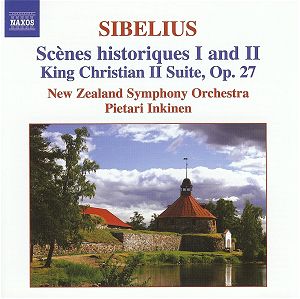
The first Suite of Scènes historiques and
the King Christian Suite are early works by Sibelius.
The former was distilled from music for a nationalist pageant
written in 1899, music from which Finlandia was later
excerpted, the latter dating from 1898. To put them in context
with the symphonies, the First Symphony, Op.39, still somewhat
influenced by Tchaikovsky, dates from 1899, the Second, in which
he arguably finds his true voice, in 1901-2. The second Suite
of Scènes dates from around the time of the Fourth Symphony,
though, like all the music here, it is much more approachable
than the symphony.
Despite being early works, most of the music on
this recording is instantly recognisable as Sibelius, especially
the Nocturne of the King Christian Suite. He
had not completely shaken off the influence of Tchaikovsky –
did he ever fully do so? – even in the Nocturne, but
this is all fine, likeable music, well worth hearing, yet these
works have received very few outings, live or on record in recent
years. These pieces deserve to be heard in this format, instead
of simply as fillers for the symphonies.
Scènes Historiques I was arranged in 1911.
The opening All’Overtura depicts the bard of the Kalevala,
the Finnish national epic; Scena evokes the drama of
the Thirty Years War; Festivo is set at the court of
the Swedish governor but its spirit is, surprisingly, not that
of Sweden but of the Spanish dance,
the Bolero.
The only competition in the two Scènes historiques
Suites comes from a rival budget-price CD, a Chandos Collect
recording, with the Royal Scottish National Orchestra under
Alexander Gibson (CHAN6591, coupled with Rakastava and
Valse lyrique), a very fine disc. My MusicWeb colleague
Bob
Briggs, reviewing a ClassicO recording in less than enthusiastic
terms, recommended this Chandos CD as “an excellent example
of how fine a Sibelius conductor Gibson was ... [in] a good
selection of Sibelius.”
Gibson is an acknowledged Sibelian but the new
recording is equal to the challenge. I had encountered the
New Zealand Symphony Orchestra on other Naxos
recordings, but I had not previously heard Pietari Inkinen in
action. It is soon apparent that he has a real feel for the
Sibelius idiom. He and the NZSO acquit themselves well from
the start; the powerful opening of All’Overtura is well
captured, the music seeming to rise mysteriously from the mist.
The Scena opens a little sedately for a Tempo di menuetto,
but comes to life as it should at the climax, while the mood
of Festivo, Tempo di Bolero, is also well caught.
Inkinen’s tempo in Festivo is slower than Beecham’s classic
78 recording, reissued on Naxos
8.110867, but then most conductors are slower than Beecham.
The Second Suite, composed in 1912, has only a
tenuous link with the 1899 pageant which gave rise to the First
Suite. The development of Sibelius’s style in the intervening
years is apparent in all three pieces, with typical Sibelian
horns in The Chase and a strong melody with harp accompaniment
in Love Song, all well captured on this recording At
the Drawbridge, probably the finest piece from this suite,
often used to be performed on its own (was it not a Beecham
‘lollipop’?); here it receives a suitably jaunty performance.
The King Christian Suite was adapted from
music for a play by Adolf Paul, depicting the love of the king
for a Dutch commoner, Dyvecke. When she is murdered by his
rival, a Danish nobleman, his revenge is passionate. When Sibelius
rearranged the music, he made the Nocturne the first
movement and Ballade the last, thus framing the music
with tender, swelling love music and blazing passion. The NZSO
and Inkinen capture the tender opening love scene and Christian’s
revenge in the blazing close equally effectively. The Musette
is lively; in the Serenade from the Third Act, with music
for a court ball, too, they match the mood perfectly.
The chief competition for the King Christian
Suite also comes from Chandos, this time in the form
of a highly-regarded full-price recording of the complete incidental
music. (The Iceland Symphony Orchestra under Peter Sakari on
CHAN9518, coupled with Pelleas and Melisande and movements
from Swanwhite.) In addition to the movements of the
Suite, Sakari includes a Minuet and the Fool’s Song.
Rob Barnett
was “not at all sure” about Shuntaro Sato’s Sibelius collection
on Finlandia 0927-49598-2, though he liked his steady pulse
in the King Christian music.
At the same budget price as the Naxos recording, Regis RRC1272
offers Pelleas and Melisande, King Christian Suite
and the Karelia Suite, with the Philharmonia under Batiz
and LSO under Tjeknavorian. Cheaper still is an EMI 2-CD set
of Sibelius music, including the King Christian Suite,
conducted by Dorati and Gibson Rob
Barnett’s Bargain of the Month in May 2004 (EMI Classics Gemini
5 857852 2).
An even better bargain is offered by the 8-CD box
of Sibelius Symphonies and other works, including the King
Christian Suite, under Paavo Berglund, Christopher
Howell’s MusicWeb Bargain of the Month in February 2002
and still available for around £25 in the UK (EMI 5 74485 2).
If you really want to go for broke, go for the
Sibelius bargain of bargains, The Essential Sibelius (BIS-CD1697-1700,
15 CDs for the price of four), Rob
Barnett’s MusicWeb Bargain of the Month in January 2007,
contains all the music on this Naxos recording and much more.
I cannot vouch personally for any of these versions,
though they come with good credentials. I can vouch for the
high quality of Inkinen’s interpretation and the playing of
the NZSO.
The Naxos recording is good, wide-ranging but just a little
too close. Initially I had the volume a couple of dB higher
than usual, having forgotten to turn it down after listening
to a CD which needed a bit of a boost. The result was overpowering
until I turned things down and, even then, I thought the sound
a little too immediate – not a serious problem, however.
The fact that the notes are by Naxos’s long-standing expert
Keith Anderson is practically a guarantee of their quality.
Brian Wilson
see also Review by Bob Briggs