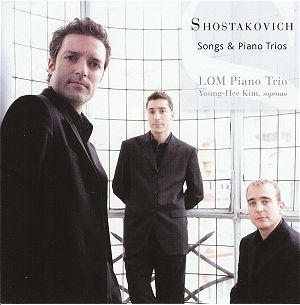
These three works with piano trio make a most satisfactory coupling
of music spanning Shostakovich’s career from 1923 to 1967. His
development can easily be seen as the 1st Trio
is overfull with ideas, the 2nd Trio more concise
with strong ideas worked out in his most serious manner, then
the Blok Songs, which are object lessons in economy.
The 1st Trio is a youthful work in one movement.
It flits from one mood to another with the swiftness of a film
cut - a most enjoyable concoction, full of good tunes, and well
laid out for the three instruments.
The 2nd Piano Trio comes from Shostakovich’s maturity,
written during the Great Patriotic War, in memory of his friend
Ivan Sollertinsky. It is the first of his Jewish works.
A difficult work to bring off it covers a vast range of emotion.
The first movement is relatively easy going, indeed, in some
ways it exudes an air of untroubled innocence. The second is
a manic scherzo and the slow, third, movement a sombre passacaglia.
The finale was started just as news
was announced of the liberation of the Nazi death camps, including
Treblinka. Shostakovich was horrified that the SS Guards made
their victims dance beside their own graves and created a programmatic
image, the music becoming wilder and wilder. Ian MacDonald (The
New Shostakovich, Fourth Estate, London, 1990) has pointed out
that at the climax of this movement there is “… the impression
of someone stumbling about in exhaustion …” which is “… painfully
vivid”.
Shortly
after his first heart attack, Shostakovich was commissioned to
write a vocalise for Vishnevskaya. It was to be accompanied
on the cello by her husband, Rostropovich. The composer quickly
realized that this wasn’t what he had in mind, and with the addition
of violin and piano created the Seven Poems
by Alexander Blok. This takes
the original idea of a duet and uses the three instruments, with
voice, in every available combination. Alexander Aleksandrovich
Blok (1880-1922) was one of the leading symbolist poets of the
time.
I
tend to shy away from any recording which includes a contemporary
singer for the standard of singing these days is marred - perhaps
ruined is a better word - by the accursed wobble. Lieder singers
of the recent past never wobbled – used vibrato to be sure,
because vibrato is an expressive device, to be used on special
occasions. Wobble is when the singer is not in control of the
voice and it is prevalent today. What is more important is that
vibrato cannot be put on every note, wobble can. At least with
vibrato the listener has a clear idea of what note the singer
is singing! It must be that young singers are taught to wobble
for whenever I hear students at the music colleges here in London,
wobble is already in place. Hasn’t anybody ever heard Elsie
Suddaby, Elizabeth Schumann, Lisa della Casa? - three of the
purest voiced singers ever to open their mouths and sing a song.
I
am afraid that Young-Hee Kim wobbles, though,
it must be admitted, not as badly as so many these days. There
are times when she actually employs a slight vibrato. But her
wobble is an unpleasant sound, and wobbling always will be.
This has bothered me for some time and it was the performance
of Jeanne-Michèle Charbonnet in Foulds’s World Requiem
which brought this problem to the fore. It’s time we returned
to a purer style of singing, one which does a service to the
composer.
The
L.O.M. Trio (the name is made from the initials of the surnames
of the members of the group) is a young ensemble with a promising
future. The Trio plays the 1st Trio expertly,
easily handling the many gear-changes Shostakovich demands of
his players, but it is less successful in the later work. This
2nd Trio makes heavy demands on its performers
from the greatest delicacy - as in the opening of the work with
the harmonics for solo cello - to the danse macabre mentioned
above. It is here that this performance falls down. In the 1947
recording made in Prague with David Oistrakh and Shostakovich
joined by a young Czech cellist, the great Milos Sadlo, this finale
borders on insanity. Shostakovich, I believe, refused to do retakes
so the piano playing is full of fistfuls of wrong notes but what
an awesome performance it is! As I have written of Shostakovich
elsewhere, this is music which is on the very edge of madness,
all caution thrown to the wind and that 1947 performance is positively
diabolical. The L.O.M. Trio is accurate but oh so polite, almost
apologetic. Where’s the urgency? The sense of danger? The passion?
It is to be hoped that this Trio will come to see the truly passionate
nature of this music and, one day, give of their all. But don’t
wait until then, go for Shostakovich and colleagues in the Trio
- truly one of the greatest performances of anything ever (Symposium
SYMPCD 1314 – coupled with other first recordings of Shostakovich’s
works) and Vishnevskaya, Oistrakh, Rostropovich and Weinberg (the
première performers of the work) in the
Blok Songs (EMI Classics 0724356282957).
Bob
Briggs