Without knowing anything
about the provenance of this recording
one thinks one will be in for an inspired
and inspirational evening. Without
looking for further details one puts
disc one in the player and leans back.
Overture!
The opening phrases
are sensitively sculptured, though
with some heavy accents, but he makes
you listen. Giulini, isn’t it? One
doesn’t expect outgoing jolliness
from him, rather nobility and this
is rounded, even mellow music-making.
But isn’t the recording poor? The
orchestra doesn’t sound too bad but
there is no real bloom and there is
a serious lack of upper frequencies.
And in the last resort there is also
a lack of fizz in the playing – and
in the conducting. Rossini would have
been depressed. Some minutes into
the opera proper even I begin to feel
depressed. The sound doesn’t improve,
quite the contrary, and the measured
tempos make the whole affair rather
bloodless.
Luigi Alva has to
struggle to keep the line in Ecco
ridente, but he sings with elegance
and mellifluous tone and there is
also some metal in it. But it is bloodless.
Wait, here comes
Tito Gobbi, and he is never dull.
No, he is in ebullient mood, but he
tends to shout. He is as detailed
as ever in his pointing of words and
the patter singing is secure, but
is he any fun? No, I find this a reading
from the brain, not from the heart,
and it doesn’t get better. The sound
also deteriorates, it comes and goes
due to the placing of microphones
– was there more than one? – and it
distorts. Enter Callas and Una
voce poco fa is technically brilliant,
as far as I can judge through the
veils of aural mist, but does she
charm the listener? Not a bit.
Shall I go on or
shall we stop playing hide-and-seek?
I knew from the beginning the origin
of this: Maria Callas, who primarily
sang the heavy dramatic roles, had
an early success in 1950 in Rossini’s
Il turco in Italia. In 1954
she recorded the role for EMI and
the following season she wanted to
do it La Scala under the direction
of Franco Zeffirelli. Again it was
a success, so for February 1956 she
demanded Il barbiere di Siviglia.
This time she didn’t want Zeffirelli
– nobody knows why – and instead La
Scala dusted off an old production
which had never been very good in
the first place and with no strong
director at hand the singers had to
create their role portraits on their
own and what has been intimidated
during the first half-hour is confirmed
with knobs on as the comedy goes on.
There is a lot of over-acting, especially
from Callas, about whom a critic wrote
that her interpretation of the role
was ‘nearly worthy of a psychoanalytical
study.’ She may be the worst sinner
but not the only one. Luigi Alva sometimes
fall in the same trap and Gobbi, for
all his acting abilities, seems less
than inspired. There also seems to
have been an anti-Callas claque
in the audience, who loudly booed
her and, even worse, greeted Nicola
Rossi-Lemeni’s disastrous La calunnia
with ovations. The veteran Melchiorre
Luise, who plays Bartolo, is more
or less the best of the bunch, and
that in a role that really invites
over-acting. I am not 100% certain
but probably it was the premiere that
was recorded. The CD cover only gives
1956.
Callas and Gobbi
admirers are lucky though, since EMI,
despite this unfortunate production,
chose to record the opera under studio
conditions in Kingsway Hall a year
later. Alva sings Almaviva again,
which he did during the next fifteen
years another four times, and with
Nicola Zaccaria as Basilio and the
excellent Fritz Ollendorff as Bartolo
this is a set worth owning. In is
now in EMI’s Great Recordings of the
Century series. See review.
And the present set
– for the dump? There is really little
positive to say about it but inveterate
Callas fans will still want it, I
suppose, and as a blueprint for the
EMI set it might at least be valuable
as a reminder that something close
to catastrophe can be turned, with
good guiding – Walter Legge was the
producer – into something valuable.
To end on a negative
note, though: the track-list is inadequate,
there are two few cue-points and the
inlay has a long essay in German and
English on Rossini and Il barbiere
di Siviglia and thumbnail bios
on the artists but nothing about the
actual recording. That information
comes from Tony Locantro’s liner notes
for the GROC issue referred to above.
Göran
Forsling
























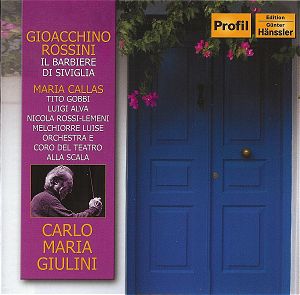
 Luigi Alva (tenor) – Conte d’Almaviva; Melchiorre
Luise (bass) – Bartolo; Maria Callas (soprano)
– Rosina; Tito Gobbi (baritone) – Figaro;
Nicola Rossi-Lemeni (bass) – Basilio; Pierluigi
Latinucci (bass) – Fiorello); Anna Maria
Canali (soprano) – Berta; Giuseppe Nessi
(tenor) – Un Ufficiale
Luigi Alva (tenor) – Conte d’Almaviva; Melchiorre
Luise (bass) – Bartolo; Maria Callas (soprano)
– Rosina; Tito Gobbi (baritone) – Figaro;
Nicola Rossi-Lemeni (bass) – Basilio; Pierluigi
Latinucci (bass) – Fiorello); Anna Maria
Canali (soprano) – Berta; Giuseppe Nessi
(tenor) – Un Ufficiale 