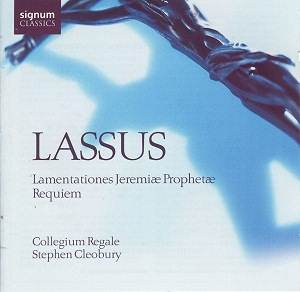
Orlandus Lassus was one of the most admired and influential composers
of his time. Born in Mons in the Southern Netherlands in 1532
he travelled throughout Europe and held several positions in Italy.
He ended his career as a member of the court chapel of the Dukes
of Bavaria in Munich, first as a singer, then as Kapellmeister,
a position he held from 1563 until his death in 1594. There the
circumstances were ideal: in the heyday of the chapel he had more
than sixty singers and instrumentalists at his disposal. He was
held in high esteem by his employers, even to the extent that
Duke Albrecht considered his compositions as his private property
and prevented them from being printed. Lassus's settings of the
penitential psalms, for instance, were published only in 1584,
25 years after Lassus composed them and five years after the death
of Duke Albrecht.
The Lamentations of Jeremiah were set to music by many composers in
the 16th century. They were originally written by the prophet
Jeremiah in reaction to the destruction of Jerusalem by the
Babylonians, who also deported the largest part of the Jewish
people. In the Christian Church the fate of Jerusalem was
connected to the suffering of Christ, as both were the result
of the disobedience of mankind towards God. The Lamentations
are then put into the mouth of Christ, and in particular the
conclusion of every part of the Lamentations was considered
highly appropriate: "Jerusalem, Jerusalem, turn back
to the Lord your God". Liturgically the Lamentations
are part of the Matins (or 'Tenebrae') on each of the last
three days before Easter, the 'Triduum sacrum': Maundy Thursday,
Good Friday and Holy Saturday. Lassus composed two settings
of the Lamentations, and here the four-part Lamentations from
1585 are performed. From the nine settings only the three
for Maundy Thursday are sung. They are followed by the motet
'In monte Oliveti', whose text (Matthew 26, vv39-42) is from
the responsory after the first reading from the Lamentations
on Maundy Thursday. Liturgically speaking it should be sung
after the first Lamentatio rather than after the third, as
is the case here.
The music of Lassus was particularly famous for its sonority and its
expression of the text. There are some nice examples of word-painting
in his setting of the Lamentations. In the performance by
the Collegium Regale - basically the Choir of King's College,
Cambridge without the boys - the sonority receives more attention
than the text. The singing is mostly legato, with little room
for colouring single words or groups of words by individual
singers. The ensemble produces a very beautiful sound, and
the voices blend perfectly. At the same time the emotional
impact of this performance is somewhat restricted. I have
compared this recording with the one by Pro Cantione Antiqua
(Hyperion, 1981), which sings the whole set of nine Lamentations.
There it is the other way round: the text is better realised
than the sonority. As an ensemble the Collegium Regale wins,
but in regard to expression Pro Cantione Antiqua is hard to
beat. In one respect I prefer this new recording: the pitch
is lower than in the Hyperion recording, which seems to me
more appropriate considering the character of the Lamentations.
The second major work is a setting of the Requiem Mass. Lassus wrote
three settings of the Mass of the Dead; here the four-part
setting is sung, which was published in 1578. Requiem Masses
weren't only sung at funerals. It was the doctrine of the
Purgatory - which developed in the Middle Ages - which led
the church to sing Requiem Masses throughout the year, asking
for the alleviation of the sufferings of the deceased. A number
of Requiem Masses were composed in the 15th and 16th centuries,
and these show considerable differences in regard to the parts
of the Mass being set to music. Lassus didn't set the Tractus
nor the Sequentia Dies irae. In modern performances these
are sometimes sung in plainchant, for example in the recording
by Pro Cantione Antiqua mentioned above. Here only the Tractus
is sung (Absolve, Domine) but not not after the Graduale,
where it belongs, but before the Requiem Mass, "serving
here to mark the division between the two main sections of
the programme", as the programme notes say. This seems
to me a rather strange decision, which makes the Tractus lose
its proper liturgical function.
The setting by Lassus is sombre in atmosphere, also due to the low
pitch which is indicated by the written-out intonations -
something normally left to the interpreters. Here Lassus without
any doubt made use of the low voices for which the court chapel
in Bavaria was famous. It seems Lassus had a special preference
for the low voices as he imported them from the Low Countries.
The basses of the Collegium Regale do a fine job here. Something
I have noticed over the years in all-male choirs is that,
whereas the boys usually don't use any vibrato at all, the
men often apply it in abundance; the Choir of King's College
is no exception. But here they avoid it, fortunately. I'm
generally more impressed with the lower voices than with the
altos, which sometimes lack clarity.
The disc ends with 'Vide homo', a motet for seven voices which concludes
Lassus's swan-song, the 'Lagrime di San Pietro', a cycle of
twenty spiritual madrigals. He wrote the cycle "for my
particular devotion now that I am of such great age".
This results in a composition which is characterised by deep
emotions and ends with the motet whose words are put into
the mouth of Jesus: "See, O man, what things I endure
for you. To you I cry, I who am dying for you". The Collegium
Regale gives a good performance, but is a little short on
expression.
In general I have really enjoyed this recording, and I am impressed
by the singing of the ensemble. I certainly hope to hear more
from them. At the same time the expression which is a feature
of Lassus's music isn't fully explored.
Johan van Veen