Editorial Board
MusicWeb International
Founding Editor Rob Barnett Editor in Chief
John Quinn Contributing Editor Ralph Moore Webmaster
David Barker Postmaster
Jonathan Woolf MusicWeb Founder Len Mullenger
Franz
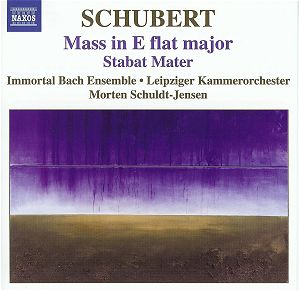
SCHUBERT (1797-1828) Mass in E flat, D. 950 (1828) [46:13] Stabat Mater in G minor, D. 175 (1815) [5:46] Immortal
Bach Ensemble
Leipziger Kammerorchester/Morten Schuldt-Jensen
rec. Grosser Saal, Gewandhaus, Leipzig, 22-24 August 2006 NAXOS 8.570381 [51:59]
This
glorious choral work comes from that miraculous final year
of Schubert’s life when so many canonic pieces were written.
The last of his six completed Masses, it lay unperformed
until a year after the composer’s death, and many writers
see in it a realization from the composer of his impending
end – his own Requiem, in other words. Like the Mozart
Requiem, this view could be construed as romantic piffle,
except that it does make a lot of sense, and the Mass inhabits
the same emotional and dramatic terrain as his last quartets,
sonatas and songs.
It
doesn’t seem to be performed all that much in concert,
but has done fairly well on disc, especially recently,
when this new Naxos was joined by a higher profile competitor
in the shape of Hickox and his starry Chandos forces. I
haven’t sampled that one, but there’s enough to give a
warm welcome to the disc under review. My benchmark for
some years has been the historically informed version under
Bruno Weil on Sony, and it’s fairly obvious that conductor
Morten Schuldt-Jensen has learnt a thing or two from that
trend. His forces are small and disciplined, with fairly
swift tempos, though not to Weil’s degree. The orchestra
plays cleanly and crisply and there’s a general no-nonsense
air about the performance. The fact that it relaxes in
places and is allowed to breathe will be welcomed by many,
but there is a pay-off in lack of dramatic tension at some
key points. One of the main places is the start of the
second section of the Gloria, the ‘Domine Deus’,
where the trombones of Weil’s Orchestra of the Age of Enlightenment
are simply more imposing and effective, as are his keener-edged
choral forces. Elsewhere, period percussion and wind cut
through the texture, underpinning the ominous overtones
of the composer’s own ‘Der Doppelganger’ at the start of
the Agnus Dei. That said, Schuldt-Jensen is alive to the
Brucknerian anticipations, especially the many searching
harmonic progressions that litter the score, and his interestingly
named Immortal Bach Ensemble are very professional and
full-toned. The few solo contributions seem to be from
within the choir’s ranks - they are named within the booklet,
not on the outer sleeve - and he uses women rather than
the all-male soloists on Weil’s version, another traditional
touch that some may prefer.
The
tiny Stabat Mater that fills out the disc comes from 1815,
when the composer was 18. Like so much early Schubert,
it’s worth hearing without setting the world on fire. A
more substantial work could have been found with these
timings, but Weil’s Sony disc has nothing at all, so perhaps
we shouldn’t complain. Recording is warm and reasonably
well detailed, rather like the performance. You may want
to search elsewhere for greater interpretative insight
(Sawallisch, Abbado) or keener dramatic impact (Weil),
but there’s no doubt this Naxos issue represent decent
all-round value.
Tony Haywood
Please support our advertisers below by clicking on the logos for further information.

























 Immortal
Bach Ensemble
Immortal
Bach Ensemble 
