Editorial Board
MusicWeb International
Founding Editor Rob Barnett Editor in Chief
John Quinn Contributing Editor Ralph Moore Webmaster
David Barker Postmaster
Jonathan Woolf MusicWeb Founder Len Mullenger
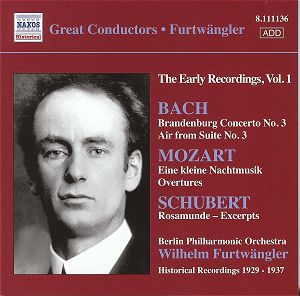
Wilhelm Furtwängler - The Early Recordings
Volume 1
Johann Sebastian BACH (1685-1750) Brandenburg concerto no.3 in G major, BWV 1048 (1721) [10:40]
Air from orchestral suite no.3 in D major, BWV 1068
[5:05] Wolfgang Amadeus MOZART (1756-1791)
Overture to Le Nozze di Figaro, K.492 (1786) [4:15]
Overture to Die Entführung aus dem Serail, K.384 [4:49]
Serenade no.13 in G major, K.525, “Eine Kleine Nachtmusik” [15:15] Franz SCHUBERT (1797-1828) Rosamunde – incidental music, D.797 (1823) [20:22]:
((i) Overture (Die Zauberharfe) [9:43] (ii) Entr’acte no.3
in B flat major [5:15] (iii) Ballet music no.2 in G major
[5:24]) Berlin Philharmonic
Orchestra/Wilhelm Furtwängler
rec. Hochschule für Musik, Berlin: 13 June 1929 (Bach Air
and Schubert Ballet music no.2); 1930 (Bach Brandenburg concerto
and Schubert Overture and Entr’acte); November 1933 (Mozart
overtures); 28 December 1936 and June 1937 (Eine Kleine Nachtmusik) NAXOS HISTORICAL
8.111136 [60:27]
A well known photograph, taken at a Berlin
banquet in the summer of 1929, shows Arturo Toscanini on
the eve of his departure for new career challenges in the
USA. Flanking him are the luminaries of the German cultural
capital’s music scene – Bruno Walter of the Berlin Municipal
Opera, Erich Kleiber of the Staatsoper unter den Linden,
Otto Klemperer of the Kroll Opera and the Berlin Philharmonic
Orchestra’s chief conductor Wilhelm Furtwängler.
Even in that year of massive economic turmoil
and political crisis, a truly fabulous array of music-making
was obviously on tap for the city’s inhabitants. And Furtwängler,
at the Philharmonic’s helm since 1922 and active in the recording
studio since 1926, was – in spite of the rather distant and
aloof posture he adopts in the photograph - at its very heart.
This first volume of a new Naxos Historical
series that will focus on Furtwängler’s earliest recordings
includes material that was clearly selected to have the widest
appeal. As Colin Anderson’s booklet notes usefully remind
us, the conductor regularly performed works by contemporaries
such as Hindemith, Bartók, Schoenberg, Stravinsky and Ravel – but
Bach, Mozart and Schubert were more obvious commercial choices
when trying to sell records in the middle of a worldwide
economic depression.
The disc gets off to a tremendous start
with the Brandenburg Concerto no.3, a real “old school” performance
with a powerful, stately and distinctly heavy-footed first
movement that clocks in at a whopping 7:14 (check out a more
modern recording from your shelves and you’ll find that somewhere
around 5½ minutes is considered the “authentic” norm these
days). I was very much reminded of Sir Adrian Boult’s last
recording of the Brandenburgs where he attempted, with the
full London Philharmonic Orchestra, to recreate the typical
Bach sound of conductors such as Sir Hamilton Harty (and,
as this recording demonstrates, Furtwängler) that he had
been used to as a younger man.
Unlike many conductors, Furtwängler chooses
not to interpolate material to bridge the gap before the
subsequent Allegro, a far livelier affair - though still,
given the involvement of the massed ranks of the BPO, a wildly “inauthentic” one.
Neither is authenticity the keynote of
the Air from Suite no.3. The conductor’s interpretation is
terribly, terribly slow and very, very deliberate – and yet,
its consistency, the degree of intense musical concentration
and the sheer quality of the performance all demand, once
our own anachronistic 21st century preconceptions
are set aside, the greatest respect on their own terms.
The Mozart tracks are all superbly performed,
with an exquisite wit and polish, sensibility and refinement.
An exceptionally lively Die Entführung overture emerges
with particular success and, while less individually characterised,
the carefully moulded and controlled Eine Kleine Nachtmusik is
also a delicious treat.
That 1936-1937 Mozart recording is immediately
followed by one of Schubert’s Rosamunde incidental
music that dates from six or seven years earlier and, moreover,
derives from an entirely different recording format. Placed
thus, the latter’s sound deficiencies are emphasised even
further by the comparison. Once the ear adjusts, however,
it is clear that these interpretations are, as required,
powerful and thrusting yet lyrical (the overture), sensitively
and finely nuanced (the entr’acte) and carefully related
to their musical context. As in all the tracks on the disc,
Furtwängler’s characteristic emphasis on the bass line and
wide dynamic range are especially notable.
The Berlin Philharmonic is, to no great
surprise, revealed in Mark Obert-Thorn’s excellent sonic
remastering as one of the most sophisticated orchestras of
its era, notably more “modern” in its sound than, say, the
portamento-prone c.1930 London Symphony Orchestra - though
you will still find some swooning violins on these tracks
too. When you then go on to consider the superb quality of
the late 1920s Berlin State Opera Orchestra, well demonstrated
on the disc of Klemperer conducting Brahms and Wagner that
I reviewed here in March, it is clear that the citizens of
Weimar-era Berlin really were – in the field of music, at
least - living through a truly golden era.
Rob Maynard
Please support our advertisers below by clicking on the logos for further information.
























 Berlin Philharmonic
Orchestra/Wilhelm Furtwängler
Berlin Philharmonic
Orchestra/Wilhelm Furtwängler 
