Editorial Board
MusicWeb International
Founding Editor Rob Barnett Editor in Chief
John Quinn Contributing Editor Ralph Moore Webmaster
David Barker Postmaster
Jonathan Woolf MusicWeb Founder Len Mullenger
Giuseppe VERDI(1813-1901) Luisa Miller(1849) [157:40] Darina Takova (sop) – Luisa
Giuseppe Sabbatini (tenor) – Rodolfo
Alexander Vinogradov (bass) – Walter
Damiano Salerno (bar) – Miller
Ursula Ferri (mezzo) – Federica
Arutjun Kotchinian (bass) – Wurm
Elisabetta Martorana (sop) – Laura
Orchestra and Chorus of Teatro La Fenice, Venice/Maurizio
Benini
Director: Arnaud Bernard
Sets: Alessandro Camera
rec. live, La Fenice, May 2006
No Region Coding, Aspect Ratio 16:9, Dolby Digital Stereo
2.0, Dolby Surround 5.0 NAXOS
2.110225-26 [2
DVDs: 108:20 + 49:20]
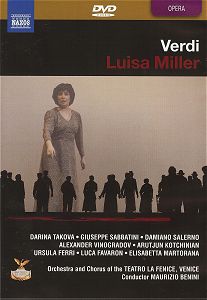
Don’t be put off by the
front cover of this DVD. At first glance the costumes and
misty infinity of the stage may give the impression that
this Luisa Miller is set after a nuclear holocaust.
Rest assured that it isn’t and that the result is well
worth exploring.
One of the lesser known
hits of Verdi’s middle period, Luisa Miller is often
criticised for its slightly staid plot, particularly in
the almost stagnant last act; but musically there’s a lot
to enjoy, and this performance from La Fenice shows that
admirably.
The setting is quite minimalist
so there’s little to distract from the drama. For most
scenes the characters are hermetically sealed into what
looks like a cube through whose fourth wall we are watching.
At times all the walls rise up together and are removed,
creating an illusion of outside space (this works particularly
well at the chorus’ entry in the final scene) and at times
they are mixed, showing a chink of light penetrating from
outside. There is very little furniture (a billiard table
for the Count’s Drawing Room, a kitchen table for Miller’s
house): instead every scene has a very tall but thin monolith
displaying a resonant image to go with that scene (a field
for the first scene, a woman with her back turned representing
Luisa’s shame for Act 2, Scene 2). They don’t really add
very much, but they don’t get in the way, and for that
we must be grateful. The period of the opera is suggested
by the costumes which, for the peasant farmers at any rate,
suggest Eastern Europe under Communism, appropriate enough
for a tale of the elite abusing its power. The Count and
Duchess dress in ostentatious finery while the peasants
wear plain costumes, the women all sporting head scarves.
This makes the production timeless enough and, while it
won’t win any prizes, it isn’t distracting.
The performances themselves
are very good. The production’s secret weapon is the Bulgarian
soprano Darina Takova. I hadn’t come across her before
but I was really impressed by her singing. All the notes
are there, showing ripeness of tone at the top of the voice
as well as a lustrous middle register. She displays absolutely
flawless coloratura in her first aria and again, impressively,
while lying on her back in the first stages of delirium
in the final scene. One to watch out for in the future.
The three basses are well contrasted. Damiano Salerno is
a young, heroic Miller, his voice displaying a real golden
quality, particularly in his duets with his daughter. He
makes one regret that he is entirely absent from the middle
act. Alexander Vinogradov, plastered in make-up to make
him seem much older than he really is, radiates dark authority
as the Count. Arutjun Kotchinian as Wurm certainly possesses
a dark colour which matches the part’s villainy, though
there are times when the gritty tone takes over from the
musicality which should always be paramount. Ursula Ferri
has a real sit-up-and-take-notice quality to her rich,
dark mezzo. Her lowest notes are entirely secure and she
seems to touch on contralto territory in her duet with
Rodolfo. The cameo role of Laura is also well taken. The
only doubt rests over the set’s only star name: Giuseppe
Sabbatini. His larger than life persona is appropriate
enough for Rodolfo and most of the time his tone and voice
are there. Too often, however, he attacks the note from
beneath, and his great aria Quando le sere al placido,
isn’t nearly as golden as it should be. He’s perfectly
adequate if you’re prepared to overlook this, but he isn’t
a good enough reason to buy this set.
The playing of the Fenice
orchestra is predictably fine, and the engineers catch
them well so that they never swamp the singers but equally
are always clear. The sound picks them up very well too,
with a good sense of placing: in the overture it is clear
which sections are sitting where, especially if you’re
listening in DTS. Maurizio Benini keeps up the pace but
isn’t afraid to broaden out for the big moments, especially
the final duet. The opening shots of Venice and the interior
of the theatre are pretty enough but inconsequential.
All told, then, this is
a fine, if not outstanding DVD Luisa Miller. It probably
doesn’t quite replace Levine’s DVD from the Met (featuring
Scotto, Domingo and Milnes). It’s not great value for money
either considering that it (needlessly) takes up 2 DVDs,
thus doubling its cost compared to the DG set. These things
aside, though, it’s a perfectly satisfying edition. Camera
work is perfectly sensible throughout, and the picture
and sound are both admirably clear.
Simon Thompson
Please support our advertisers below by clicking on the logos for further information.

























 Darina Takova (sop) – Luisa
  [2
DVDs: 108:20 + 49:20]
[2
DVDs: 108:20 + 49:20] 
