It’s
astonishing that the daring
Symphonie fantastique was
written just three years after Beethoven’s death. Nothing
quite prepares one for its heady mix of unrequited love,
opium-fuelled daydreams, madness and death. Not surprisingly
it’s a perennial favourite in the concert hall and on disc.
There are more than 130 versions listed in the catalogue
today.
French
maestro Jean Martinon conducted a wide range of music,
from Berlioz to Varèse via Debussy, Ravel and Nielsen.
That said he is probably best known for his recordings
of 19
th-century French repertoire. Indeed, I
first encountered him on a boxed set of Saint-Saëns symphonies
back in the 1970s. I vaguely remember hearing this
Symphonie
fantastique on LP as well; it didn’t make much of an
impression then, so I was curious to see if I felt any
differently about it now.
Martinon
is up against some stiff competition, notably from the
Concertgebouw under Sir Colin Davis (Philips 475 7557),
Bernstein (also with the ORTF) and Sir John Eliot Gardiner
and the Orchestre Révolutionnaire et Romantique (Philips
434 40220). Sir Roger Norrington’s pioneering LCP performance,
using period instruments and playing techniques, is also
worth hearing (Virgin 3632862).
First
impressions of Martinon’s
Symphonie fantastique are
not at all promising. Apart from a fairly brisk – I nearly
wrote brusque – approach to
Réveries what really
undermines this performance is the shrill, fatiguing transfer.
Admittedly it’s an AAD recording but I don’t remember it
sounding quite so fierce. There’s very little passion here
and none of the weight and colour of the Davis version.
The French orchestra has a distinctively Gallic sound of
course but it comes across as undernourished here.
Davis
and Martinon’s first-movement timings aren’t that different – 15:16
and 15:08 respectively – yet it’s Davis who mines the rich
orchestral seam most thoroughly. That’s certainly true
of his reading of
Un bal, where giddiness and delirium
are never far away. The Concertgebouw phrase the waltz
rhythms superbly and the recording has remarkable warmth
and depth. By contrast the ORTF strings are steely, although
the harp and Jacques Lecointre’s bracing cornet playing
ameliorate matters a little. Once again timings aren’t
that different but Davis directs a much more passionate,
red-blooded performance, making Martinon sound positively
anaemic by comparison.
Switching
between Martinon and Davis in
Scène aux champs pretty
much confirms my earlier reservations. Martinon’s pastoral
idyll isn’t quite so lovingly painted, nor does it have
the cumulative tension of Davis’s account. The latter finds
a wonderful sense of innocence in the shepherds’ duet and
generates considerable menace with the drum-rolls that
follow. In both instances the Concertgebouw outplay the
French band and the warmer Philips recording is far more
atmospheric.
Marche
au supplice is a visceral
piece of writing and is probably the best-known ‘bleeding
chunk’ from this symphony. I have particularly fond memories
of an early Decca digital LP from Zubin Mehta and the
New York Philharmonic – now available on special order
from ArkivMusic – which has enormous impact at this point.
Predictably
the weight and breadth of the Philips recording adds to
the thrill of this music, the eruptive brass and pulsing
timps superbly caught. Unfortunately the French brass are
much too brightly lit and the lightweight percussion simply
emphasises the poor balance. Again Martinon misses the
sheer grotesquerie of this lurching death march, elements
Davis projects so vividly. The Dutch band play with splendid
attack, conveying a real sense of inevitability. The percussion
are particularly thrilling, the brass suitably malevolent.
By contrast Martinon sounds too headlong to be completely
satisfying.
Songe
d’une nuit de Sabbat is another
showpiece, those strange plucked strings, tolling bells,
Dies
irae quotations and other diabolical effects guaranteed
to raise a hair or two. But more than this it needs a
bravura performance to bring it off. Davis certainly
manages that, yet retains a remarkable degree of focus
and control throughout. Unfortunately Martinon isn’t
in the same league and it really shows here; he is let
down by the shrill recording and a lack of dramatic flair.
Also, the French bells are rather more clangourous than
usual and the bass drum makes very little impact. Altogether
a disappointing climax to a marvellous work.
If
you’re looking for a reading of this symphony that does
justice to the composer’s extraordinary orchestral and
dramatic skills this isn’t it. Davis is still
sans pareil in
this work, although his later recording for LSO Live lacks
the proselytizing, fire-in-the-belly quality of his earlier
performances.
Some
listeners may be tempted by the coupling: Berlioz’s rather
odd ‘monodrame lyrique’
Lélio, ou la retour à la vie. Written in 1831, it is the composer’s response to yet another disastrous
infatuation, this time with Camille Moke. Considered a
sequel to the symphony,
Lélio chronicles
the artist’s emergence from the darkness of despair into
the sunlight of renewed optimism. While it may not be as
musically cogent as the symphony it does have some inspirational
moments.
Lélio consists of six sections linked by spoken text. Curiously, Davis
dispenses with the narration, which tends to emphasise
the work’s episodic nature and undermines the drama of
the piece. Martinon’s narrator Lélio is played by Jean Topart, who delivers
his lines with great conviction; arguably it’s all a little
too emotive but it’s as idiomatic as you’re likely to hear.
Davis’s tenor (Horatio) is José Carreras, who really struggles
with the vocal demands of
Le pêcheur. Ballade (The
Fisherman’s Ballad). Martinon’s tenor Charles Burles negotiates
the high notes with comparative ease and the ORTF chorus
sing with great fervour. That said the recording is still
too fierce for comfort and there’s a hint of congestion
in the choral climaxes.
Although
he is better recorded Davis sounds rather ponderous in
this work, leaving Martinon to discover the many nuggets
in this strange score. For instance in
Chant de bonheur – Souvenirs (Song
of Happiness – Memories) Berlioz delivers music of real
tenderness and beauty. The ORTF band – especially harpist
Marie-Claire Jamet – play eloquently, Nicolai Gedda wonderfully
warm and passionate as the imaginary Lélio. Thomas
Allen does well enough for Davis but the orchestral playing
is a little too earthbound at times.
The
French choral singing is crisp and clear in
La harpe éolienne (The
Aeolian Harp) but once again it’s too brightly lit. Berlioz
whips up quite a storm in
Fantaisie sur la ‘Tempête’ de
Shakespeare (Fantasy on Shakespeare's ‘The Tempest’).
Here he combines his two great passions, Italy – the chorus
sing in Italian – and Shakespeare. And despite the disappointing
transfer Martinon’s performance is undeniably powerful,
brimming with optimism and energy.
If
you must have this pairing there is an elusive RCA recording
from Michael Tilson Thomas and the San Francisco Symphony.
And if it’s
Lélio you’re after there is a recent Chandos release from Thomas Dausgaard
(see Michael Cookson’s
review).
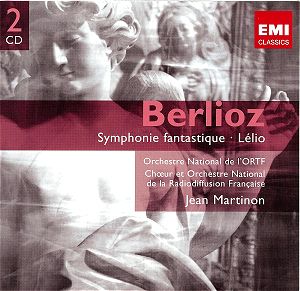
But even if Martinon’s
Symphonie fantastique isn’t
a front runner this EMI twofer is worth acquiring for
Lélio alone
.
Dan
Morgan

























 Jean Topart
(narrator): Lélio
Jean Topart
(narrator): Lélio 
