Note: *The tracking times listed
above (taken from the CD) are incorrect;
the actual timings are as follows: Symphonic
Dances [17:56], Sonata for Solo Cello
[20:32] and Symphony #1 [14:55] for
a total of [53:23].
The recently defunct
CRI (Composer’s Recordings, Inc.), was
a pioneering record label founded in
1954 based out of SoHo in New York City
and dedicated to championing the music
of American composers. Fortunately New
World Records, also based in Manhattan,
have committed to re-releasing the entire
CRI catalogue. This disc, part of CRI’s
"American Masters" series,
is currently available through the New
World Records website at full-price
or from ArchivMusic.com for only $2.99!
Halsey Stevens was
born in Scott - a small town in central
upstate New York about four hours north
of Manhattan - on 3 December 1908. At
Syracuse University in the mid-1920s
to mid-1930s, he studied composition
with William Berwald (1864-1948), a
German-born composer who had studied
with Rheinberger and von Sternberg.
Stevens also studied piano with George
Mulfinger (1900-1988), a student of
Emil von Sauer and Franz Schmidt. This
was where he first encountered the music
of Stravinsky, Bartók and Schoenberg
and was particularly affected by Bartók’s
String Quartet #2. Later in 1944,
at The University of California at Berkeley,
he had a few composition lessons with
Ernest Bloch. In 1946, Stevens secured
a teaching post at USC (University of
Southern California) and was to remain
there until the end of his life serving
as "Professor Emeritus" from
1976 until his death in Los Angeles,
California on 20 January 1989 after
a twenty year battle with Parkinson’s
disease.
Stevens composed music
that was essentially tonal but not without
modern influences, particularly Stravinsky
and Copland. Though undeniably "American"
in his musical language, the European
sway is tangible. Stevens himself has
acknowledged the pivotal influence of
Bela Bartók. In fact, Stevens
learned Hungarian in order to be able
to read Bartók’s letters in their
original language for a book he wrote
about the composer in 1953: The Life
and Music of Bela Bartók
- the first major study of Bartók
and a work that is still considered
definitive to this day. He has also
stated that Brahms, Hindemith, Prokofiev,
Mozart, Johann Sebastian Bach and to
a lesser extent Ravel and Schoenberg
had served as important models for his
music.
In his memoirs,
the British composer Humphrey Searle
described Stevens as "a composer
somewhat in the neo-classical style
and a man of great culture". In
the liner notes for this record, Robert
Carl writes that "Stevens is a
composer whose music is deeply expressive,
but also essentially modest … It effortlessly
alternates between play and gravity.
It gives pleasure at every turn".
And, as a final point, the professor,
composer and former student of Stevens,
Dr. Morten Lauridsen states that "In
the significance and eloquence of his
contributions to music of our time,
Halsey Stevens had few peers".
Also included among
his students were Benjamin Lees, Ramiro
Cortes, Wallace Berry, John Biggs, Robert
Dillon, Robert Nelson, Shirley Munger,
Herbert Bielawa, James Hopkins, David
Cope and the renowned jazz composer
and tenor saxophonist Charles Lloyd.
Symphonic Dances (1958)
This work was commissioned
in 1958 by the San Francisco Symphony
Orchestra under a grant from the Ford
Foundation to the American Music Center.
The first performance was conducted
by Enrique Jorda on 10 December 1958.
In three movements,
this piece may just as well be considered
a short symphony.
The first movement
has a distinct Stravinskian air to it
– a ballet, modern yet home-spun somewhat
reminiscent of Copland. The horns play
a central role. Through this electric
energy and harmonic mixture there is
a certain grace to this music that is
undeniable and quite attractive. It
steps lightly - difficult but efficient.
The second movement
has a lovely elegiac quality underlined
by sweetly sounding strings. Yet, this
is not sentimental music – nostalgic
yes, but not sentimental. Stevens has
a distinct way of sounding richly tonal
and heartfelt yet firmly neo-classical.
Special mention should be made of the
plaintive melody of the horn solo, moving
and in good taste but by no means maudlin.
Tasteful is the best
way to describe Stevens’ music. The
third movement takes up where the first
left off; well-constructed with attractive
ideas that are untraditional but so
very familiar. These dances would make
a wonderful ballet.
The playing of the
Londoners is technically on-point and
the Hungarian composer/conductor George
Barati (1913-1996) – who, by the
way, studied with Bartók - is
clearly "inside" this music.
Sonata for Solo
Cello (1958)
Also from 1958, this
sonata was written for and dedicated
to the Hungarian cellist Gabor Rejto
(1916-1987) who introduced the piece
on 5 January 1959 at one of the Monday
Evening Concerts in Los Angeles and
who also performs the work here. At
the age of sixteen Rejto entered the
Academy of Music under Adolf Schiffer
- a student of the Czech cello virtuoso
and composer David Popper. At the age
of twenty he traveled to Spain to study
with the great Pablo Casals subsequently
concertizing all over the world. In
addition, he was Professor of Cello
at USC from 1954 until his death in
1987.
This sonata is in five
movements with a fast-slow-fast-slow-fast
format.
The first movement
(Introduction) entices the listener,
combining a tonal style with a chromatic
flavor. Rejto establishes a richly romantic
mood that suggests the presence of Bach.
The Ciaccona that follows
is a set of ten variations that elicits
a beautiful songlike effect, poised
and restrained. This music is quite
understated, comfortably familiar yet
wholly individual.
The next movement (Scherzo)
is a two-minute dissonant interlude
affirming clearly Rejto’s prodigious
virtuosic capabilities. This music completely
explores the instruments’ communicative
possibilities with such economy, each
and every note vital.
The fourth movement
(Notturno) along with the Ciaccona is
the "heart" of the sonata.
There is elegance and taste to this
music, prototypically neo-classicist.
Stevens has a way of being reserved
and august without ever seeming old-fashioned.
This movement alone should justify this
sonata’s place in the mainstream cello
repertory.
The Finale is rhythmically
masterful and Rejto once again proves
equal to the challenging technical demands
making them appear effortless – the
music so tightly composed that its four
minutes feel like one!
The equilibrium of
these five movements is faultless -
a masterpiece of beautifully balanced
and delightful notes.
Symphony #1 (1945)
This symphony was completed
in 1945 although some of the music was
composed as early as 1938. The original
version was premiered on 7 March 1946
with the composer himself conducting
the San Francisco Symphony Orchestra.
The revised edition (the version recorded
here) was premiered on 2 March 1950
by the Los Angeles Philharmonic Orchestra
under the leadership of Alfred Wallenstein.
Although in one movement,
this is a multi-faceted work that juggles
propulsive rhythms in a manner most
original and expressive. Beginning ominously,
building into a varied flow of interesting
ideas with a distinct exotic flavor,
the sections mesh fluently with orchestration
somewhat suggestive of Bartók,
perhaps Ravel, even Sibelius but always,
unmistakably – Halsey Stevens. There
is much activity here, and once again,
not one note seems out of place or superfluous.
The contrast of ideas is striking, vigorous
and unquestionably moving. Stevens’
writing for strings is dark-hued and
the effect of the distantly tolling
bells towards the end is magical. This
work will never sound the same twice,
like a hologram – multi-dimensional.
The Japan Philharmonic
Symphony Orchestra is conducted by one
of its founders, Akeo Watanabe (1919-1990)
- the other being Shigeo Mizuno. It
plays impressively and enthusiastically.
Watanabe conducted numerous recordings
for CRI featuring such composers as
Copland, Cowell, Sessions, Ruggles and
Vivian Fine. He was also one of the
founders of the Sibelius Society - his
mother was Finnish. On the down side
the sound is rather boxy - the packaging
offers no hint of recording dates or
venues.
This disc will unquestionably
lead me to explore the works of Halsey
Stevens further; his Sonata for Trumpet
and Piano seems to be his most frequently
recorded work. The time for a renaissance
of the work of this unjustifiably neglected
composer is long overdue. I strongly
urge those who may be curious to familiarize
themselves by means of this collection.
Osvaldo Polatkan
























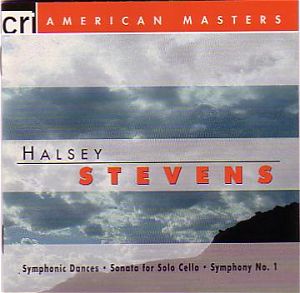

 London Philharmonic Orchestra/George Barati
(Symphonic Dances); Gabor Rejto (cello);
Japan Philharmonic Symphony Orchestra/Akeo
Watanabe (Symphony #1)
London Philharmonic Orchestra/George Barati
(Symphonic Dances); Gabor Rejto (cello);
Japan Philharmonic Symphony Orchestra/Akeo
Watanabe (Symphony #1)