|
Making
a Donation to MusicWeb
About MWI
Site
Map
More
Reviews
How to find a review
Books
Film
Music
Nostalgia
Records Of The Year
Recommendations
Comment
Arthur Butterworth Writes
Phil
Scowcroft's Garlands
Classical
blogs
Reviewers
Logs
Announcements
Don't
Go Here!
Community
Bulletin Board
Web
Ring
Reviewers
Helpers
invited!
Resources
How
Did I Miss That?
British
Composers
British
Light Music Composers
Other
composers
Indexes
Label
Masterwork
Discographies
Composer
National
Themed
Review pages
Complete Books
Programme
Notes
External sites
British Music Society
The BBC Proms
Performers
Orchestra Sites
Recording Companies & Retailers
Online Music
Agents & Marketing
Publishers
Other links
Newsgroups
Web News sites etc
Editorial
Board
Classical Editor
Rob Barnett
Seen & Heard
Editor and Webmaster
Bill Kenny
MusicWeb Webmaster
Len Mullenger
Assistant Webmaster
David Barker
PotPourri
A
pot-pourri of articles
MW
Listening Room
MW
Office
Helping
MusicWeb
Advice
to Windows Vista users
Questionnaire
Site
History
What
they say about us
What
we say about us!
Where
to get help on the Internet
CD
orders By Special Request
Graphics
archive
Currency
Converter
Dictionary
Magazines
Newsfeed
Web Ring
Translation Service
Rules
for potential reviewers :-)
Do
Not Go Here!
April Fools
|

 |
 |
|
AVAILABILITY
Inedita
|
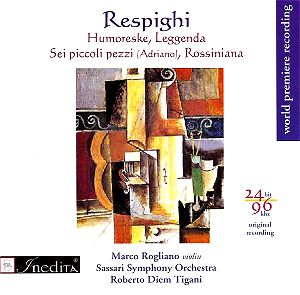
Ottorino RESPIGHI (1879-1936)
Humoreske for violin and orchestra* (1903) [11:50]
Leggenda for violin and orchestra (1902) [6:37]
Sei piccoli pezzi* (orch. Adriano) (1926) [12:55]
Rossiniana (1925) [25:18]
Marco Rogliano
(violin)
Sassari Symphony Orchestra/Roberto Diem Tigani
* World premiere recordings
No recording details given; published November 2007
INEDITA PI2632 [57:00] |
|
|
This is a delightful
collection of lesser-known Respighi.
All works here are
scored for a smaller orchestra than for the three opulent Roman
portraits: ’Pines, ’Fountains and ’Festivals. The
melodic and freely rhapsodic Humoreske for violin and
orchestra dates from 1903. It has all the elements of a concerto
in miniature with a grateful part for the violin. Respighi,
aged 24, was in Berlin studying with Max Bruch. The Humoreske is
charming and graceful but not without pomposity and artful humour
reminiscent of the Commedia dell’arte. Its orchestration
already shows the colour and imagination that would be Respighi’s
hallmark including some clever blending of triangle and timpani.
Why this little gem has escaped attention until now is a mystery.
The sweetly lyrical and elegiac Leggenda is another composition
that has inexplicably escaped attention even if it had not slipped
into the kind of oblivion that befell Humoreske. Marco
Rogliano is a beguiling soloist, beautifully expressive, clearly
relishing these two lovely romantic pieces.
The Sei piccoli
pezzi (Six little pieces) was written for four-handed
piano and dedicated to children. It has been transcribed for
orchestra by that champion of Respighi’s music, the conductor
Adriano, who has recorded so much lesser-known Respighi for
Marco Polo. Adriano’s vividly colourful transcriptions are
faithful not only to the style of Respighi but also to the
spirit of childhood and its joys. This is the orchestral version’s
premier recording. It is unashamedly romantic and nostalgic
- the first piece, marked ‘Romanza’, especially so. ‘Canto
di caccia siciliano’ reminds one of playground games, one
can so easily imagine hopscotch for instance; the graceful,
lilting ‘Canzone armena’ is something of a lullaby; ‘Natale,
Natale!’ is a rustic whimsical melody with bells that suggests
a nursery-rhyme tune. ‘Cantilena scozzese’ is a chinoiserie,
while, finally, ‘Piccoli highlanders’ transports us to Scotland
for a tongue-in-cheek highland dance with Adriano’s orchestration
brilliantly suggesting the bagpipes. Adriano makes glittering
use of an array of treble percussion including celesta and
tubular bells.
Rossiniana is
suite of four movements based on Rossini’s Les Riens, a
collection of divertissements for piano written in Paris
in his old age. They foreshadowed the eccentricities of Satie
by a half century or so. Respighi orchestrated them with considerable
wit and in spirit they are not too far removed from Respighi’s
much more familiar Rossini transcription, the ballet music, La
Boutique fantasque. The first movement is the delightful ‘Capri
e Taormina’ (Barcarola e Siciliana). ‘The Lamento’, second movement
is much more sinister, beginning with deep tam-tam strokes;
this is a melodramatic piece that lampoons operatic and other
romantic excesses; reminding one maybe of Puccini (Manon
Lescaut) and Berlioz (Le Carnaval romain) amongst
others. The short ‘Intermezzo’ is all filigree grace, with a
fairy-like daintiness and exquisite woodwind writing. The final
movement ‘Tarantella’ is self-explanatory and a hedonistic delight.
Once again, much colourful percussion is in evidence throughout Rossiniana
A rare treat for
Respighi fans. Engaging performances in very good sound. This
recording is almost bound to be one of my CDs of 2008.
Ian Lace
|
|
Advertising
Rates
Visitor
stats
MusicWeb
International
has over 25,000 Classical CD reviews on offer
Gerard
Hoffnung Concerts &
The
Bricklayer Story

New
Releases

New
Releases


MusicWeb
sells the Polish
catalogue CDAccord
£10.50 post free W-W

MusicWeb sells the
Arcodiva catalogue
£12.00 post free W-W

£11.50
post-free world-wide
Try
it and see - Sale or Return
MusicWeb
can now offer you discs from the following catalogues:
Prices include postage
Musicweb
Special
Offers
Google Ads - for information about privacy matters, click here.
|