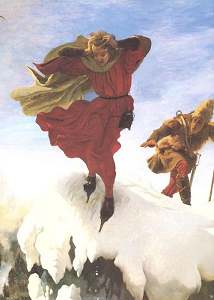
 [Ford Maddox Brown’s ‘Manfred on the Jungfrau’ - Manchester City Art Galleries, Manchester, England]
The painting depicts an incident from Byron’s epic poem. The Chamois
Hunter, seen in the background, persuades the demoralised and
disillusioned Manfred not to jump from the mountain’s summit.
Later,
and implicit in Tchaikovsky’s third movement music, the hunter
offers Manfred hospitality and comfort but to no avail for Manfred
realizes that he is doomed.
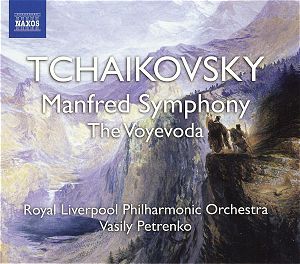
Tchaikovsky’s Manfred Symphony, or to give the
work its full name: “Manfred Symphony in Four Scenes after
Byron’s Dramatic Poem, Op. 58” was written between the
composer’s Fourth and Fifth Symphonies. Keith Anderson’s notes,
for this new Naxos release, do not give this full title but he
does include some details about Byron’s poem, sufficient to give
meaning to the programme of the music.
In
July 2006 I compared two recordings of the work: the classic
1954 Kletzki recording with the Philharmonia Orchestra now available
on Testament SBT 1048; and Jurowski’s 2004 live recording with
the London Philharmonic Orchestra on their own label - London
Philharmonic Orchestra LPO-0009.
Kletzki’s recording,
still recommended in the catalogues, is a pared down version of
the symphony. As I have remarked, the cuts, in my opinion are
fully justified: the main deletions, from the finale, being lugubrious
material that adds little and loosens the tension.
I give below, for
interest, respective timings for the three recordings. In this
review I will concentrate on comparing only the Kletzki and Petrenko
readings. I would refer readers to the file above for an assessment
of the Jurowski recording.
Manfred Symphony - Timings Kletzki
Jurowski Petrenko
Movement I – Lento lugubre – etc 17:03
17:37 15:43
Movement II – Vivace con spirito 8:37
8:32 9:37
Movement III – Andante con moto 9:26
11:38 11:54
Movement IV – Allegro con fuoco 16:00
20:21 20:32
The first movement introduces Manfred, in his Alpine castle.
He is tired of life, having drunk his fill of all experiences,
forbidden and otherwise. He has shunned the company of men. He
communes with the spirit world, attempting to expiate his guilt
over his illicit love for his sister Astarte. Byron was, it is
thought, probably attempting to expiate a similar incestuous relationship
and, in all probability, Tchaikovsky his homosexuality.
Petrenko’s opening is dire and dark indeed. He presents Manfred
in the darkest of colours, being totally irredeemable, one senses.
Kletzki is a bit kinder, creating a more three-dimensional character.
In contrast Petrenko captures Astarte’s sweet innocence and yearning
well enough. Like the classic Kletzki recording the RLPO’s opening
movement has plenty of bite. It also revels in the advantages
of hi-fi sound as well as wide stereo perspectives and dynamics.
That said, Testament’s, digital remastering of Kletzki’s 1954
sound is nothing to be sniffed at.
The second movement was suggested by an episode in Byron’s poem
in which ‘The Alpine Fairy appears to Manfred beneath the rainbow
of the waterfall’. Petrenko, in more expansive mood - 9:37 as
opposed to Kletzki’s 8:37 - brings many little felicities and
nuances to his evocation of the rainbow shining through the waterfall.
Rivalling Kletzki he conjures a most tender portrayal of the Witch
of the Alps. In both recordings Manfred’s sudden presence is sinister
indeed. The third movement – a pastoral - is subtitled: ‘The simple,
free peaceful life of the mountain folk’ –see picture caption
above. Petrenko is more bucolic. He makes this episode more of
an expansive ramble than Kletzki who is more animated. But Petrenko’s
reinstatement of Manfred’s malign influence is devastating especially
with its darkly tolling bell.
The finale which departs substantially from Byron’s narrative,
depicts a subterranean bacchanal: “the spirit of Astarte appears,
and pardons Manfred for his earthly sins before his death."
Petrenko’s reading thrusts forward wildly with the music tremendously
exciting and the RLPO strings especially keen and characterfully
nuanced. Petrenko makes you really feel a thrashing elemental
maelstrom as well as a hedonistic celebration and Manfred’s anguish.
He does not shy away from using portamento to heighten the emotional
temperature. The climax is tremendous with the organ exultantly
proclaiming redemption. Gain he rivals Kletzki’s punchy, dynamic
reading, itself delivered at white heat.
Tchaikovsky’s symphonic
ballad The Voyevoda was inspired by Pushkin, who had in
turn been influenced by a work of the Polish poet Mickiewicz.
The story is about the Voyevoda, a provincial governor, who surprises
his wife with her lover and bids his servant shoot her. The servant
shoots his master in error. Tchaikovsky graphically covers the
story from his preliminary suspicions, through spying on his wife
and then the attempted murder. The mood is sinister. It has been
suggested that the work’s mood might have reflected Tchaikovsky’s
dismay at the severance of relations between himself and his benefactor,
Nadezhda von Meck. The work was first performed in Moscow in 1891
some two years before Tchaikovsky’s death. Petrenko opens the
work in agitation with galloping rhythms suggesting the Voyevoda’s
anxiety to clarify his suspicions. The lovers’ meeting is depicted
as agitated and somber. Their guilt-ridden tryst leads to the
ultimate tragedy and Tchaikovsky piles on the agony with Petrenko
underlining the music’s rage and the violence.
Petrenko draws a thrilling, darkly-hued Manfred that rivals
Kletzki’s classic 1954 mono recording.
Ian Lace
see also Review
by Rob Maynard