Though still only in his early forties René Pape has been a leading
bass for two decades. He made his stage debut at the Berliner
Staatsoper in 1988 becoming the youngest ever Sarastro at Salzburg
in 1991 at the age of 26. He has taken part in numerous recordings
but this is his first solo recital. Basses rarely get opportunities
to create lovers on the operatic stage but besides crooks of different
kinds – Sparafucile in Rigoletto for instance – and comical
characters – Osmin in Die Entführung aus dem Serail – they
are designated Gods, Kings and Demons – Demons being super-human
crooks as opposed to more earthbound ones like Sparafucile. One
aim for Pape with this programme was also ‘a little bit educational’:
to show people ‘that sopranos and tenors don’t have the monopoly
on beautiful arias’.
All of the chosen
scenes and arias are not primarily beautiful but several are:
Méphistophélès’s serenade from Faust, in spite of its
mocking laughter, the same character’s aria from La Damnation
de Faust and the two rarities from Rubinstein’s Demon,
which should be hits on any recital. The Waterspirit’s aria
from Rusalka is possibly even more beautiful and Dapertutto’s
– another Demon in human disguise – Scintille, diamante
has long been a favourite, often played on the radio in my youth,
even in ‘popular programmes’ as they were called.
It seems that René
Pape is more naturally attuned to kings and gods than to demons
– I was slightly disappointed in his Le veau d’or from
Faust. There is nothing wrong with his singing; on the
contrary the very first notes tell us that here is a voice of
exceptional beauty and evenness, easily produced and rising
effortlessly up to the highest notes. It is not the largest
bass voice one can hear, nor is it the deepest - the sound is
more baritone than bass. I would rather classify him as a bass-baritone
like José Van Dam or Ruggero Raimondi. What I found lacking
in his reading was that all-embracing malevolence that permeates
the singing of a Boris Christoff or Evgeny Nesterenko – but
neither of them can match Pape for pure singing. And he quickly
makes amends with marvellous legato singing and a diabolic laughter
in the serenade. With three devils in a row we can compare different
grades of Satanism. Boito’s Mefistofele is truly abominable
when he ‘hoodwinks the churls´, those who believe he is a fiction.
Here Pape is more threatening, while he is superbly lyrical
in the Berlioz aria, where Van Dam has for long been my benchmark.
When he takes the
leap from ruler in Hell to this potentate’s once proxy on earth,
the Spanish King Filippo, he makes him a very human and vulnerable
person. Avoiding the histrionics he sings with restraint but
great intensity. This is a superb reading and I regret I wasn’t
able to see him in this role in Oslo earlier this autumn.
Back in the satanic
sphere he sings a splendid Scintille, diamante before
he is elevated to Valhalla and presents Wotan as a bel canto
god, noble and youthful.
When I reviewed
the Glyndebourne Tristan on DVD less than a year my only
objection against Pape’s Marke was that he sounded too youthful.
This didn’t disturb me on this recital – on the contrary he
only sounds warm and human in his anger, disappointment and
sorrow. He certainly belongs among the greatest interpreters
of the role on disc, in company with Kurt Moll, Martti Talvela,
Matti Salminen and Hans Sotin.
In the two Rubinstein
arias he confirms that his is the probably most beautiful bass
voice currently before the public. This is marvellous singing
without any signs of strain even at the powerful climax in the
second aria. The same dramatic intensity characterises the Rusalka
aria, which I am going to return to many times in the future.
In the final number
he is back on an earthly throne again and depicts that other
great operatic autocrat in the same vein as Filippo: inward
and recessed but with deep involvement and expression. He reminds
me a little of my first Boris Godunov on records, the Finnish
bel canto bass Kim Borg. Carl-Johann Winkler, member of Dresdner
Kreuzchor, sings Fyodor’s brief part rather well.
Sebastian Weigle
is rapidly becoming an eminent recording conductor and his flexible
conducting of the superb Staatskapelle Dresden – and in two
numbers Staatsopernchor Dresden – is a further feather in his
cap. The recording can’t be faulted. The booklet has texts and
translations and an essay on René Pape but no notes on the music,
which is a pity considering that there are some of the numbers
here are off the beaten track.
Just a few months
ago I reviewed the bass Erwin Schrott’s debut recital on the same
label in very positive terms. Here Deutsche Grammophon have come
up with another outright winner.
Göran Forsling
























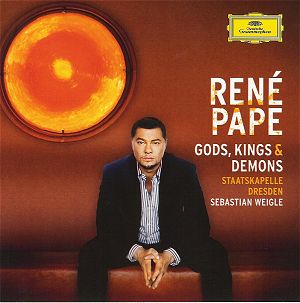

 René Pape
(bass); Carl-Johann Winkler (treble) (12);
René Pape
(bass); Carl-Johann Winkler (treble) (12); 
