Editorial Board
MusicWeb International
Founding Editor Rob Barnett Editor in Chief
John Quinn Contributing Editor Ralph Moore Webmaster
David Barker Postmaster
Jonathan Woolf MusicWeb Founder Len Mullenger
Olivier
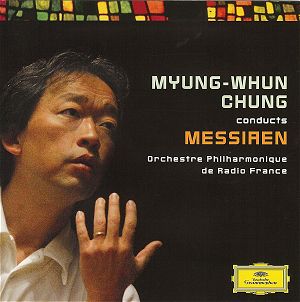
MESSIAEN (1908-1992) Trois petites liturgies de la présence divine (1944)
[34:04] Couleurs de la cité céleste (1964)
[17:24] Hymne
pour grand orchestre (1932 ) [16:44] Roger Muraro
(piano); Valérie Hartmann-Claverie (ondes-martenot);
Hélène Collerette (violin); Catharine Cournot (piano)
Maîtrise de Radio France/Morgan Jourdain
Orchestre Philharmonique de Radio France/Myung-Whun Chung
No recording information given. DEUTSCHE
GRAMMOPHON 4777944 [68:14]
Trois petites liturgies de la présence divine is overwhelming; all the more so because
it was written in a gloomy winter during the occupation of
France. No wonder there was a near riot at its premiere in
April 1945. How could liturgical music be so uninhibited?
How could Christian music contain so much that was Balinese
and “pagan”? Even to modern ears, it’s music of wild abandon,
a shorter and sharper precursor of the Turangalîla-symphonie which
still shocks many today. But that epitomises Messiaen. He
was a revolutionary who paved the way for composers as diverse
as Boulez, Stockhausen, Xenakis and Grisey.
Scored for thirty-six high voices, thirty-two strings,
various gamelan-like percussion, piano, violin solo, vibraphone,
celesta and ondes-martenot, it holds nothing back. The splendour
of God’s presence obliterates all else, and carries us hurtling
forward. Myung-Whun Chung, a specialist in this repertoire,
gets extremely bright, vivid playing from the orchestra..
If Chung’s approach is muscular and strident, this is by
no means a fault. This is strong, heady stuff meant to shine.
Messiaen’s intensity stems from the exuberant faith expressed
in medieval art and music. In their full glory, cathedrals
were vividly painted and gilded, lit by enormously detailed
stained glass. Saints were depicted with a kind of glowing
ecstasy. There are different approaches to religious music,
just as there are different approaches to religion. Myung-Whun
Chung is good because he understands where Messiaen’s idiom
springs from. The brightness of the string and percussion
playing makes a good foil to the ondes-martenot, which adds
otherworldly, wavering textures. Hartmann-Claverie’s playing
is so good that Muraro’s piano needed to be more assertive
to balance it.
The choir though is the glory of this performance. The
women sound exceptionally youthful. Messiaen sets the choral
part as unison but this simplicity serves to emphasize the
vigour and exalted passion. Sometimes choirs sing Messiaen
as if they were singing sober, conventional hymns. It doesn’t
work because it doesn’t reflect the music. Singing Messiaen
needs wilder, almost jazz-like freedom. Full credit to Maîtrise
de Radio France and choirmaster Morgan Jourdain for understanding
Messiaen’s unique idiom.
Couleurs de la cité céleste is even more visionary. Messiaen himself
said “The work does not end, but turns upon itself … like
the rose window of a cathedral”. Like Buddhist mandalas and
Sanskrit wheels, the symmetry in this piece suggests eternity,
development without end. Like The Quartet for the End
of Time, and Et Expecto resurrectionem muortuorum, Messiaen
draws on The Book of Revelation and its prophecies. Thus
the piece creates in sound the idea of The Celestial City
shimmering in jewel-coloured transparencies. The scoring
is unusual, four trombones reinforced by four trumpets and
two horns juxtaposed with a bank of xylophone, xylomarimba
and marimba, and a spectacular part for solo piano with extra
percussion and wind. Messiaen gives “colour values” to sounds,
suggesting that brass might “play red” for example and the
winds “play blue”. The sounds are further extended with bird-song
which adds another “international” layer to the music expanding
it across space as well as time.
Colour is exceptionally important in this work, and
Myung-Whun Chung gets good results from his orchestra, but
one dreams of a truly first rank ensemble playing this piece.
At the 2008 Proms, Sir Simon Rattle achieved wonders with
the Berlin Philharmonic, in the Turangalîla-symphonie. That is an orchestra whose ability to achieve colour,
transparency and richness of tone is close to perfection.
The performance bore no relation to the CBSO recording twenty
years before! The bench mark for Couleurs de la cité céleste, is Pierre Boulez and Ensemble Intercontemporain.
Boulez premiered this at the new music festival at Donaueschingen
in 1964. Indeed, he chose it for the very anniversary of
Messiaen’s centenary, the culmination of the Messiaen retrospective
at the South Bank during 2008. Direct comparisons, however,
are meaningless. Each interpretation stands on its own terms.
Myung-Whun Chung may not have an orchestra of the calibre
of Ensemble Intercontemporain or the Berliners, but this
is a very strong performance indeed, affirming Chung’s place
as one of the significant Messiaen conductors.
After these two sublime works, Hymn pour grande orchestre is
something of an anticlimax, for it’s a very early work. Nonetheless,
the basics of Messiaen’s later style are already present,
and it’s a useful study piece.
Anne Ozorio
Please support our advertisers below by clicking on the logos for further information.

























 Roger Muraro
(piano); Valérie Hartmann-Claverie (ondes-martenot);
Hélène Collerette (violin); Catharine Cournot (piano)
Roger Muraro
(piano); Valérie Hartmann-Claverie (ondes-martenot);
Hélène Collerette (violin); Catharine Cournot (piano) 
