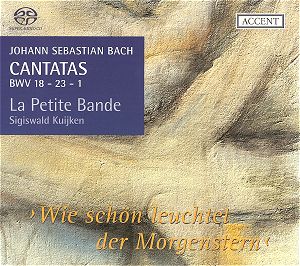
The Belgian violinist and conductor Sigiswald Kuijken is presently
recording cantatas by Johann Sebastian Bach in interpretations
with one voice per part. The sixth volume reviewed here contains
three cantatas for the same time of the year.
The first two, BWV 18 and 23, were written for Sundays Sexagesima and
Estomihi, the two last Sundays before Lent. The last cantata,
BWV 1, was composed for the Feast of the Annunciation of Mary,
25 March. Normally there were no cantatas during Lent, but when
this feast fell within the period of Lent an exception was made.
'Gleichwie Regen und Schnee vom Himmel fällt' (BWV 18) was originally
composed in Weimar. The only cantatas we know from this period
date from between 1713 and 1716. It was the time when Bach for
the first time made use of texts by Erdmann Neumeister. Cantata
18 was also written by this poet. The scoring is remarkable:
four violas, cello, bassoon and bc. The cantata was performed
again in Leipzig, probably in 1724. For this performance Bach
added two recorders which play colla parte with the two upper
violas, but one octave higher. It is this version which is recorded
here.
The cantata begins with a Sinfonia in which the snow falling from heaven
is depicted by large intervals. The tempo chosen is rather fast,
perhaps too fast, and I feel that stronger accents would have
exposed the effect Bach was aiming at somewhat better. Otherwise
the playing is very good. Next follows a recitative for bass,
who represents the 'vox Dei'; the quotation is from the prophet
Isaiah (ch 55, vv10-11). Jan Van der Crabben gives a good performance,
with the right amount of authority, although one has to get
used to his pronunciation of the "r". The accompanied
recitative which follows consists of a sequence of four prayers,
sung by tenor and bass respectively. Each of them is concluded
by a quotation from Martin Luther's Litany; the first line is
sung by the soprano, the last - "Erhör uns, lieber Herre
Gott!" (Hear us, dear Lord God) - by the tutti. Here the
advantage of the use of four single voices shows itself: when
a choir is used these entries are always a bit too heavy. Here
there is a much better balance between soli and tutti. The only
aria is set for soprano, which is nicely sung by Siri Thornhill.
The words "fort, nur fort" (away, only away) could
have been treated with a little more power and panache. The
closing chorale demonstrates the fine blending of the four voices.
'Du wahrer Gott und Davids Sohn' is historically an important work:
it was this cantata which Bach performed for the audition when
he applied for the position of Thomaskantor in Leipzig in 1723.
But for the occasion Bach reworked a piece he had previously
composed. The first three sections of this cantata date from
Bach's time in Cöthen (1717-1723); in Leipzig Bach added the
closing chorale which he filled out with parts for one cornett
and three trombones. He also transposed the cantata downwards,
which meant that the oboe parts were set for oboi d'amore. The
recording on this disc is a later reworking, performed between
1728 and 1731, where the parts of cornett and trombones have
been removed and the oboes return. It is interesting how Bach
has treated the text written by an unknown poet, who completely
ignores the readings of the Sunday Estomihi when the cantata
was to be performed. In the reading from the Gospel (Luke, ch
18, vv31-42) it is told that Jesus goes to Jerusalem to die,
but also that he heals a man from his blindness. Only the second
element is referred to in the text, but Bach 'corrects' this,
as it were, by quoting the Passion chorale 'Christe, du Lamm
Gottes'. It can be heard in the oboe parts in the second section,
the accompanied recitative 'Ach! gehe nicht vorüber', and in
the basso continuo part of the third, the chorus 'Aller Augen
warten, Herr'. At the end it is used as the chorale which closes
the cantata.
The cantata opens with a duet for soprano and alto where the two voices
blend well. Both sing this duet quite beautifully, but at the
same time I felt a bit uninvolved. In fact, I had this feeling
throughout the recording: everything is done stylishly and the
text is delivered well, but something is missing. It is perhaps
that the voices are all a bit neutral, without character. That
is also the case with the tenor Marcus Ullmann, who sings his
part well and thanks to being a German speaker has a natural
pronunciation. In his recitative he gives a good account of
the text, but his singing is a little bland. The chorus and
the chorale are the best parts of this cantata. The shifts in
the tempo in the chorus are splendidly realised.
The last cantata, 'Wie schön leuchtet der Morgenstern', belongs to
Bach's best-known. It is a so-called chorale-cantata, in this
case meaning that the first and last section quote the beloved
hymn by Philipp Nicolai (1599). The sections in between are
paraphrases of the remaining stanzas of the hymn. Again the
opening chorus and the closing chorale are done best, although
I would have liked more dynamic accents in the chorale. The
playing of the two violins in the tenor aria 'Unser Mund und
Ton der Saiten' - Let our voice and strings resounding – is
very good, a nice example of text illustration. Also beautiful
is the oboe da caccia part in the soprano aria 'Erfüllet, ihr
himmlischen göttlichen Flammen'.
The disc has two booklets. The first is the same in all volumes of
this series; here Sigiswald Kuijken gives a general introduction
to the cantatas, the texts and his approach of Bach's cantatas,
especially in regard to the use of solo voices and the scoring
of the basso continuo. As far as the latter aspect is concerned
I mention the fact that no cello is used, but a so-called 'viola
da spallo' instead, played at the shoulder like a violin, and
assumed to be the instrument which was meant by Bach to play
the 'cello' parts. This booklet is very interesting, and I strongly
advise reading it carefully before listening to this disc. The
second booklet contains introductions to the cantatas on this
disc, in which Kuijken at length explains what they are about
and in particular how Bach has translated text into music. This
is all very interesting and really helps in gaining an understanding
of Bach's cantatas. The booklet also contains the lyrics in
the original with an English translation. Unfortunately in this
booklet the latter half of Cantata 18 has been omitted.
To sum up: I am generally positive about Sigiswald Kuijken's approach
to Bach's cantatas, and I have enjoyed listening to the result.
At the same time I am not really touched by these performances.
I would have preferred some singers with more personality and
a stronger involvement. The depths of Bach's cantatas have not
been fully explored here.
Johan van Veen