In the mid-1950s when the LP was still in its relative infancy
and before the advent of stereo, there were at least four complete
recordings of Rigoletto on the international market. On
Decca there was a set with the reliable but rather dull Aldo Protti,
supported by the lovely Hilde Güden and a bawling Mario Del Monaco.
Italian Cetra - and available in some other countries on sundry
labels – offered the great singing-actor Giuseppe Taddei partnered
by Lina Pagliughi, who was nearing fifty and had sung Gilda also
on the first ever Rigoletto recording almost thirty years
earlier. In addition there was Beniamino Gigli’s natural heir
Ferruccio Tagliavini, still in creamy voice. On Columbia Tullio
Serafin had gathered his dream trio Tito Gobbi, Maria Callas and
Giuseppe Di Stefano.
On RCA Victor the
set under consideration here appeared almost simultaneously
with these other three versions. In spite of some reservations
the general opinion was that the Serafin set was the out-and-out
winner. The Cetra, conducted by Angelo Questa had its advocates
and the RCA Victor also met with some respect. Philip Hope-Wallace
in Gramophone, who wasn’t an easy conquest, is quoted
in the booklet. There he is predominantly positive, even though
he found Roberta Peters ‘a capable rather than appealing Gilda’.
His most serious objection concerned the many cuts. I don’t
a score so there may be a number of other minor omissions. I
did however note that in the Rigoletto-Gilda duet in the second
scene in act I most of Ah! veglia, o donna, is excised.
This is a particularly serious loss since this is one of the
finest scenes in the whole opera. The Duke’s cabaletta in act
II, Possente amor is also missing, but that was more
or less the norm in those days. Still it would have been great
to have had Björling in that vital number.
Another drawback
is the recorded sound. Audio restoration engineer Mark Obert-Thorn
refers to the many instances of overload distortion in the master
tapes as well as a lot of studio noise. To this may be added
restricted dynamics and a rather one-dimensional sound. The
stage orchestra in the first scene seems little different from
the orchestra in the pit. Interestingly enough there is much
better sound on the four arias in the appendix, recorded immediately
after the complete opera. Here the rasping brass in the Otello
aria is reproduced with stunning brilliance and power and the
strings have a lustre that is totally absent from the Rigoletto
recording. Dynamics are also wider and the bass is impressive.
There seems to be a decade separating the two recordings instead
of a weekend. It surprises me that so experienced a producer
as Richard Mohr should have let so many deficiencies pass unnoticed.
Maybe it was the daytime heat and the lack of air conditioning
in the Rome Opera House.
These are real obstacles
to enjoyment. The question is: is the quality of the performance
good enough? Jonel Perlea was an able conductor, who had already
a couple of complete opera recordings behind him: Manon Lescaut
a couple of years earlier with both Björling and Merrill among
the soloists and Aida the year before, also with Björling
in the cast. Both sets still rank among the best. By and large
this Rigoletto is also well paced without many eccentricities,
apart from some idiosyncratic slowing down a couple of times.
The rhythms are well sprung, so on this account it is more than
acceptable.
It is when we get
to the soloists that doubts arise. In the supporting roles some
of the regular Italian singers from the RCA Victor stable deliver
the goods and in particular Vittorio Tatozzi’s impressive Monterone
stands out. Anna Maria Rota’s fruity contralto lends dramatic
power to the quartet and the agitated scene with her brother
in the last act. Her brother Sparafucile is sung by the eminent
Giorgio Tozzi, whose dark bass has adorned so many recordings.
He may seem too noble for this professional murderer but in
the first encounter with Rigoletto in act I he is truly ominous.
As for Roberta Peters she seems a bit anonymous to begin with,
technically impeccable, no doubt, and with some brilliant top
notes, but I miss a soul behind the façade. She is warmer and
sings with more face in the second act and in the final duet
Lassù in cielo she is actually very good.
I am afraid there
have to be reservations when we come to Jussi Björling’s Duke
of Mantua. This was one of his best roles but here he is not
in best voice in some of his solos. His Questa o quella
has vigour but he is strained; same goes for the duet with Gilda.
In his big recitative Ella mi fu rapita he has the necessary
glow. Few tenors have managed the aria Parmi veder le lagrime
with such lyrical intensity, but here too he is strained. La
donna è mobile is light and elegant. In the quartet he is
frankly glorious, but it is in the reprise of La donna, sung
sotto voce, that he shows his mastery. According
to Stephen M. Stroff’s Björling biography there were quarrels
between the tenor and the conductor during the recording sessions.
This came to a head during the first take of the quartet. Björling
was in brilliant form, as can be heard on the recording, but
Perlea wasn’t satisfied. He wanted more sotto voce. Björling
bristled. ‘This is my solo’, he said, ‘I sing the way I feel’.
‘Softer’, Perlea said. ‘Read the score!’ On the second take
Björling whispered his part. Perlea was furious, but the producer
Richard Mohr decided in Björling’s favour. It was the first
take that was used on the finished recording. Björling was however
so furious that as soon as the ensemble scenes were finished
he left Rome and returned to Stockholm. There he recorded his
solos to the pre-recorded tape. Whether this somewhat antiseptic
situation affected his singing is difficult to know but fact
is that he sings below his normal standard.
Robert Merrill was
the possessor of one of the most glorious baritone voices of
the last century. Large, manly and even throughout the register
he was able to sing a soft pianissimo without loss of quality.
On the other hand he was not always a very expressive singer
and compared to Gobbi or Taddei he may seem straight-faced.
Still his reading of the jester’s part has a lot to offer. His
Cortigiani is deeply moving and in the duet with Gilda
at the end of act II he is so warm and caring. His Piangi
fanciulla, e scorrere is so achingly beautiful and charged
with emotion that one is moved to tears. And his forceful Si,
vendetta tells us that this is not a person to tamper with.
He recorded the role again some years later with Solti, partnered
by Anna Moffo and Alfredo Kraus (review).
When I reviewed the reissue of that recording a couple of years
ago I referred to his singing on the older set as ‘glorious
but bland’. It seems that my memory deceived me on that occasion.
Rehearing his older recording I think I was being unfair to
him. He is even better with Solti but his first recording was
no mere blueprint.
The four arias with
Merrill that appear as an appendix to CD2 which make it a very
long disc indeed, again displays the beauty and power of his
voice. I see in my notes that I jotted down ‘glorious’ for the
three Verdi arias but there are also some less flattering comments.
‘Others have expressed the evil of Iago more explicitly’ and
for the other two ‘without special insight’. On the other hand
about the Barbiere aria my notes read ‘lively and fun’
and ‘singing with face’. For all four: ‘a pleasure to wallow
in the glory of so accomplished singing’.
Summing up pros
and cons: is this set worth having? Hi-fi addicts shouldn’t
bother. For them there are several other sets that are safer
investments: Serafin (also on Naxos and in mono), Solti, Kubelik
(on DG with Fischer-Dieskau, Renata Scotto and Carlo Bergonzi)
and Molinari-Pradelli (on Classics for Pleasure with Cornell
MacNeil, Reri Grist and Nicolai Gedda) to mention some vintage
recordings in the lowest price bracket. For Merrill’s first
recorded assumption of this fascinating role and for Björling
partly below his best but still better than many tenors on top
of their form, this could still be a tempting offer.
Göran Forsling
see also Review
by Robert Farr
























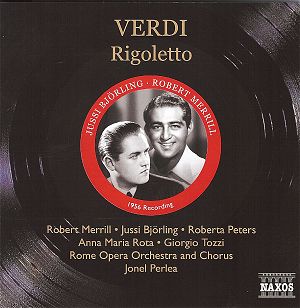
 Robert Merrill (baritone) – Rigoletto; Roberta Peters (soprano)
– Gilda; Jussi Björling (tenor) – Duke of Mantua; Anna Maria Rota
(contralto) – Maddalena; Giorgio Tozzi (bass) – Sparafucile; Vittorio
Tatozzi (bass) – Count Monterone; Arturo La Porta (baritone) – Cavaliere
Marullo; Tommaso Frascati (tenor) – Matteo Borsa; Leonardo Monreale
(bass) – Count Ceprano; Lidia Grandi (soprano) – Countess Ceprano;
Silvana Celli (mezzo) – Giovanna; Santa Chissari (soprano) – Page
of the Duchess; Andrea Mineo (baritone) – A Herald; Rome Opera Orchestra
and Chorus/Jonel Perlea
Robert Merrill (baritone) – Rigoletto; Roberta Peters (soprano)
– Gilda; Jussi Björling (tenor) – Duke of Mantua; Anna Maria Rota
(contralto) – Maddalena; Giorgio Tozzi (bass) – Sparafucile; Vittorio
Tatozzi (bass) – Count Monterone; Arturo La Porta (baritone) – Cavaliere
Marullo; Tommaso Frascati (tenor) – Matteo Borsa; Leonardo Monreale
(bass) – Count Ceprano; Lidia Grandi (soprano) – Countess Ceprano;
Silvana Celli (mezzo) – Giovanna; Santa Chissari (soprano) – Page
of the Duchess; Andrea Mineo (baritone) – A Herald; Rome Opera Orchestra
and Chorus/Jonel Perlea
