|
Making
a Donation to MusicWeb
About MWI
Site
Map
More
Reviews
How to find a review
Books
Film
Music (Archive)
Interviews
Nostalgia
Records Of The Year
Monthly Best Buys
Comment
Arthur Butterworth Writes
Phil
Scowcroft's Garlands
Classical
blogs
Reviewers
Logs
Announcements
Don't
Go Here!
Community
Bulletin Board
Web
Ring
Reviewers
Helpers
invited!
Resources
How
Did I Miss That?
British
Composers
British
Light Music Composers
Other
composers
Review Indexes
By
Label
By
Masterwork
Discographies
Composer
National
Themed
Review pages
Complete Books
Programme
Notes
External sites
British Music Society
The BBC Proms
Performers
Orchestra Sites
Recording Companies & Retailers
Online Music
Agents & Marketing
Publishers
Other links
Newsgroups
Web News sites etc
Editorial
Board
Classical Editor
Rob Barnett
Seen & Heard
Editor and Webmaster
Bill Kenny
MusicWeb Webmaster
Len Mullenger
Assistant Webmaster
David Barker
PotPourri
A
pot-pourri of articles
MW
Listening Room
MW
Office
Helping
MusicWeb
Advice
to Windows Vista users
Questionnaire
Site
History
What
they say about us
What
we say about us!
Where
to get help on the Internet
CD
orders By Special Request
Graphics
archive
Currency
Converter
Dictionary
Magazines
Newsfeed
Web Ring
Translation Service
Rules
for potential reviewers :-)
Do
Not Go Here!
April Fools
|

 |
 |
|
alternatively
Crotchet AmazonUK
AmazonUS
|
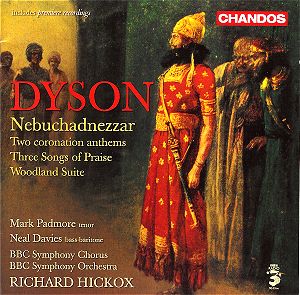
George DYSON (1883-1964)
Nebuchadnezzar for tenor, bass-baritone, chorus
and orchestra (1934) [47:48]
Woodland Suite for strings and wind (flute, oboe,
clarinet and bassoon ad libitum) (1921) [7:22]
O Praise God in His Holiness for chorus and orchestra
(Psalm 150) (1937) [2:12]
Three Songs of Praise for accompanied chorus (string
orchestra, with two timpani, two trumpets and three trombones
ad libitum) (1935) [9:54]
Confortare (Be Strong and of a good courage)
for chorus and orchestra (1953) [1:37]
Mark Padmore
(tenor); Neal Davies (bass-baritone); BBC Symphony Chorus;
BBC Symphony Orchestra/Richard Hickox
rec. Watford Colosseum (Town Hall), 18-19 November 2006.
DDD. premiere recordings
CHANDOS
CHAN10439 [68:57]  |
|
|
Dyson
was very much the darling of the English choral traditionalists
yet resisted its cloying excesses. He wrote music with sturdiness
and brilliance and had a natural aptitude for the human voice.
An RCM student, his professor was
Stanford who was so impressed that
he dissuaded Dyson from studies at
Leipzig. Instead he encouraged him
to spend time in Italy which he did
and from which period the tone poem
Siena (unrecorded) emerged.
After Italy he spent time in Vienna
and Berlin where Nikisch included
Siena in his concert programme.
He served in the Great War and survived,
though not unmarked by the experience.
His Canterbury Pilgrims (Chandos
CHAN9531) and other choral works including
to a lesser degree Quo Vadis
(see end of review for a list of Dyson
recordings reviewed on this site)
became enduring staples of cathedral
and concert hall. By contrast the
symphony and the violin concerto had
their premieres and then languished;
he had been pigeonholed as a choral
man related in some inchoate way to
the Stanford tradition. In fact his
choral works show an imaginative updraft
borne in from Continental influences
and occasionally from Sibelius.
His Nebuchadnezzar is
a very substantial piece marked by Walton’s blazingly imaginative Belshazzar’s
Feast from only three years previously. It sets words
from The Book of Daniel and from Song of the Three
Holy Children from The Apocrypha. The fall of
the voices, both solo and occasionally choral, carry the
Walton stigmata – emphasised by Dyson’s use of words many
of which were set by Walton as part of his 1931 masterpiece.
However this has not sucked all the originality out of Dyson’s
inspiration as we can hear time after time. In the case of
this work the sometimes gawky humour of Canterbury Pilgrims is
absent. Instead Dyson often captures the Old Testament ferocity
of the text avoiding any hint of Victorian fustian or rum-ti-tum
miscalculation. There is an aggressive Orff-like edginess
to Part II which contrasts with the ruggedly Elgarian power
of the step-down finale of Part I. Poetry aplenty abounds
in the sea-swell of Part III which also reminded me at 5:58
onwards of Holst’s Choral Symphony of 1925. In the
majestic exaltation of Part IV there are moments of familiarity
if you know Vaughan Williams’ Benedicite. It’s a splendid
work bursting with inspiration - brilliant and majestic.
The
little Woodland Suite comprises four movements in
a light-hearted, gentle and poetic Coatesian vein. It only
succumbs to jauntiness in the finale. The movements are At
Evening Bell (Tranquillo); Silken Sails (Allegretto); Moon-Fairy (Andante); Elfin
Market (Allegro).
The Three
Songs of Praise include a suave and smooth Let all
the world …, a cherishably lovely Ye that have spent
the silent night in which the string writing is of
the gentlest and a final Poet’s Hymn which has the
buoyancy of the start of At the Tabard Inn.
The
two coronation anthems have the tradition and the manner
down to a tee. Listen to the grandiloquence of O Praise
God in His Holiness in which the horns roll over the
contours of the choir in golden balance. Confortare is
very short and is just slightly distanced from Vaughan Williams
in style.
The
complementary notes are by Lewis Foreman and Freeman Dyson
and provide a balance of hard information, intrigue, humanity
and fascination. The whole project which is magnificently
performed throughout would not have happened without the
support of the Sir
George Dyson Trust. I look forward to
later instalments including Siena.
Enthusiasts
for the festive yet idiosyncratic mainstream of British choral
music need look no further.
Rob Barnett
Reviews of other Dyson CDs
Choral music: Somm SOMMCD014
Quo
Vadis: Chandos CHAN10061
St Paul's Voyage: Somm SOMMCD234
Symphony: Chandos
CHAN10308X, Naxos
8.557720
Violin Concerto: Chandos CHAN9369
|
|
Advertising
Rates
Visitor
stats
MusicWeb
International
has over 30,000 Classical CD reviews on offer
Gerard
Hoffnung Concerts &
The
Bricklayer Story

New
Releases

New
Releases


MusicWeb
sells the Polish
catalogue CDAccord
£10.50 post free W-W

MusicWeb sells the
Arcodiva catalogue
£12.00 post free W-W

£11.50
post-free world-
wide
Try
it and see - Sale or Return
MusicWeb
can now offer
you discs from the following catalogues:
Prices include postage
Musicweb
Special
Offers
Google Ads -
for information about privacy matters, click here.
|