SOME RANDOM JOTTINGS
ABOUT
WILLIAM ALWYN’S ELIZABETHAN
DANCES
You can bet your bottom
Euro that William Alwyn’s Elizabethan
Dances is one anniversary that will
almost certainly pass unnoticed by the
vast majority of music listeners in
2007. It is fifty years since this work
was first performed at the BBC Light
Music Festival at the Royal Festival
Hall. It would be easy to justify ignoring
this work if we assumed that it was
simply a piece of ‘light’ music that
was largely ephemeral or belonged to
a more innocent era. However, there
are four reasons why this view is wrong.
Firstly, there has
been a huge rise in the awareness of
‘light music’ over the last ten years.
Record labels including Naxos, Marco
Polo and Hyperion have issued a large
number of important and entertaining
CDs, however pride of place must go
to the ever-growing catalogue from Guild.
Secondly, William Alwyn is one of the
United Kingdom’s most important composers
in spite of the fact that he is little
known in the world-view of Classic FM
producers (David Mellor being an honourable
exception). The fact remains that few
people will have managed to avoid hearing
his music. This is largely because of
Alwyn’s huge film score output. We need
only think of Carve Her Name with
Pride, A Night to Remember
and Odd Man Out to mention at
least three films that will endure till
mankind is no longer amused and entertained
by moving pictures. Thirdly, the quality
of this particular piece of ‘light’
music is second to none. This is a work
that exhibits the highest degree of
invention, imagination and sheer craftsmanship.
To quote Christopher Thomas’s review
on MusicWeb – "to describe this
as light music would be potentially
to trivialise the quality of the composer’s
work." And lastly, in spite of
the unsurprising fact that it is not
programmed for this years Proms it is
easily available on three excellent
recordings.
The 1950s were an interesting,
if somewhat stressful, time for William
Alwyn. He wrote in his autobiographical
book, Winged Chariot, that he
often wondered how he had coped with
this hectic period of his life. He had
been in constant demand for important
film scores which required a vast amount
of music. He recalled that, in spite
of the hard work, he was grateful that
he did not have to spend long hours
teaching or equally long hours of practice
needed to maintain instrumental virtuosity
as a concert performer. At this time
Alwyn was seriously involved with the
Composers' Guild of Great Britain –
"meetings of every kind, serving
on and chairing committees," etc.
etc. In addition he suffered health
problems which seem to have led him
close to nervous breakdown. It was at
the turn of the decade that he finally
decided to stop writing for the cinema.
Alwyn was to complete his last film
score, The Running Man, in 1961.
Bernard de Nevers was
the director of Alwyn’s main publisher,
Lengnick: he was also a close personal
friend. In the late 1940s de Nevers
had persuaded Malcolm Arnold to compose
the well known English Dances. This
was in response to a suggestion that
Arnold should write a suite of music
akin to Dvorak’s Slavonic Dances
or perhaps Bartók’s Romanian
Folk Dances. Six years later, he
suggested to Alwyn the ‘Elizabethan’
theme of the present work. The composer
had already received the commission
from the BBC however it was de Nevers
who was largely responsible for the
direction and mood of this work.
William Alwyn had previously
composed a series of Scottish Dances
in 1946. These had been dedicated to
the ubiquitous film music composer and
conductor Muir Matheson. It was a seven-movement
work that has been described as a pastiche
of Handelian Scottishry! Each one of
these movements is quite short, entertaining
and straight to the point. They are
fun and reflect a very Scottish way
of celebrating – the whisky bottle is
never far away, although the slow movement
is romantic and quite sober.
The following years
had seen a succession of works that
could hardly be described as ‘light
music.’ There had been the first two
symphonies, the Magic Island Prelude
and two concertos. In 1955 there was
the radio opera Farewell Companions;
the following year saw a number of important
works including the Fantasy Waltzes
for Piano Solo, the Moor of Venice
Overture for Brass Band and the
magnificent Third Symphony. This
was a "stormy and passionate work,
strongly rhythmic in the outer movements
but finding tranquillity and repose
in the ‘adagio’ and in the closing pages
of the symphony." It was first
performed at the start of the 1956/57
orchestral season when Sir Thomas Beecham
conducted the BBC Symphony Orchestra.
In parallel to the
‘art’ music, Alwyn had worked non-stop
on film music. Perhaps the best known
scores of those years were The Ship
that Died of Shame, The Million
Pound Note and The Malta Story.
It is interesting that the Elizabethan
Dances was the only major non-film
piece to be written and performed in
1957. Film scores from this year included
The Smallest Show on Earth and
Fortune is a Woman.
The Elizabethan
Dances was first performed on 6
July 1957 at the Royal Festival Hall
during the 1957 BBC Festival of Light
Music. The composer conducted the BBC
Symphony Orchestra. The work is some
sixteen minutes duration and is scored
for a standard orchestra with an exotic
array of percussion including castanets,
wooden blocks, maracas, celesta and
harp.
Other works produced
at that Festival included Rhapsody
& Rondo for Horn and Orchestra
by Ernest Tomlinson, Malcolm Arnold’s
Scottish Dances and Charles Spink’s
Concert Toccata for Organ and Brass.
The enjoyable London Transport Suite
by Sidney Torch and the Cornish Holiday
for Brass Band and Orchestra by
Dennis Wright added to an impressive
programme. Both the Spink and the Wright
are unavailable on CD.
The Elizabethan
Dances are written in six contrasting
movements. The composer’s wife has provided
this helpful overview:-
- This suggests the pipe and tabor
of Elizabeth I
- A modern slow waltz
- A Morris Dance – or perhaps a
"Mock Morris Dance"
- A neo-Elizabethan dance with a
hint of the ‘Blues.’
- A dance in the style of a Pavane
as played by a concert of viols
and recorders
- A rousing dance.
Alwyn himself wrote
that the title refers to the reigns
of both Queen Elizabeths. Unlike Eric
Coates’s Three Elizabeths Suite
it does not signify the Queen Mother
- however much the more reflective music
could suggest ‘Lillabet,’ her girlhood
and her childhood home and family. Alwyn
is at pains to point out that the music
is not an attempt at pastiche: he does
not wish to imitate the music of the
two periods but rather to nod in their
direction. Nowhere is contemporary ‘pop’
music quoted or even alluded to – and
remember that Elvis had sung Heartbreak
Hotel around the time this work
was being composed! Furthermore, I feel
that Alwyn is being a little disingenuous
when he suggests that the second dance
is a "lilting and seductive modern
(my italics) waltz." It would
have been little recognized as being
‘hip’ by the young café society
in London or Manchester!
The first movement
is quite definitely a 20th
century film composer’s recreation of
the ‘pipes and tabors’ of Queen Elizabeth’s
court. Yet even here the mood is more
1950s than 1550s! Full orchestra is
used with great imagination: a surprise
upward harp scale reminds us more of
the Tudors as seen through Ralph Vaughan
Williams’s eyes and ears.
The Waltz as
noted above is ‘modern,’ yet it not
a work to dance to. If anything it is
a miniature tone poem evoking a depth
beyond what was typical of ‘light’ music
of the day. It has been described variously
as being ‘languorous, lilting, suave,
insouciant, beguiling and very easy
on the ears.’ Barnett even suggests
that it has the "psychological
reach of a Prokofiev waltz." I
find it an evocative and deeply reflective
movement that belies its two minute
duration.
There is no way that
any 13th century Morris Dancers
heard anything like the attractive third
movement. Once again it is the past
seen through the lens of Hollywood or
Ealing. The main tune is presented by
the bassoon before being repeated by
the flute and then the strings. Percussion
adds an exoticism that distances this
dance from its historic frame of reference.
William Alwyn rarely
nodded to popular music in his ‘art’
music. Yet the fourth dance is a definite
exploration of ‘the blues’: Bernstein
would have enjoyed this. Maracas and
castanets give it a kind of international
feel. The tune is presented firstly
on the violins before a great almost
Gershwin-like full orchestral climax
brings the movement back to a more reflective
mood. I detected hints of Ravel here
too! Yet soon the boisterous music returns
with a great splashy sound before closing
enigmatically. This is the longest of
the dances.
The moderato is the
heart of the work. It is ostensibly
a Pavane which is supposed to suggest
the viols and recorder consorts of the
16th century. However, if
one did not know the source of this
piece, if one was listening to it with
an innocent ear, it would certainly
be seen as a contemporary work – if
a wee bit old-fashioned.
The last movement is
quite definitely the big finish that
would be required of a work written
for the Light Music Festival. Alwyn
noted that it starts as a hornpipe and
was intended to continue as such – yet
something went wrong – it suddenly turned
into a kind of Rumba! Lots of brass
and the entire percussion department
give the movement a lively and impressive
conclusion.
There are three recordings
of this work currently in the CD catalogues.
The earliest is conducted by the composer
himself. Unfortunately he did not record
all six dances for Lyrita: he chose
to omit the third and fourth movements.
In 1992 Chandos recorded the entire
work with the London Symphony Orchestra
conducted by Richard Hickox. The programme
notes for this CD were written by the
composer’s widow. The latest, and to
this listener’s ears the finest recording
is from Naxos: David Lloyd-Jones convincingly
conducts the Royal Liverpool Philharmonic
Orchestra and appears to best represent
the shifting moods and reflections of
this work.
Deryck Cooke reviewed
the score which was published by Lengnick
in 1959. He notes that the music was
an ‘amalgam of imitation Tudor and modern
popular idioms,’ without further comment.
However he states that the modal waltz
– No. 2 was, in his opinion a failure.
He believes that the two principal melodies
were unconvincing. He is impressed with
the other five dances stating that they
are successful. He reserves special
praise for the final "mixture of
country dance and rumba."
Listening to this work
half a century after it was first composed
and performed brings to mind two comments.
Firstly this is hardly ‘light music’
in the sense of the ‘potter’s wheel’
type of interlude that was once so popular
on TV. This is music that has a considerable
depth: virtually ever movement could
be presented as ‘art’ music. It quite
definitely belongs to the concert hall
rather than the soundtrack of a 1950s
advert for ‘Holidays in Devon’ Secondly
this is a well-crafted piece that exemplifies
good composition, fine orchestration
and rigorous stylistic balance. It is
definitely not pastiche: generally speaking
its mood is quite up-to-date if not
contemporary.
Discography
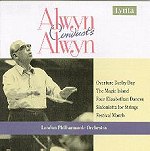
Lyrita SRCD 229 William
Alwyn conducting the London Philharmonic
Orchestra (Dances 1, 2, 5, 6 only) (coupled
with Derby Day Overture, The
Magic Island, Sinfonietta for
Strings and the Festival March)
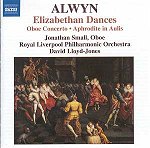
Naxos 8.570144 David
Lloyd-Jones conducting the Royal Liverpool
Philharmonic Orchestra (coupled with
the Oboe Concerto, The Innumerable
Dance - An English Overture, The
Magic Island, the Festival Overture
and Aphrodite in Aulis)
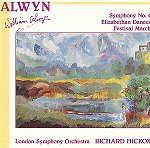
Chandos CHAN 8902 Richard
Hickox conducting the London Symphony
Orchestra (coupled with the Symphony
No. 4 and the Festival March)
Ó
John France, July 2007
The
William Alwyn website























