Return
to Chapter 6
7
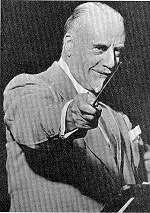
Sir Thomas Beecham
The Beecham Wind Orchestra – a unique
wind ensemble. Memories and anecdotes from musicians who played for
him, including my father (from 1912 onwards) and myself (from 1944
until his last concert in 1960). His rehearsal methods, repertoire
and influence on all who played for him. Playing for him at concerts,
on recordings, film and TV. His last concert.
The first really great musician that
I worked with was Sir Thomas Beecham. This was a quite wonderful experience
and a source of great pleasure that I was to enjoy for the following
sixteen years – for a year or so in the LPO and then, from 1947, in
the Royal Philharmonic Orchestra.
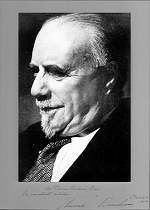
Those of us who made music under Sir Thomas’s direction
were extremely fortunate, because he was a conductor of a particularly
unusual, indeed unique, kind. There have, of course, been a number of
outstanding and a few ‘great’ conductors – artists who inspired performances
that reached the heart of the music, bringing it to life and inspiring
players and audiences alike. But, having played for nearly all the most
renowned conductors between 1943 and 1980 and worked with many, in a
different capacity, for a further ten years, no one else has seemed
to me to have had the remarkable qualities Beecham possessed.
|
|
Click
for larger picture
|
Though I did not to play for Beecham
until 1944, the wonderful records he made with the London Philharmonic
Orchestra, between 1932 and 1939, were known to me. His leading players
– Reginald Kell, Leon Goosens, Anthony Pini and David McCallum, had
become my boyhood heroes. One always heard the solos so clearly and
the players seemed to have such freedom of expression and an opportunity
to be creative. I was to learn later, from personal experience, that
when playing for Sir Thomas one never had to fight one’s way through
a barrage of strings ‘scraping away regardless’, as Sir Henry Wood
used to call it, when playing a soft, delicate solo passage.
Beecham formed the LPO in 1932 and
from the start he and the orchestra were a great success. The audience
at the first concert was stunned and excited by the verve and virtuosity
of the performance of the very first item Carnaval Romain Overture
by Berlioz. It was also the first piece Beecham conducted when he
returned to the LPO exactly 12 years later. It was to remain one of
Beecham’s favourite works.
I first heard about Sir Thomas from
my father. He had played for Beecham in the short-lived, but adventurous
Beecham Wind Orchestra in 1912. Later he played for Sir Thomas, several
times, in various orchestras. As a child I remember him speaking of
these occasions with enthusiasm.
 |
|
Click
for larger picture
|
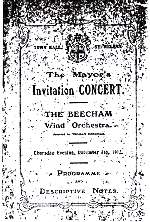
The Beecham Wind Orchestra, in contrast
to a military band, is of historical interest in that it predated
the rise of the wind bands of the 1950s by some 40 years. The Wind
Orchestra’s first concert (I believe the Orchestra only gave three
concerts) took place in St. Helens, Thomas Beecham’s (as he then was)
hometown. It was billed as ‘The Mayor’s Invitation Concert’, and was
probably funded by Beecham’s wealthy father.
The programme notes for this occasion
included the following information, (first printed in the Daily Telegraph):
Mr Thomas Beecham, convinced that wind-instrument playing in this
country is – and has for some time past been – steadily deteriorating,
has founded a new wind orchestra, primarily with the view of raising
the standard of wind playing and opening a new field to composers
and executants. The formation of the orchestra is the practical outcome
of several years study of (i) the possibilities generally of wind-instrument
music; and (ii) the condition of wind-instrument
playing in the British Isles.
Mr Beecham maintains that with
the improvement of the manufacture of most wind instruments and the
invention of several others of great beauty, which are still unfamiliar
to the average player, there is a field for new development both in
the practical reorganisation and theoretical treatment of wind combinations.
It must, therefore, be made quite clear that this body of players
is not in the least what is generally known as a brass or military
band; it is essentially a wind orchestra. Whereas in the brass or
military bands of the Grenadier Guards, the Coldstream Guards, etc.,
the proportion of brass to woodwind is in the approximate ratio of
two to one, in the Beecham Wind Orchestra the proportion is reversed
to one to two. It is hardly necessary to point out that this preponderance
of a woodwind quality of sound alters the entire nature of the combination,
and justifies the description of it as a ‘wind orchestra’.
There were 52 musicians and as can
be seen from the orchestra list it included a number of instruments
not usually found in a military band: cor anglais, heckelphone (or
bass oboe), 2 corni di bassetto or basset horns), contra bassoons
(the 2 bassoons have been omitted from the list, though they are mentioned
elsewhere), bass trumpet, and, rather surprisingly, celeste.
The programme has the mixture of classical
and entertainment music one would expect to find in a programme of
that date. H F Willemson, who had worked as a copyist and also scored
for Brahms, specially arranged the Wagner overture. I think he did
a number of other arrangements for the band and these, plus a great
deal more music and a wonderful collection of Beecham’s personal belongings,
are housed in the Sir Thomas Beecham Archive.
Listening to some of the Music Preserved
Oral History recordings that have been made since 1987, it has been
interesting to hear the views of some of the players who had played
with Beecham during the 1930s, when he was much younger than I ever
knew him.
Richard Walton, his principal trumpet,
in both the LPO and RPO, recalled that ‘he had authority – and he
used that authority. He could be quite a tartar. It had to be really
good.’ ‘He always implied a lyrical line – I’m sure both the orchestras,
the LPO and the RPO, had this from Beecham – the importance of a beautiful,
lyrical line.’ Leo Birnbaum, one of the violas, remembers the excitement
of working with Tommy, ‘He was one of those few rare conductors who
could really get better playing out of us than other conductors. At
the first rehearsal Tommy would conduct the whole work, straight through.
He’d get excited and we’d get excited, too. At the end we’d all cheer.
I think that sometimes these rehearsals were even more exciting to
us than the actual performance. Even after the last rehearsal he’d
use a blue pencil to put in what we call ‘hairpins’ – crescendos and
diminuendos – he was always marking and re-marking nuances.’
Playing for Tommy that ‘beautiful
lyrical line’ gave me continual pleasure and the changed ‘blue pencil
marks’ always gave one new insight into the music.
In 1946 Sir Thomas formed The Royal
Philharmonic Orchestra and in 1947 I joined that orchestra, at the
same time as Jack Brymer, Terence MacDonagh and Gwydion Brooke. When
I was reviving old memories with Jack and remembering some of the
works we had played many times with Tommy, I recalled how different
his rehearsal methods were from other conductors. Jack Brymer responded
with his own recollections, ‘His rehearsals were more a matter of
familiarisation than anything else – you hadn’t the faintest idea
what the old man wanted, really, because he didn’t put it into words.
But when you got to the performance you looked at him, you looked
at those eyes and the whole body, and the gestures, and you knew what
he wanted, because this was real conducting, the art of gesture. I
remember one day, Beecham had just returned from America, and he said,
‘Let’s see what we can do with this little bit of music.’ and we played
the First Cuckoo (On Hearing the First Cuckoo in Spring), by
Delius. If you listen to that recording – fantastic – it is affection
in music.’ And indeed it was. He had such a great influence on all
those who had the privilege of making music with him that it has always
seemed to me that I could tell, from their playing, those musicians
who had played for Tommy. Whatever their own individual ability, their
playing was infused with some special element of imagination, whomever
they were playing for.
However many times you played a piece
– perhaps Mozart Symphony 39, which I must have played dozens of times
with him – he always rehearsed it again. His method of rehearsal was
to say, ‘Oh! Gentlemen, I think we’ll have a look at Mozart 39.’ After
we had played right through to the end, without any stops, he would
say, ‘Yes, that was very nice, gentlemen.’ and I would say to my friend
Jack Brymer, ‘That means we’re going through it again.’ Then Tommy
would say, ‘Just one or two points – it’s going extremely well’ –
and we’d play straight through the symphony again.
But, of course, you didn’t just play
through it again, because he would do different things with the baton,
he would look in a different way, his gestures would change. He knew
what he wanted to hear, he knew what had not gone the way he wished
and he would do what was needed, in some subtle extraordinary way,
that enabled the players to produce the sounds he heard in his head
and wanted to hear again. He didn’t tell you what to do, or explain
it. It was at his eightieth birthday party that he said, ‘You don’t
have to teach musicians – they’re good musicians – they probably know
more about the music than you do. All that you can do is help them
play that music together, come together to make a performance. As
I get older I’ve learnt to do less and less.’ Some people might think
that he didn’t really mean it, but it was absolutely true. He did
do less and less, that is he got in the way less and less. He conducted
like a man bowling a hoop along. He tapped the hoop only when it was
necessary. When he came to a corner he tapped it so that it started
to go round and left it alone until it had gone round. Then he tapped
it again. Others tap it all the way round the corner, and as likely
as not it goes into the wall.
No other conductor, that I have known
was able to get an orchestra to play with such a degree of rubato
and yet at the same time, achieve outstanding precision of attack
and ensemble. There was something so inevitable in his rhythm, that
however wayward his beat might appear you always knew what was happening.
In the 1947 recording of Ein Heldenleben, by Richard Strauss,
there are some wonderful examples of this talent. In particular towards
the end of that work where there is a lovely duet between the violin
and the horn that is of breath-taking loveliness. On this first recording
(we recorded it again with him in 1958) this passage is played with
great sensitivity by the then Leader, Oscar Lampe, and the late, great
Dennis Brain. It was taking part in performances like that, when Beecham
combined masculine tenderness, subtle rubato, sensitive phrasing
and dynamic outbursts of energy, that made working
with him something very special indeed.
Sir Thomas was a man of many sides
and moods. Not withstanding his autocratic style, more usually with
managements, the press and those he wanted to impress, Beecham was
always popular with musicians who felt considerable affection for
him and always referred to him as ‘Tommy’ when they spoke of him.
Although he had a reputation for being a martinet – perhaps this was
true when he was younger – he was always extremely pleasant and courteous
to the orchestra during the time I played for him. However, he did
not respond well if players, especially those he held in high regard
and who he wanted always to be available to him, decided to follow
their own interests and not his. I remember that on one occasion Dennis
Brain had told the orchestral manager he would not be
available for a concert when Ein Heldenleben, which has a very
important part for the principal horn was on the programme, because
he had already accepted an engagement to play one of the Mozart Horn
Concertos with another orchestra.. When Beecham was informed. he said,
‘Please tell Mr Brain that he either makes himself available for our
concert, or he will not play with the orchestra again.’ Dennis Brain
did not do the concert and though Brain was one of Sir Thomas’s favourite
players he did not play in the orchestra again for a year or more.
Beecham would rather let him go than have his authority challenged.
Of course, Beecham provided a great
deal of employment, paid well and from time to time put his own money,
as well as other people’s, into his musical enterprises. But that
was not the main thing – it was, as always, the pleasure everyone
got from taking part in magical performances that made the difficult
and often unrewarding life of an orchestral musician really worthwhile.
Rehearsals could also be enjoyable
because he was usually in a good humour when making music. His reputation
for off-the-cuff ripostes and asides is not something I experienced
very often. It was more his timing, his tone of voice, and his manner
of speaking that led to quite ordinary remarks being greeted with
howls of laughter. He could make ‘pass the salt’ sound amusing. There
are two anecdotes that I can vouch for and one must have been spontaneous.
It was when my father played for Sir Thomas for the first time, about
1910 or 1911. He had been engaged as deputy principal clarinet in
one of the orchestras Sir Thomas was conducting. During the rehearsal
Beecham wanted to make a musical point to my father. Not knowing his
name he turned to the principal second violinist and asked him, ‘Who
is playing principal clarinet today?’ Unfortunately this player suffered
with a quite dreadful stammer. ‘It’s Mr ch – ch – ch – chhh… …’. ‘Oh!
dear!’ said Sir Thomas, ‘I didn’t know we had a train with us today.’
The other time was when we were doing
a TV programme that Sir Thomas was presenting as well as conducting.
We had already rehearsed everything that morning and had reassembled
for a short rehearsal before the actual telecast – this was still
in the 1950s when TV broadcasts went out ‘live’. As usual Beecham
was very late arriving and as we neared the time of the transmission
the studio manager was becoming more and more agitated. When Tommy
eventually arrived the studio manager by then extremely flustered
rushed up to him and said ‘Oh! Sir Thomas it’s so terribly late we
really must have some voice levels.’ ‘There’s nothing to worry about
my boy.’ said Tommy as he went towards the microphone and in his most
serious voice started to recite:
Mary had a little watch,
She swallowed it one day.
She took a box of Beecham’s Pills,
To pass the time away.
Beecham was able to rescue music that
had been neglected, often because it required someone with his special
kind of imagination to bring it to life. One such work that I enjoyed
very much, to which Tommy brought his magic, was Fifine at the
Fair by Granville Bantock. This employs a very large orchestra,
in the Strauss/Mahler tradition. Though rather too long, it has some
fine dramatic moments and lyrical interludes, which Beecham realised
to their full potential.
Goldmark’s Rustic Wedding Symphony,
surely deserving of more performances, was another of Tommy’s favourites.
In the recording he made with the RPO, the slow movement is played
with particular sensitivity and beauty of tonal colouring. One hears
the lyrical, firm yet infinitely flexible rhythm Beecham brought to
everything he conducted. The music moves forward, never dragging,
always unhurried and timeless. The Last Sleep of the Virgin,
by Massenet, usually consigned to the ‘lollipop’ category, is a small
gem. It was intensely moving when the recording he had made with the
RPO was played at his reburial in St. Peter’s Churchyard, Limpsfield,
close to his beloved Delius, on the 29th April 1991.
His championship of Delius is well
known and his recordings of the very large works, The Mass of Life,
A Village Romeo and Juliet, and many smaller works remain a touchstone
for performance of these great compositions. The sounds he drew from
the orchestra were transparent and airy, supported by an extraordinary
rhythmic spine that moves the music along, never letting it become
shapeless, as it can become in other hands. I remember very clearly
the week of performances of Irmelin in Oxford. The cast, the
scenery and the production were not of the highest standard. Indeed,
it was even rumoured that the scenery for the previous year’s pantomime,
Cinderella, had been called into service. The opera was unknown
and with the poor notices the first performance received the audiences
were very thin. Box office taking were nowhere near sufficient to
cover the costs incurred and it took a long time for the deficit to
be paid off. There is so much lovely music in this opera, though no
doubt it would benefit from some cuts (it is said that the best operas
are known by their cuts), that it is a shame it is not heard more
often. Beecham’s love and understanding of the music shone through
every performance. Without his magic could it ever be the same?
Though Beecham had been an innovator
for the first thirty or more years of his career, he showed little
sympathy for music written after 1940. Nonetheless his programmes
were extremely varied. He loved French music – especially Berlioz
and Bizet, Cesar Franck, Saint-Saëns, Bizet, Massenet, Debussy
and occasionally Ravel.
The performance of Ravel’s Daphnis
and Chloe Suite No 2 at a Royal Festival Hall concert remains
as a memory of what, in other hands, would have been a major catastrophe.
Not withstanding his wonderful sense of rhythm Tommy had no liking
for 5/4 or 7/8 time signatures. He was frightened of the 5/4 section
towards the end of Daphnis and Chloe and therefore barely rehearsed
it. At the concert one player, with an important solo entry, came
in a bar early. Some sections of the orchestra followed him, some
did not. Beecham bellowed and wagged the baton frenetically under
the conductor’s stand. Gradually the music fell apart. At one point
I think only the two flutes were still ‘wiffling’ away. But the orchestra
rallied and we finished together, always an asset. ‘How about that
for a near disaster’ I said to Norman Del Mar, when I met him after
the concert. ‘Well,’ he replied, ‘it was a bit untidy in one place,
but, my goodness, what an exciting and splendid performance!’
As well as Richard Strauss, Sibelius,
Tchaikovsky and regular performances of his beloved Mozart, and to
a lesser extent Haydn, we played a good deal of Brahms and Beethoven.
Beecham is sometimes thought to have ignored the German masterpieces.
This was not so. Brahms’s Second Symphony and the St. Anthony Variations
were regularly in his programmes and the other symphonies rather less
frequently. We often played Beethoven’s Second, Fourth and Sixth symphonies.
The Pastoral was rather slower than usual, but the Second and Fourth
were the best renditions of these works that I can recall. He also
liked the Seventh Symphony, which we played quite frequently. The
Ninth Symphony was scheduled several times, but for some reason Beecham
seemed to be heir to ill-health on most of these occasions and his
place was taken by someone else.
Beecham was a conductor who always
needed to be musically ‘in charge’. He was a wonderful accompanist,
within the framework of his own conception. For players and singers
who shared his view of a work he was a delightful collaborator: with
those soloists who did not the collaboration could be less happy.
His recordings of Magic Flute, Carmen, and La Boheme
are ample evidence of his powers as an opera conductor and the rapport
he had with singers. For his concert performances he used soloists
rather infrequently. I recall an outstanding performance with Clifford
Curzon, who put his subtle artistry at Beecham’s disposal in a magnificent
reading of Brahms’s Second Piano Concerto. There were a number of
performances of the Sibelius Violin Concerto with Isaac Stern, who
also made a splendid recording of this work with him. The recording
of the Mendelssohn Violin Concerto with Jascha Heifetz was a less
happy occasion. At one point it seemed unlikely that the recording
would ever be completed satisfactorily. Heifetz had decided that he
wanted to play the last movement extremely quickly. Certainly much
faster than Sir Thomas was inclined to think correct. Heifetz played
at one tempo, Beecham conducted at another. The rest of us, in particular
the woodwind, had to do the best we could. The result is interesting,
if not quite orthodox.
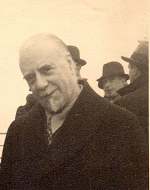
When we travelled to Portsmouth in May 1960, none
of us thought for a moment that this would be the last concert that
Sir Thomas would conduct. He was in good shape and it seemed he would
go on for ever. We all hoped he would. As on the occasion that I first
encountered Sir Thomas, when he put the baton through his hand, this
concert had strange and unusual events connected with it. For some reason
he decided to invite the whole orchestra to luncheon when we arrived
in Portsmouth. This was extremely unusual, indeed unique in my experience.
Though always polite and courteous, Beecham never became familiar with
members of his orchestras. He neither travelled with the players nor
indulged in any kind of social relationship with them.
 |
|
Click
for larger picture
|
However, this was a very pleasant occasion and he was
at his most benign. After lunch we went to the concert hall and rehearsed
for about twenty minutes. Then, another surprise. A large television
set was brought on to the platform and Sir Thomas invited the orchestra
to join him in watching the cup final. Liverpool, the football team
closest to St. Helens where he was born, was playing that year. There
was no more rehearsal and after the match we went our separate ways.
It was a splendid concert and it was
received with enthusiasm. The concert ended with a characteristically
ebullient performance of the Bacchanale, from Samson
and Delilah by Saint-Saëns. Tommy was loved by audiences
and he in his turn loved them and was generous with his encores. He
loved music and enjoyed it more than any other conductor I have played
for. It was this enjoyment that was so infectious, affecting audiences
and players alike. Shirley, Lady Beecham, told me that Tommy had related
to her how on an occasion, when he was very, very young, there was
a little concert in his hometown. He was terrified of the audience.
His nurse led him to the curtain and let him peep through. ‘Now, Master
Thomas, you mustn’t be nervous’ she said ‘out there are all your little
friends.’ On this occasion, in Portsmouth, a great many of his friends,
in the audience and all of us in the orchestra, were treated to an
encore, Sleigh Ride by one of his favourite composers, Frederick
Delius. It was the last piece he was to conduct.
Beecham has left a treasury of incomparable
recordings to enrich the listening hours of all music lovers. For
those of us who were fortunate enough to make music with him, he has
left a gap that remains unfilled. Though I was fortunate enough to
play under the direction of a number of other outstanding conductors,
none gave me the continuos musical satisfaction I enjoyed when working
with Beecham. Even when he conducted music that he was not suited
for temperamentally the spontaneity and the feeling that the music
was being recreated in performance was exhilarating.
 Chapter
8
Chapter
8