|
|
Click
for larger picture
|
The last of the giants (and not
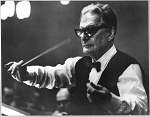
only musically) was, in my experience, Otto Klemperer. He was a
big man and extremely tall. Even towards the end of his life, when
he was in ill health, he stood so erect that as he came in through
a doorway his fine head of silver hair brushed against the top lintel.
I probably worked with him more often than any other conductor except
Beecham. No two conductors could have been more dissimilar. Beecham
had a rapier-like wit and a sparkling temperament, whilst Klemperer
was rock-like with a caustic and devastating humour.
On one of the Philharmonia’s trips
to Paris Klemperer was to conduct Mahler’s 9th.
Symphony, which we had played several times at concerts and also
recorded with him. Towards the end of his life Klemperer never rehearsed
on the day of the concert so it had been arranged for him to rehearse
in Paris on the evening before the concert. I had already accepted
an engagement with another orchestra for that evening so I told
the management I was sorry but I was not able go to Paris for the
rehearsal. Gerald McDonald, the General Manager, agreed that I could
come over on the day of the concert and they would get a player
in Paris to take my place for the rehearsal. When I arrived the
following day Hugh Bean, then the Leader of the orchestra, told
me that at the end of the rehearsal the previous evening Klemperer,
perhaps wishing to thank my deputy, had called out, ‘Eb clarinet!’
As there was no response, and his sight was not good, he called
out again, ‘Eb clarinet’; still no reply. Turning to Hugh he asked,
‘where is the Eb player’. Hugh, seeing that the player had already
left the platform, no doubt thinking the rehearsal was over, replied,
‘Oh dear! He seems to have gone home’. ‘And I don’t blame him’ said
Klemperer.
As a young man he must have been
quite frightening, a big man, very tall, with a stern and fierce
expression. I have been told that he had a habit, when he wanted
to tell a player something at rehearsal, of rushing across the platform
and towering over the player. At one rehearsal he suddenly rushed
towards the 4th horn player, a small, nervous man. ‘Do not be afraid!
I am your friend. I have come to tell you, you are no good.’ As
always he was being himself, direct and honest. It was this quality
that he brought to his performances of Beethoven’s and Mahler’s
9th symphonies. No one else in my experience gave these works the
epic quality he did. They had the structure and vastness of a great
cathedral – quite overwhelming.
When in 1964 Legge decided to abandon
the Philharmonia, he also took its name away. This was a great surprise
and devastating for the players. But, in the same way and with the
same spirit that the players in the London Philharmonic Orchestra
had shown 25 years earlier, they decided to carry on. They re-formed
the orchestra, elected their own board of management and asked Otto
Klemperer, who had been the Philharmonia’s Principal Conductor,
if he would continue in that position. He agreed to remain with
the orchestra, when it became the New Philharmonia. At that time
the future for the orchestra did not look at all certain, so his
loyalty was of tremendous importance in the eyes of the public and
of immense value to the orchestra. He was a man of great integrity
and strength of character, unwilling at any time to bow to expediency.
Throughout this book I have referred
to The Philharmonia Orchestra though for a period from
1964, after Legge had gone the orchestra was obliged to call itself
the New Philharmonia for about 10 years. I believe that most
people thinking of this orchestra think of it as the Philharmonia,
certainly musicians do.
As well as capturing a number of
the already established ‘greats’ Legge also had a fine discerning
ear and quickly recognised emerging talent. He introduced some remarkable
young conductors of outstanding ability to London audiences, including
Guido Cantelli, Lorin Maazel and Colin Davis.
Cantelli was thought by quite a
few of the critics to be the conductor who would take on the mantle
of Toscanini, who in 1950 had said ‘ This is the first time in my
long career that I have met a young man so gifted. He will go far,
very far’. He achieved some very good concert performances and made
some fine recordings with the Philharmonia, but unfortunately he
was killed in a plane crash when he was only 36 before he was able
to fulfil the very high expectations Toscanini had forecast. He
was exceptionally demanding, both on and off the platform, even
insisting that all the toilets back stage at the Royal Festival
Hall be kept locked during all his rehearsals and concerts.
Lorin Maazel immediately astonished
everyone with his incredible memory and conducting technique – especially
his memory, which was truly remarkable. He never used a score, at
rehearsals or concerts, even when there was a soloist. Not only
did he know every note of the score, but all the rehearsal numbers
or letters. He was still young at that time and though the performances
were excellent he was inclined to be extremely cerebral in his interpretations.
He was also a fine violinist and had some success as a soloist.
When we recorded the opera Thais by Massenet he insisted
on playing the Meditation, the famous violin solo, himself
and brought in someone else to conduct that section of the opera.
He worked a great deal with the Philharmonia conducting a large
repertoire with them and for a time was their Principal Guest Conductor.
I first met Colin Davis a very long
time ago when we were both clarinettists. In the early 1950s he
came down to Glyndebourne a few times to deputise as second clarinet
when I was in the RPO and we were doing the opera season there.
He was a very good player but, though at that time I don’t think
he had done any conducting at all, it was obvious that he had other
intentions than playing the clarinet for the rest of his life. We
were doing one of the Mozart operas, I think it was The Marriage
of Figaro, and he had brought the full score of the opera with
him. During the arias in which the clarinets do not have a part
to play Colin was so intent on studying the score that he was not
always ready for his next entry without being prompted.
His big chance came when he took
over from Otto Klemperer at the last minute to conduct a concert
performance of Mozart’s Don Giovanni with the Philharmonia
at a concert in the Royal Festival Hall. He was an immediate success
and his career took off at once. Perhaps it was because he was young
and his manner was inclined to be abrasive, plus the very proud
attitude of several of the Philharmonia principals, that he only
conducted the orchestra very occasionally. At that time his communication
and people skills were not yet well developed. Many years later,
when I had become Chairman, I felt it was quite unjustified that
Colin Davis who had by then achieved a considerable reputation should
not be conducting our orchestra . I suggested that we should engage
him, but I still met resistance from a number of players and the
orchestra lost the opportunity of creating a relationship with a
musician who I had believed for a long time was the only young British
conductor with the potential to become outstanding and possibly
a ‘great’ conductor. It is not often that one makes a correct forecast
but this time there is no doubt that I was correct: his collaboration
with the LSO as the years went by developed into perhaps the best
relationship a London Orchestra has had with a British conductor
since that which Beecham had with his orchestras, especially the
Royal Philharmonic.
During the years that I played in
the Philharmonia we worked with many of the conductors on the international
circuit. All of them, in my opinion, were good or very good in the
repertoire that suited their temperament: Claudio Abbado, Vladimir
Ashkenazy, Rafael Frubeck de Burgos, Andrew Davis,
Edward Downes, Bernard Haitink, Norman Del Mar,
Igor Markevitchi, Kurt Masur, Eduardo Mata, Riccardo Muti, Seiji
Ozawa, Mstislav Rostropovich, Kurt Sanderling, Wolfgang Sawallisch,
Georg Solti and Yevgeni Svetlanov
Riccardo Muti was Principal Conductor
with the Philharmonia for some years. He took over this position
at about the same time that I was elected Chairman of the Council.
The orchestra’s fortunes and reputation were at a low ebb at that
time and we needed someone to instil some discipline into our performances.
Muti was still relatively young and this was his first major appointment.
He was respected but made life difficult for himself in that he
was very critical and even when everyone was trying as hard as they
could to please him he never seemed to be satisfied. Musicians do
not need to be praised but some kind of response showing that their
efforts have not been in vain is necessary if they are not to become
discouraged. I had the task of trying to help him understand this.
Like many perfectionists he found it very difficult, and often impossible
to accept anything but his ideal. He did improve the orchestra to
a considerable extent before he took the position of Musical Director
of the Philadelphia Orchestra. Now, 30 years later, I have heard
several broadcasts, radio and TV, with him conducting, one in particular
conducting the Vienna Philharmonic Orchestra at one of their New
Year’s Day concerts when they play Strauss overtures, waltzes and
polkas. This is not the kind of music we associated him with, so
that it was a surprise how really good it was, beautifully elegant
and charming. Once again showing how dangerous it is to decide about
a conductor’s talent when he or she is under 40.
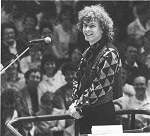
In 1974 I was tipped off that there
was an extremely talented conducting student at the Royal Academy
of Music and that I should go to see and hear him that afternoon.
When we finished
rehearsing I went home to my flat in Welbeck Street,
which is only three minutes walk from the Academy.
When I arrived at the Royal Academy I found this young conductor,
Simon Rattle, rehearsing the student orchestra in preparation for
a concert performance of L’enfant et les Sortileges by Ravel.
After quite a short while I thought, ‘this is the real thing.’ After
consulting with two of my colleagues we decided that although he was
then still only 19, the Philharmonia should offer him the opportunity
of making his debut with the orchestra at the Royal Festival Hall
in 1976, when he would be 21. When he arrived to conduct us he impressed
the orchestra from the first rehearsal with his technique, knowledge
of the music and his light-handed authority. His ability as a very
young man to take charge of a famous orchestra with such ease and
charm was remarkable – I have never seen it matched.
His first concert with us was on
the 15th of February 1976 when he conducted a splendid programme
that included Shostakovich’s 10th symphony, which he conducted from
memory. At one point our very distinguished principal bassoonist
made a false entry and started to play a couple of bars too early.
Without any fuss or disturbing his control over the rest of the
orchestra Rattle stopped him after only a note or two and then brought
him in again at the correct place in the music.
I have written elsewhere about the
qualities a conductor requires but I left out one quality that few
have and that Rattle has in abundance – the ability to keep an orchestra
happy, even when playing music it does not enjoy playing or that
makes demands of an unusual kind. There was one particular composition
that I remember him coping with that with anyone else might well
have created open hostility from the players. The orchestra had
commissioned Peter Maxwell Davies to compose a symphony and undertaken
to give the first and some subsequent performances. Maxwell Davies
had asked particularly that Simon Rattle should conduct it. The
symphony was not difficult technically but it was rhythmically complex
and however many times one played it one could never feel sure one
was in the right place; so many contrary rhythms were going on at
the same time and there seemed to be no melodic pattern to hold
on to. At the first performance, as I recall, Rattle conducted it
from memory. If I am right, it was an astonishing achievement. We
also played The Song of the Earth by Mahler and again he
conducted from memory. This was a rather ordinary performance that
seemed uninspired by sufficient sensitivity, but perhaps this was
because he had not allowed enough time for the rehearsal of this
wonderful, evocative music, which is difficult in a quite different
way to the Maxwell Davies symphony. Learning how to use the available
rehearsal time, in Britain usually insufficient, is a skill that
comes with experience. Many conductors never learn to organise their
time well, and others ask for more time than is needed and alienate
the orchestra by boring them. Simon Rattle learnt amazingly quickly
and therefore soon became welcomed by major orchestras everywhere.
His decision, when he was the conductor
and Music Director of the City of Birmingham Orchestra, to remain
there for so many years enabled him to create a very fine orchestra
from what had previously been a rather ordinary regional orchestra.
He also built a regular audience that was prepared to come to concerts
and take on trust programmes that in London would have played to
a half empty hall. It is not surprising that the Berlin Philharmonic
Orchestra decided to appoint him as their Principal Conductor before
he was 50.
The conductors I have written about
with enthusiasm were respected for their knowledge, ability and
musical integrity. But above it was those who created performances
that inspired orchestras to extend themselves to the limit, so that
they played better than they thought they could, that were most
welcome. Whenever I have heard a relay of a concert or a recording
broadcast, when I did not know who the artists involved were, within
a few bars I have thought ‘this is really good – something special’.
When the performers are announced I have nearly always found that
it was a performance I had enjoyed in the past, sometimes many years
previously. However, I have to admit there have also been other
occasions when I have thought ‘this is a very good orchestra and
an outstanding conductor’, only to learn later that it had been
an orchestra and conductor for whom I had little regard.
 Chapter 11