Back
to Chapter 9
10
The Great and the Good
Playing for great, good, very good
and outstanding conductors – in the London Philharmonic, Royal Philharmonic
and Philharmonia and elsewhere – Victor de Sabata, Bruno Walter, Charles
Munch, Thomas Beecham, Herbert von Karajan, Otto Klemperer, Lorin
Maazel, Colin Davis, Simon Rattle and many more.
What is it that makes us consider
some conductors ‘great’? What qualities do they possess that distinguishes
them from those we assess as good, very good or outstanding? Are those
we think of as great always dead? It seems to me that I remember artists,
composers and politicians being referred to as ‘great’ during their
lifetime. Perhaps because we now see them so often on TV and no longer
treated with the deference accorded them in the past we only think
of them as personalities or celebrities.
It is difficult to describe what it
is that a very few conductors have that makes us believe they are
great, yet we always recognise it when we are in its presence. We
sense that they are beyond the ordinary, have remarkable ability,
are in some way unique and have something extraordinary that separates
them from most of the rest of us. In some way they command our respect
and inspire us.
All the very best conductors, those
that my colleagues and I would consider great, combine the authority
and control I referred to in a previous chapter with the self-confidence
that allows them to respond to musicians in the orchestra who have
solo passages to play. This interplay between conductor and members
of the orchestra is one of the elements that leads to an orchestra
playing ‘better than it can’. The whole orchestra is inspired by the
conductor and by the playing of individual musicians in the orchestra.
Together, they combine to produce a great performance.
Because there are so many less good
than good conductors, orchestral musicians quite often feel that the
conductor stands in the way of them playing as well as they can. Every
musician who has taken part in a great performance will tell you that
this is only possible with a great conductor. However demanding he
may have been, and however extreme the demands one has to make on
oneself, the reward of taking part in a great performance is what
makes playing in an orchestra worthwhile. It is something very special.
One is enlarged by being part of something much bigger than oneself.
When one takes part in a performance
of a great piece of music with a great conductor in a fine orchestra
it is like being an eagle flying over Everest. At other times one
may only fly over Mount Blanc and that is very pleasant, too. However,
a lot of the time one is coasting along just above a range of hills.
Unfortunately, there are quite a number of occasions when one is at
ground level and, on the darkest days, even down in a valley.
From 1943 until 1979 it was my good
fortune to play with many of the very best conductors who came to
London: in 1943 in the London Philharmonic Orchestra (LPO), from 1947
until 1960 in the Royal Philharmonic Orchestra (RPO) and finally in
the Philharmonia, from 1955 (while still playing in the RPO) until
1979. Over these years I also played with nearly all the other orchestras
in London, either as a deputy or an extra, in particular with the
London Symphony Orchestra (LSO).
I worked with several of the conductors
I refer to in more than one of these orchestras. The very best of
them obtained excellent performances from whichever orchestra they
were directing; other conductors, though very good, would get much
better results with one orchestra than another.
The London Philharmonic Orchestra
(LPO)
Towards the end of the 2nd World War,
from 1944, many conductors who had not been to Britain for a number
of years came to conduct the London Philharmonic Orchestra. Some were
probably at the height of their powers and came with the advantage
of an established reputation. The first to arrive was Sir Thomas Beecham,
about whom I have written earlier.
No one I can recall had a greater
or more instantaneous effect on an orchestra than Victor de Sabata.
We knew very little about him other than that he was the musical director
at La Scala in Milan. On his arrival for his first rehearsal with
us he presented a rather romantic figure. He was quite tall, walked
with a limp and had the face of a Roman emperor. He wore a wide brimmed
black hat and wore his overcoat over his shoulders like a cape. Quickly
removing his hat and coat he stepped on to the podium. ‘Good morning,
Gentlemen. We start with Dvorak Symphony.’ We played through the whole
of the New World Symphony, from beginning to end as if it had
been a performance. It was tremendous. Incredibly volatile, his unique
conducting style at once electrified the orchestra. We had all played
this symphony many times before, but never quite like this. In fact,
I have never taken part in any performance of this work as rewarding
as those we did with him.
During the next few years de Sabata
conducted a wide-ranging repertoire with us and though he never used
a score, at rehearsals or concerts, his ear was so discerning that
I felt that even in the loudest orchestral passages he could hear
every note I played. At times he asked for such extremes of dynamic,
from the quietest pianissimo to the loudest fortissimo
that he quite frightened us. On one occasion, when we were recording
the Third Symphony by Beethoven with him, he demanded that the strings
play the spiccato passage in the third movement very quietly
indeed. When playing spiccato the violinist uses a bouncing
stroke of the bow to detach each note. Especially to do this very
quickly and very softly is extremely difficult. After several attempts
that did not satisfy him, one of the first violinists said, ‘Maestro,
it is getting worse – you are frightening us.’ de Sabata, eyes flashing
replied, ‘You are frightened, I am frightened – we must do it.’ He
remained a legend for all of us who played for him at that time and
one of a handful of truly great conductors
Bruno Walter was a man with a very
different personality. He was charming, courteous and urbane. His
approach to music was essentially lyrical. To play Mozart and Schubert
with him was a delight. I still have a programme for the concert he
conducted with us in January 1947 at the Royal Albert Hall – the Overture
Leonora No.3 by Beethoven, Mozart Symphony in G minor
No.40, and the Symphony No.9, the great C major,
by Schubert. Now, nearly sixty years later I remember it as one
of the great concerts I was fortunate to take part in. His tempi might
be thought rather slow by today’s standards but for me the ‘heavenly
length’ of this beautiful symphony by Schubert, though even longer
than usual in this performance, was quite wonderful.
It was with Bruno Walter that I first
played a Mahler symphony. At that time, in the 1940s, Mahler’s music
was practically unknown in Britain and was considered long and boring.
In the 1939 edition of The Oxford Companion to Music, in the article
on German and Austrian music Mahler is only mentioned in a paragraph
about the ban the Nazi regime imposed on the performance of music
by Jewish composers. In the very short article under his name it states,
‘He left nine symphonies which have been taken very seriously in Germany
and Holland but have never had much hearing elsewhere’. His 4th Symphony
was the first one we played, perhaps because being the shortest and
least complicated it was felt it would be the easiest one for the
audience to accept. Later we also played the 1st Symphony. It is now
difficult to understand the opposition there was to his music, not
only from the public but also from the musicians in the orchestras.
In many of his compositions Mahler
makes use of techniques that in the late 1940s and early 1950s were
resented by musicians in Britain and elsewhere. They resisted playing
in ways that they felt went against not only good taste but also against
some of the techniques they had practised so long and hard to perfect.
String players were instructed, at times, to glissando, slide
from one note to another. At its best this style can be heard in the
recordings made by the great violinists Fritz Kreisler and Jascha
Heifetz and other outstanding string instrument players in the first
part of the 20th century. The leaders of the many small light orchestras
playing in cafes, restaurants and holiday resorts were still playing
in this way in the 1940s. Increasingly, conservatoire trained musicians
had come to see this way of playing as vulgar and old fashioned and
to be avoided. Wind players were instructed by Mahler, at certain
points in the music, to raise their instruments so that they pointed
straightforward, rather than at an angle to the ground. Clarinettists
and oboists in particular were unhappy because it affected their embouchure
and to begin with many refused to follow this instruction. After the
mid-1960s, as performances of the Mahler symphonies became increasingly
popular, the complaints disappeared.
Charles Munch was another conductor
the LPO played under many times. He had immense charm (and the most
beautiful smile I’ve ever seen) as well as the ability to inspire.
Before he became a conductor he had been a fine violinist and was
the leader of the famous Leipzig Gewandhaus Orchestra when Wilhelm
Furtwangler was their conductor. He could on occasion be rather wayward.
I remember that when we were to play a Brahms symphony, that for some
reason it seemed he did not want to conduct, he barely rehearsed it
at all. But to play the French repertoire, Debussy, Ravel, Berlioz
and Rameau with him was really a great joy. In particular I remember
wonderful performances of Daphnis and Chloe, L’Apres Midi d’un
faune , La Valse and in particular La Mer. Years later
I remember playing it again with him with the Philharmonia in Vienna
in the wonderful Musikvereinsaal.
Someone, not really a conductor,
the orchestra always enjoyed playing with was Richard Tauber, generally
remembered as one of the great tenors of his time, equally at home
in the Mozart operas as in operettas and musicals. He proved, if proof
is needed, that formal lessons in conducting and conventional technique
are not required in order to obtain wonderful performances. Danny
Kaye, years later, displayed this same talent. Tauber brought a Viennese
charm to his Mozart and Schubert and an innate musical understanding
to everything he conducted. Unfortunately his vanity did not allow
him to wear glasses in public and this limited his repertoire as it
meant he had to conduct everything from memory.
Eduard van Beinum, then principal
conductor with the Concertgebouw Orchestra in Amsterdam, worked a
great deal with the LPO. A very fine musician, he was a restrained,
undemonstrative conductor who obtained very fine results in a wide
repertoire. He was greatly respected by the orchestra who really enjoyed
working with him. He was also a kind and remarkably tolerant man.
When we were recording The Songs of a Wayfarer by Mahler with
him in 1946 or 1947, our regular bass clarinettist was absent for
some reason and his replacement on that day was less than up to the
standard required. In one very quiet passage for the three clarinets
this player just could not play as softly as necessary. He was either
too loud, or came in too early, or did not come in at all. Finally,
after a number of unsuccessful attempts he became so nervous that
he produced the dreaded ‘squeak’. Rather than being cross and humiliating
the player in front of the whole orchestra, as many other conductors
might have done, he let it pass and left recording that section until
another day when another player had been engaged. It is a great pity
that he died before he had made as great an international reputation
as surely he would have done.
The Swiss conductor Ernest Ansermet,
famous for his performances of the music of Stravinsky, was engaged
by Decca to record the music Stravinsky had composed for the ballet
Petrushka. Today this is accepted as a regular work in the
concert repertoire. In 1946 it was still a very exciting and difficult
composition for the orchestra. At that time we were still making records
in the 78rpm format. Each side of a record lasted about four minutes
without any facility for editing. If there was anything unsatisfactory
– a wrong note, poor intonation or ensemble, or a cracked note in
the brass, the whole side had to be recorded again. Decca allowed
10 three-hour sessions to record this 40-minute work, more sessions
than would normally be allocated for recording a piece of this length
even in 1946. But it was worthwhile; this recording, the first major
recording to make use of Decca’s new full frequency recording technique,
FFRR, was a great success and won an award. Years later I remember
recording Petrushka again with the Royal Philharmonic Orchestra,
in the ‘long play’ 33rpm.format, when we were only allowed two sessions.
On that occasion quite a few of the musicians in the orchestra had
never played Petrushka before and so it required rather more
retakes than usual to splice the performance together to produce an
acceptable recording.
In 1946 when Leonard Bernstein came
to conduct the LPO he was still very young and full of New York ebullience
and chutzpah. He had recently had a great success with the
New York Philharmonic and did not seem to be at all impressed by the
LPO, no doubt finding it lacking in the kind of ‘attack’ he was used
to with American orchestras, and nothing like as virtuoso as the New
York Phil. For their part the orchestra did not like him because he
was young, brash and far too sure of himself. None the less, I recall
the performances were good, even if performed through gritted teeth.
He survived this brief encounter to become one of the most outstanding
conductors of his time and a remarkable many faceted musician: a virtuoso
pianist – his recording of the Ravel Piano Concerto in G major remains
one of the best still available – and a fine composer. As a composer
he is probably most widely remembered for West Side Story and
Candide. But his symphonies and much orchestral, choral and
chamber music still remain in the repertoire, though not performed
so frequently. Later, after a similarly false start to that he had
had with the LPO, he established a very good relationship with the
LSO. In time they came to like him very much and they did many splendid
concerts and recordings together. He was less successful when working
with the BBC Symphony Orchestra where on one occasion there was an
unfortunate confrontation between him and some of the brass section
on a ‘live’ TV broadcast.
The LPO engaged a number of conductors
who came to Britain for the first time in the early post-war years.
One of them, Sergiu Celibidache, at that time a very young man, made
a considerable impression and showed great promise. He had at one
time been a footballer and was still rather wild. Later he made a
considerable reputation as a conductor of great integrity, though
rather eccentric. He was one of the only conductors with an international
reputation who came to dislike commercial recording to such an extent
that after a few years he refused to do any further recording.
As well as Charles Munch two other
very good French conductors were engaged by the orchestra: Paul Paray,
and Jean Martinon. Like Munch they conducted a lot of French music,
a great joy to me – the repertoire is so dominated by the Austro-German
composers. The orchestra liked Paul Paray very much. He got very good,
exciting performances and we were sorry he did not return. He had
been a fighter in the French Résistance and was extremely tough.
On one occasion he refused come onto the platform at the beginning
of a concert until he received his fee – in cash! He was the Principal
Conductor of the Colonne Orchestra in Paris from 1945 until he went
to Detroit in 1952 where he had a very successful career with the
Detroit Symphony Orchestra before returning to Paris again in 1963.
Though he continued to conduct in France until his death in 1979 he
never returned to Britain. Jean Martinon was also admired by the orchestra.
He was a fine musician and a very good conductor and the orchestra
did a number of very good concerts with him. He had a considerable
success but, perhaps because of his easy personality and the fact
that when he first conducted us in 1945 he brought Ginette Neveu with
him, who was so charismatic and such a wonderful violinist, I remember
her more than him.
Three more conductors who had some
success with the orchestra were Albert Coates, Erich Leinsdorf and
Nicolai Malko. They could not have been more different from each other,
though each succeeded in getting good results. Albert Coates was already
elderly at the time and went out of his way to be pleasant to the
orchestra. He had made his reputation before the war in Britain and
also in Russia and by the time he conducted us was rather too easy
going and laid back to get outstanding results. In contrast Erich
Leinsdorf was fairly young, not particularly agreeable, but showed
that he had real ability. Many years later I took part in a number
of recording sessions with him when he conducted some extracts from
the Wagner operas with the LSO. By then he had established himself
as an outstanding concert and opera conductor. Though he was able
to get first class results he did not inspire orchestras sufficiently
to receive the accolade ‘great’. Nicolai Malko was a good conductor
of the old school; authoritarian, efficient but not inspiring.
 |
|
Click
for larger picture
|
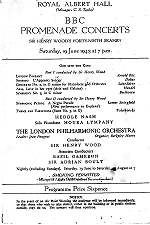
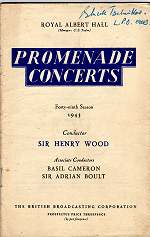
Of course we played frequently for
British conductors, most notably Sir Henry Wood, Sir Adrian Boult,
Dr Malcolm Sargent (still to be knighted) and John Barbirolli (again,
still to be knighted) and then, when he returned from the USA, Beecham.
Sir Henry will always be remembered for his part in creating the Promenade
Concert season, the ever-popular ‘Proms’. He was also the first truly
English conductor to make a great reputation. I only played for him
a few times after I joined the LPO in 1943 before the Prom season
that summer when the orchestra were to do all the
concerts in the first two weeks of the
season. I was looking forward to this
and the opportunity to play a large repertoire with him but, sadly,
he was taken ill and was able to conduct only the first two concerts
before he became too unwell to continue.
I don’t feel that Boult’s talents
were sufficiently recognised at the time by those who worked with
him. It is true that even those who played for him for many years
in the BBC Symphony Orchestra were often unable to tell what he was
doing with the very long baton that he favoured and though he could
be dull there was some music he did extremely well. I remember several
performances of the ‘Great’ C major Symphony by Schubert that were
very fine. The part he played in the formation of the BBC Symphony
Orchestra in 1930, his selection of the players that would make it,
at that time, the best orchestra in the country, and his subsequent
role in bringing a very great deal of new music to the public’s attention
was a very considerable achievement.
Sargent was unique in my experience
in that he was greatly admired by audiences and choruses, especially
by the ladies, and universally disliked, both as a man and a musician,
by orchestras. Only in the last years of his life, when he had somewhat
mellowed and his past was largely forgotten by a new, younger generation
of musicians, did orchestras come to have a better relationship with
him. His vanity and obvious contempt for orchestral musicians was
such that he would try to teach even the most distinguished and experienced
players how to play their part. His publicly expressed opinion that
a musician ‘ought to give of his life-blood with every bar he plays’
and that ‘the feeling of instability about where next year’s bread
and butter was to come from had made many an artist give continuously
of his best’, did nothing to create good feeling between him and the
orchestras. These remarks were particularly resented because in 1933
the orchestral musicians in London had made a substantial collection
for him when he was seriously ill. The great violinist Fritz Kreisler
said ‘I am sure that musicians the world over play better for feeling
secure. The more secure a musician feels the happier he is and the
better he plays’. Years later Sargent was involved in constant quarrels
with several leading principals in one of the orchestras. On at least
one occasion this led to him becoming so distraught that he started
to cry when outspoken criticisms about his ability were openly expressed
by some of the musicians in the orchestra. This did nothing to raise
his reputation as a man: orchestral musicians are only too accustomed
to very direct and sometimes wounding criticism.
The conductor that we admired the
most after Beecham was John Barbirolli, later Sir John, known by his
many admirers as ‘Glorious John’. In the LPO, when Beecham left to
form the RPO, the orchestra would have liked Barbirolli to have become
their Principal Conductor, but he had already taken up that position
with the Hallé Orchestra in Manchester when he returned to
Britain in 1943, after being with the New York Philharmonic, and was
not willing to leave Manchester. I also worked with him in the RPO
and the Philharmonia, always with pleasure. He did inspire both the
orchestra and the audience and must join the ‘great’ category. When
the Philharmonia toured South America in the 1960s Barbirolli conducted
most of the concerts. He created such enthusiasm from the audience
that on several occasions at the end of a concert, during tumultuous
applause, women bearing young infants would approach the stage apparently
seeking to have their children blessed by the Maestro. The
last time he conducted was at a rehearsal with the Philharmonia, in
preparation for a visit to Japan we were about to undertake in 1970.
During a rehearsal he suddenly became unwell and was unable to do
the tour. It was only a short while later that he died. His place
for the tour was very ably taken at extremely short notice by John
Pritchard (later Sir John), an extremely talented conductor.
The Royal Philharmonic Orchestra
(RPO)
The Royal Philharmonic was really
the only one of the four London orchestras to have a Musical Director,
Sir Thomas Beecham. It could be said, indeed it was, that it was his
orchestra. He not only conducted the orchestra a great deal he also
influenced the management of the orchestra in every way. In most British
orchestras the Principal Conductor usually does no more than about
12 concerts a year, a number of recordings and perhaps a tour. Quite
often, especially in the past when there was a great deal more recording,
the choice of a principal conductor was often determined by the number
of recording sessions he brought with him. The only other conductors
of a British orchestra that I can recall who performed a similar role
to Beecham were Sir John Barbirolli with the Hallé and Simon
Rattle (later Sir Simon) with the City of Birmingham Symphony Orchestra.
Though Beecham gave me more pleasure
whilst I was playing in the orchestra than anyone else and has continued
to do so whenever I listen to the recordings he made, I can also recall
that at times he could behave very badly and very autocratically,
especially if one of his favourite players was not available. On one
occasion we were rehearsing with him in St. Pancras Town Hall when,
just before the tea break, the personnel manager came to announce
that an additional concert had been arranged several weeks hence.
The principal cello, Raymond Clarke, a magnificent player whom Beecham
admired and who greatly admired him in return, said, ‘I’m extremely
sorry Sir Thomas, I afraid I am not free on that date. I have already
accepted another engagement on that day’. Beecham went mad, shouting
and raving and being very rude and disagreeable to poor Clarke. He
worked himself into such a state that he came off the podium and went
storming through the orchestra, kicking chairs and music stands in
all directions, finally leaving the Hall and the rehearsal. With anyone
else the players would have found it difficult to forgive this kind
of behaviour. However, most of us recognised that at times he could
behave like a spoilt child, but forgave him because making music with
him was so rewarding.
When for some strange reason it had
been decided to present a series of concerts at the Earls Court ice
rink, Beecham displayed the autocratic side of his nature. A quite
low platform for the orchestra had been built on top of the ice. As
we waited for Sir Thomas to arrive for the first rehearsal, not surprisingly,
we found that we were getting very cold. Of course, as usual Tommy
was late. Someone must have told him about the prevailing conditions,
so that when he did arrive he came storming onto the ice, shouting
at the top of his voice, ‘I have been deceived – I have been deceived!
It’s a disgrace. Cancel the concert. Everyone go home.’ And with that
he went off again. It always seemed to me he walked with one leg in
2/4 and the other in 6/8 – I used to refer to him to my friends as
‘goody two-shoes’ – on this occasion it was a miracle he did not tumble
over on the slippery ice.
A few minutes later the personnel
manager came on to the stand and announced that the concert was cancelled
and that we could all leave. At about half-past four that afternoon
I received a telegram, as did all the members of the orchestra, instructing
us to return to Earls Court for a short rehearsal at six-thirty to
be followed by the concert at eight o’clock. It was quite remarkable
that everyone was still at home and able to respond to his call to
return. When we arrived back nothing had changed except that Beecham
now seemed to be in his normal good humour. The concert went quite
well, even though we were all frozen and it was very difficult to
keep one’s instrument up to pitch if one had more than a few bars
rest.
With Beecham conducting the orchestra
a great deal of the time the RPO did not have so many guest conductors
as the other orchestras in London. However, we did have some very
fine conductors, including Stokowski, about whom I wrote earlier.
We did a great deal of recording with Artur Rodzinski who was an excellent
conductor though he was not a pleasant man to work with; a martinet
and, possibly because at the time he was elderly and in poor health,
short-tempered and inclined to be rude. In 1956 when Gennadi Rozhdestvensky
came to London with the Bolshoi Ballet it seems that Beecham was impressed
by him because it was not long before he was engaged by the RPO. He
at once made a great impression on the orchestra. His conducting style
was absolutely idiosyncratic and his gestures, though frequently unconnected
to beating time in the generally accepted manner, were extremely effective.
I played with him in three orchestras, the RPO, LSO and the Philharmonia
and with all of them he obtained splendid performances. Subsequently
he was appointed Principal Conductor of the BBC Symphony Orchestra.
This relationship was finally unsuccessful, largely because he disliked
rehearsing, a rare failing in a conductor. Though orchestras often
feel that conductors go on rehearsing far too long, Rozhdestvensky
would at times not rehearse a work that was unfamiliar to the orchestra
sufficiently for them to feel confident that they understood his very
unusual gestures.
Nonetheless, as I was to learn years
later, when he came to conduct the orchestra at the National Centre
for Orchestral Studies for me a number of times for concerts and broadcasts,
he could get the most remarkable performances from an inexperienced
young orchestra with the minimum of rehearsal time. On one occasion
I decided that we should create the tension of the recording studio
for the young musicians by asking Rozhdestvensky to record the suite
from the ballet The Miraculous Mandarin by Béla
Bartók. This is an extremely difficult piece for every section
of the orchestra, technically and rhythmically, so it was arranged
that there should be two extra rehearsals with another conductor before
Rozhdestvensky joined us. Rozhdestvensky was booked for two sessions,
10.00 a.m. until 1.00 p.m. in the morning and 2.00 p.m. until 5.00
p.m. in the afternoon. In the morning he arrived somewhat later than
ten o’clock, rehearsed for just over two hours and decided it was
time for lunch. As he wanted to get back home to central London (we
were working in Greenwich) he asked if we could restart at 1.30 instead
of 2.00. He rehearsed a few of the tricky places for about twenty
minutes and decided to record straight away. He recorded the whole
work without any re-takes or edits, said ‘ Thank you. Goodbye’ and
at about three o’clock went home. I have played this work a number
of times, with Rozhdestvensky and with other conductors, and always
found it difficult. Listening to this recording I find it hard to
believe it was done in one ‘take’, with so little preparation and
with young inexperienced players.
The Philharmonia Orchestra
When Walter Legge formed the Philharmonia
Orchestra in 1945, his position at EMI and the acclaim his new orchestra
quickly achieved enabled him to attract the most celebrated and sought
after conductors. Arturo Toscanini, Wilhelm Furtwängler, George
Szell and Karl Böhm delighted the orchestra, audiences and critics
alike. Perhaps Legge’s greatest coup was to capture Herbert von Karajan
for the Philharmonia in the years before he replaced Furtwängler
as Principal Conductor of the Berlin Philharmonic Orchestra. I have
already written about Karajan, probably the most successful conductor
of the second half of the 20th century. At one time he dominated Europe
and had more power than any conductor before or since. His style was
to influence many younger conductors.
I was still in the RPO when Toscanini,
Furtwängler and Böhm conducted the Philharmonia, but I did
play for Karajan and always found it a rewarding experience. I also
played for George Szell. Though he was an outstanding musician and
conductor I did not enjoy the experience. I do not think it unfair
to say that most musicians around the world disliked him
Karajan conducted the Philharmonia
frequently before he took over the Berlin Philharmonic after Furtwangler
died in 1954. When I was still in the RPO the Philharmonia asked me
to do a concert with them in the Royal Albert Hall. This was the first
time I had played for Karajan and I remember how disconcerting it
was that he kept his eyes closed all the time. It was so different
from Beecham for whom the eyes were so important. He was a remarkable
conductor who combined nearly all the qualities required by a great
conductor. The wonderful sinuous musical line he obtained and the
subtle gradation of dynamic from the quietest pianissimo to the loudest,
powerful fortissimo was unsurpassed. A good example of this ability
can be heard in the fourth movement of Respighi’s The Pines of
Rome on the recording he made in 1958 with the Philharmonia. His
many recordings with the Berlin Philharmonic are evidence of the breadth
of his repertoire and his ability to create a truly magnificent virtuoso
orchestra.
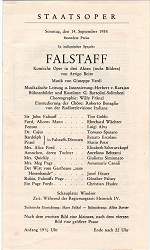
I had the opportunity
of witnessing his astonishing gifts when we were in Vienna for several
days recording the Beethoven’s Missa Solemnis. I
was delighted to be able to get a ticket for a performance
of Verdi’s Falstaff at the famous Vienna Opera House. My seat
was in a box that gave me a good view of the pit. It was a wonderful
cast: Elisabeth Schwarzkopf, Giulietta Simionato, Tito Gobbi and with
Karajan conducting. After recording the Missa Solemnis during
the day Karajan came into the pit that evening and conducted, without
a score, an immaculate performance of this difficult opera. He demonstrated
some of the essential qualities a great conductor must have: a fantastic
memory, energy and stamina and a powerful musical intention with the
skill to convey that intention.
Another quality nearly all great conductors
share is their ability to conduct ‘light’ music, now seldom played
by symphony orchestras in the concert hall other than at the famous
Vienna Philharmonic’s ‘New Year’s Day’ concerts, or Johann Strauss
evenings that have become so popular. Barbirolli, Beecham, Charles
Munch and Karajan immediately come to mind. A
recording of The Skater’s Waltz by Waldteufel conducted by
Karajan with the Philharmonia is a very good example. In
the introduction to the waltz there is a lovely horn
solo.On this occasion it was played by Alan Civil, a fine artist in
his own right.. Like all great conductors Karajan lets Civil play expressively
and freely. The player feels he is playing just as he wants to, but
in fact it is within the context of the conductor’s conception.
Carlo Maria Giulini, extraordinarily
elegant and refined in both appearance and in his conducting, was
very fine in a wide-ranging repertoire, above all in his reading of
the Verdi Requiem. He did it a number of times in London with
the Philharmonia, each time better than the last, culminating in 1964
with what may well be the definitive performance of this wonderful
work. A video of that performance can be seen and heard at the Music
Preserved’s archives in its Listening Studio in the Barbican library,
within the Barbican Centre, and in the Jerwood Library of the Performing
Arts at Trinity College of Music. Though he was not actually a pupil
of de Sabata, he was much influenced by him and
shared some of his charisma and intensity.
 Next
Page
Next
Page