 |
|
| 

alternatively
CD: MDT
Sound
Samples & Downloads |
Heinrich ISAAC
(c.1450-1517)
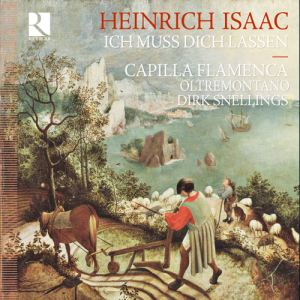
Ich Muss dich lassen
Tmeiskin vas iunch [2:31]
Missa Tmeisken was jonck [4:42]
La morra by 1507 [2:17]
Tartara, chanson for 3 voices 1504 [2:16]
Fammi una gratia, amore, song for 3 voices [4:36]
Donna di dentro/Dammene up pocho/Fortuna d'un gran tempo,
song for 4 voices 1480s[1:48]
A la battaglia [4:47]
Missa La Spagna: Agnus Dei 2 [2:20]
Quis dabit capiti meo acquam, motet for 4 voices [5:07]
La mi la sol [3:16]
Las rauschen, song for 4 voices [2:52]
Ich stund an einem Morgen, song for 4 voices [7:11]
En l'ombre d'un buissonet, chanson for 3 or 4 voices (also
attrib. Josquin) [1:39]
Missa carminum: Innsbruck, ich muss dich lassen/O welt/Christe
secundum [6:07]
O Maria, Mater Christi, motet for 4 voices [7:11]
Salve Regina: Ad te clamamus [1:22]
Hor'è di maggio, song for 4 voices (incomplete) [1:03]
 Capilla Flamenca; Oltremontano/Dirk Snellings
rec. March, 2011, Provinciaal Museum Begijnhofkerk Sint-Truiden,
Belgium. DDD
RICERCAR RIC318 [65:33]
|
|
|
This is a typically robust, lively and extrovert hour or so
from the vivacious yet sensitive Capilla Flamenca with Oltremontano.
The director (and bass) Dirk Snellings explores the still too
shady and overlooked world of Heinrich Isaac. Isaac was born
some time around 1450 in the Low Countries. There he clearly
wrote music of significance early on. He served at the court
of Innsbruck; later in Augsburg and Florence. A move to Vienna
saw him become the first European musician known for certain
to have been employed exclusively to compose music.
The purpose of this excellent, compelling and varied CD is to
illustrate the breadth of Isaac's output. It succeeds well.
In addition to unaccompanied songs and motets in all the languages
used by Isaac, there are instrumental and sung pieces with instruments.
The players are drawn from the dozen plus members of the two
ensembles, Capilla Flamenca and Oltremontano - both formally
founded in 1993.
There’s a dearth of recordings by the nevertheless significant
and influential Isaac. Almost unbelievably, there are only three
CDs in the current catalogue devoted entirely to the composer!
It would have been all too easy against this backdrop to jump
in to make this offering either too overtly an exercise in advocacy,
rather too spectacularly attractive, or in some other way a
superficial taster. This would have done no-one any good.
Instead Snelling exercises as much control and reserve in the
style of his direction and interpretation as enthusiasm. He
lets the music make its own case - rather, one assumes, as must
those who performed it in the fifteenth and early sixteenth
centuries have done. Take the striking La mi la sol [tr.14]
for brass. It's as measured as it is a piece to call us to attention.
It's brief. Yet it encapsulates a world of emotions …
stateliness, control, detachment. Immediately following comes
Ich stund an einem Morgen, the longest work on the CD.
It is also attributed jointly to Ludwig Senfl (1486-1542 or
1543), Isaac's famous pupil. Equally impressive is the song
from which the CD's title was taken, Innsbruck, ich muss
dich lassen [tr.18]. This is a tapestry of plaintive reflection
on what it means to leave a place one loves; and - by extension
- what it means to leave the kind of life one has lived. Capilla
Flamenca and Oltremontano bring out and offer gently every ounce
of compression, condensed emotion and distillation in the harmonies
and melodic insistence. Yet they do not dwell on the composer's
sensitivity to such feelings nor do they overstate the case
for him. At the same time they fail to underplay the emotion
by steering away from it.
Indeed, the alternation of vocal, unaccompanied, accompanied
and instrumental pieces enhances the freshness which Isaac's
music otherwise has in abundance. It's nevertheless music that
- in keeping with the traditions of Flanders - is concentrated,
weighty and never flippant. I say this for all the joy and even
exuberance which it at times exhibits. Las rauschen [tr.15],
for example, actually a song for four voices, is offered here
in a delicate and sensitive arrangement for instruments alone.
The acoustic is close, warm yet not overbearing throughout.
It suits the style of the singers and players well. The booklet
is highly informative and contains all the texts in the original
languages only. Even if it weren't for the absence of recordings
of a good half of the works available here - some others are
well known and do have rival recordings - usually as part of
compilations, though - this would be a CD to buy immediately.
It's idiomatic, its interpretations are perceptive and the performers'
technique is high.
Lovers of Renaissance music can't afford to miss this CD from
the ever-enterprising Ricercar; specialists in Isaac likewise.
As an example of top-notch sensitivity in honouring a major
composer without making a fetish of it, this is a CD to go for.
Mark Sealey
|
|























