|
|
|

alternatively
CD: MDT
AmazonUK
AmazonUS
Sound
Samples & Downloads |
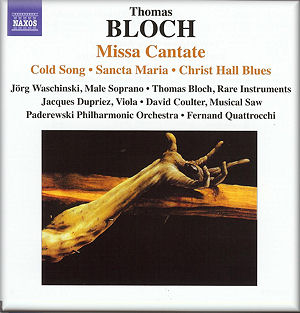
Thomas BLOCH (b. 1962)
Missa Cantate (1999) [44.11] (1, 9, 10); Sancta Maria
(1998) [7.01] (1, 2, 3, 4, 5, 6); Cold Song (2009) [5.46]
(1, 4, 7); Christ Hall Blues (1990/2005) [7.05] (1, 8, 3,
4, 11); Christ Hall Postlude (2008) [2.10] (8, 5, 4)
 Jorg Waschinski (counter-tenor) (1); Jacques Dupriez (viola) (2);
Thomas Bloch (glass harmonica) (3); Thomas Bloch (cristal Baschet)
(4); Thomas Bloch (crystal bells) (5); Thomas Bloch (keyboards)
(6); Thomas Bloch (waterphone) (7); Thomas Bloch (ondes martenot)
(11); David Coulter (musical saw) (8); Paderewski Philharmonic Orchestra
(9); Fernand Quattrocchi (conductor) (10)
Jorg Waschinski (counter-tenor) (1); Jacques Dupriez (viola) (2);
Thomas Bloch (glass harmonica) (3); Thomas Bloch (cristal Baschet)
(4); Thomas Bloch (crystal bells) (5); Thomas Bloch (keyboards)
(6); Thomas Bloch (waterphone) (7); Thomas Bloch (ondes martenot)
(11); David Coulter (musical saw) (8); Paderewski Philharmonic Orchestra
(9); Fernand Quattrocchi (conductor) (10)
rec. Pomeranian Philharmonic Hall, Bydgoszcz (Poland) June 2002
(Missa Cantate); Labo T, Neuilly Plaisance, France 2005 (Sancta
Maria, Christ Hall Blues), 2002 (Cold Song, Christ Hall Postlude)
NAXOS 8.572489 [66.13] 
|
|
|
Thomas Bloch is perhaps best known as a performer on unusual
instruments such as the Ondes Martenot, glass harmonica and
cristal baschet. He has participated in quite a number of musical
collaborations, from Mozart to John Cage to Radiohead.
This disc shows another side to him, that of composer; his style
reflects the eclectic nature of his musical personality. His
Missa Cantate was written in 1999, originally
for voice and piano but was orchestrated by Hubert Bougis, an
arranger best known in the film world. The other works on this
disc use Bloch’s own orchestrations, though they are for far
smaller groups. I am unclear as to why Bloch felt it necessary
to have someone else orchestrate the piece; the liner-notes
do not elucidate this point.
Certainly Bougis’s highly effective orchestration has given
the Missa Cantate a lovely surface gloss
but having listened to Bloch’s smaller pieces for unusual forces,
you can’t help but wish that he’d use some of this aural originality
in the Missa Cantate. As it is, the work’s main
claim to fame is that the solo part was written for the high
counter-tenor (billed as a ‘male soprano’) Jorg Waschinski.
The work fully exploits the remarkably ethereal tones of Waschinski’s
upper register, and relies quite heavily on Waschinski’s ability
to project supremely other-worldly tones.
In fact, Waschinski’s upper register - he seems to go up to
soprano top A on the disc - is fascinating, pure and beautifully
produced, but lacks the variety of colouration that a female
soprano would bring to this repertoire. It is worth bearing
in mind that a soprano, even a low soprano, who sang a role
going up to top A, would usually have a few notes above this
to spare, to allow for some variation; I suspect that Waschinski
does not. There are times, especially in the later movements,
when his voice seems to be under a great deal of stress.
The piece owes its balance between voice and orchestra rather
too much to the recording engineer and I was curious whether
Waschinski’s voice was large enough to project over what appears
to be quite a large orchestra.
The opening movements are very much in the style of Gorecki’s
3rd Symphony; the text of that work gives a variety
of thoughtful layers. Bloch uses the text of the mass, including
one or two sections not normally set. Rather frustratingly,
the text is not included in the booklet and Waschinski’s diction
leaves something to be desired, so it is tricky to work out
what the texts are.
Though the Missa Cantate has moments of drama and stress,
the overall feel is of an ambient take on Gorecki and as such
may have its charms. The performance from the Paderewski Philharmonic
Orchestra under Fernand Quattrocchi is exemplary.
The remaining shorter pieces on the disc are all smaller in
scale and use a variety of remarkable instrumental combinations.
All are musically quite slight but Bloch’s imaginative use of
his unusual instruments provides a charm of its own. For Sancta
Maria Waschinski provides all four vocal parts, accompanied
by viola, glass harmonica, cristal baschet and crystal bells.
Then Cold Song has Waschinski again multi-tracked seven
times, with cristal baschet and waterphone. Christ Hall Blues
uses Waschinski twelve times, accompanied by musical saw,
cristal baschet, glass harmonica, bells and ondes martenot.
Finally the Christ Hall Postlude uses just musical saw,
cristal baschet and Crystal Bells.
For me, this disc appealed mainly for Bloch’s interesting use
of unusual instruments - including Waschinski’s high counter-tenor
- rather than from an intrinsically musical point of view.
Robert Hugill
see also review by Byzantion
|
|