 |
|
| 

alternatively
CD: MDT
AmazonUK
AmazonUS
Downloads available from http://www.eclassical.com/
|
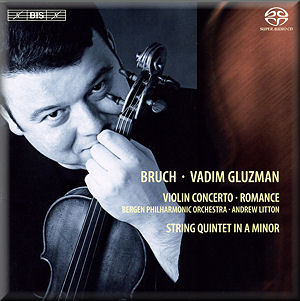
Max BRUCH (1838-1920)
Violin Concerto No.1 in G minor Op.26 (1864-68) [24.17]
Romance in F Op.85 (1911) [8.30]
String Quintet in A minor Op. posth. (1918) [24.05]
 Vadim Gluzman (violin); Sandis Šteinbergs (violin); Maxim Rysanov
(viola); Ilze Klava (viola); Reinis Birznieks (cello)
Vadim Gluzman (violin); Sandis Šteinbergs (violin); Maxim Rysanov
(viola); Ilze Klava (viola); Reinis Birznieks (cello)
Bergen Philharmonic Orchestra/Andrew Litton
rec. Schloss Nordkirchen, Orangerie, Westphalia, Germany, September
2009, and Grieg Hall, Bergen, Norway, October 2009
BIS-SACD-1852  [58.04] [58.04]

|
|
|
An understandable reaction to yet another performance of Bruch’s
first violin concerto would surely have elicited much eye-rolling
and a lot of invective from the composer, who always exhorted
violinists to play one of the other eight concerted works for
the instrument. As his biographer I can guarantee that. Yet
I would be surprised if he did not like what he hears here.
Vadim Gluzman, with a finely attentive accompanist in Andrew
Litton and his responsive Bergen Philharmonic Orchestra, plays
it superbly – it’s quite the finest performance I have ever
heard, including Kreisler’s famous 1925 recording. While transitions
to tempo changes may strike one as over-stated, there is immense
detail, subtle, sometimes rightly unsubtle, nuance and robust
energy in the playing, as well as lingering lyricism. Clean
cut double-stopping in a Hungarian goulash of a finale peppered
with spice and rushing to a headlong conclusion will leave the
listener breathless. The central Adagio avoids sentimentality
while giving full rein to its Romanticism in long-arched phrasing
and sweet tone, this after a ruggedly presented Prelude (itself
starting with an almost too inaudible pp timpani roll).
This account reminds us of the timely arrival of this work in
1868 between Mendelssohn’s and Brahms’ contributions to the
genre, but more significantly it shows us how much Bruch was
influenced by the former and in turn influenced the latter.
If nothing else, it made financial sense for Bruch to make versions
of his music for other instruments to play and while he did
not (to my knowledge) envisage his viola Romance being accompanied
by an orchestra, he certainly did offer a version with piano
accompaniment. Pragmatism dictated the sense of doing so for
after all there were and still are more solo violinists about
than solo violists. It is a beautiful work, hard to programme
because of its awkwardly short length but ideally suited for
inclusion on a recording. One misses the viola’s lowest fifth
from G to C which Bruch always loved in much-favoured alto register
instruments (clarinet, cello and French horn were often prominent
in his orchestration), but Gluzman’s fine playing is fair exchange
in this very interesting and rewarding exercise - and there
is always Gérard Caussé’s fine account on Erato of the original
version for the viola.
At the end of his life Bruch - like so many other composers
- returned to chamber music. At the start of his career in the
early 1860s he produced a piano trio and two string quartets,
but apart from a mid-life piano quintet in 1886, he wrote nothing
else until two quintets and an octet all for strings in 1918/1919.
They in no way sound as if the Rite of Spring was five
years old, nor that Bartók and Schoenberg were well on their
way to establishing themselves on the music scene. Instead they
remain rooted in the 1860s when Bruch was writing his best music.
Ferdinand David, Joachim and Sarasate were consulted when writing
all his earlier works for violin, but they were all dead by
1918 so it was now the turn of Willy Hess to take on that advisory
role. The result is that the first violin is the virtuoso while
its four colleagues (including a second viola) take on a comparatively
subsidiary role (also true of the other quintet and the octet).
Needless to say Gluzman rises to the occasion if not beyond.
His masterly technique is admirable and recalls Ulf Hoelscher’s
disc for CPO. If, as one would assume from a lack of a name
for this ensemble, this is a put-together group who have met
for the recording, one can only praise their blend and balance
as well as unity of phrasing and control of passage-work.
This is an enterprising combination of works by Max Bruch, given
superb performances by everyone involved, not forgetting the
sound engineers and post-production editors Fabian Frank, Martin
Nagorni, Hans Kipfer and Michaela Wiesbeck, who too often go
unappreciated in our perception of the recording industry.
Christopher Fifield
|
|























