Editorial Board
MusicWeb International
Founding Editor Rob Barnett Editor in Chief
John Quinn Contributing Editor Ralph Moore Webmaster
David Barker Postmaster
Jonathan Woolf MusicWeb Founder Len Mullenger
Buy
through MusicWeb
for £11.00 postage
paid World Wide. Try
it on Sale or Return You
may prefer to pay by Sterling cheque or
Euro notes to avoid PayPal. Contact
for details
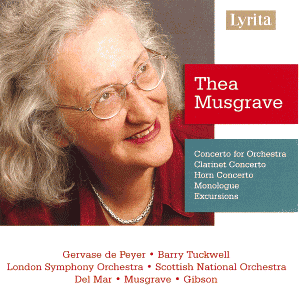
Thea
MUSGRAVE (b. 1928)
1. Concerto for Orchestra, (1967) [20:26]
2. Clarinet Concerto, (1969) [23:38] Sample
3. Horn Concerto, (1971) [22:06] Sample
4. Monologue for solo piano, (1960) [6:02]
5. Excursions, eight duets for
piano (four hands), (1965) [7:40]
Gervase de Payer (clarinet)(2); Barry
Tuckwell (horn)(3); Thea Musgrave (piano)(4,5);
Malcolm Williamson (piano) (5)
Scottish National Orchestra/Alexander
Gibson (1)
London Symphony Orchestra/Norman Del Mar
(2)
Scottish National Orchestra/Thea Musgrave
(3)
rec. January 1974, City Hall, Glasgow,
Scotland. ADD (1,3), January 1972, London
Opera Centre, UK. ADD (2); September 1971,
Kingsway Hall, London, UK. ADD (4,5)
LYRITA SRCD.253 [80:00]
This is a generous CD of reissues of
classic new music from the 1960s, later
recordings of which exist only for the
Clarinet Concerto (Clarinet Classics,
35), Excursions (Campion 1353)
and Monologue (Capstone 8714).
They are played by performers then at
the height of their powers and with
flair and surety that makes this a landmark
disc and one to be bought without hesitation
by anyone interested in the development
of post-war British music in general
and Thea Musgrave’s mellow, steady and
always inventive style in particular.
Born in Scotland but now resident in
the United States, Musgrave’s career
and output have always matched breadth
with a rather single-minded determination
to work as she has wanted to, and not
as fad or fashion might have suggested.
An example would be her adherence to
the dramatic qualities of her music
in their conscious rejection of tonality
while at the same time avoiding the
formality of serialism. Thus the concerto
as a genre proved a suitable vehicle
for the resultant exploration of structure
with gusto. Particularly since, for
Musgrave, her music’s performers are
more actors than conveyors of a pre-existing
score. That’s very evident in the orchestral
pieces here.
The Concerto for Orchestra is
a work full of tension, tonal and temporal.
Indeed, it explores the notion of instruments
‘in revolt’ against the conductor. There
is a certain liberality of interpretation
(freedom to repeat, with rubato) which
is designed to strain the very fabric
of the music. For this to be effective
the playing has to be impeccable; every
note has to be heard; every attack and
decay controlled; every timbre distinct.
And so it is on this landmark recording
by another provincial orchestra (the
Scottish National Orchestra) than that
to which the work was dedicated (the
CBSO). The playing is crisp, vibrant,
rounded, tuneful; yet it fully conveys
the apparent waywardness of line which
is in fact the very essence of the concerto.
The supremacy of the clarinet before,
throughout and after the stunning tutti
and crescendi is key to the work and
emerges with great effect here. Exemplary.
Musgrave’s Clarinet Concerto
has the distinction of requiring the
soloist to promenade through the orchestra.
It’s a logical progression after the
Concerto for Orchestra - again
exploring aural space. Musgrave was
(and has remained) fascinated by the
way sounds group in space as well as
time and ways in which (orchestral)
soloists can wrest the lead from the
conventional director of events, the
conductor. Once again there are extremes
of volume and texture. Once again, the
forces of - this time - the LSO are
more than up to the task, playing with
a certainty and conviction that carry
the work as far, surely, as Musgrave
intended it to go: these were the days
before sounds were savoured exclusively
for their own sake with emphasis on
massed percussion or aleatoric devices.
Notable (as was the case with the Concerto
for Orchestra) is a major part for
harp; there is also a prominent accordion
part.
The Horn Concerto also builds
upon Musgrave’s concept of ‘Space music’:
in this piece members of the horn section
themselves move around the hall. There
are also ‘prepared’ instruments – a
piano with screws, a book and a metal
bar; and a harp with paper threaded
through some of its strings. This is
not a frenetic or self-conscious work;
rather a virtuosic and lyrical concerto,
although the extent to which the leading
role of the horn soloist is established
yet undermined confers an iconoclastic
quality on the piece. As de Peyer’s
in the Clarinet Concerto, Tuckwell’s
(the work’s dedicatee) articulation
and phrasing in this concerto are outstanding.
Monologue is the earliest (and
shortest) piece on this disc; it does
experiment with serialism. Again, this
is a piece of contrasts and music distinguished
by Musgrave’s characteristic ‘tumultuoso’
marking, it still lives in the world
of contrasts and the sort of subdued
rhetoric which was to interest Musgrave
later on in her career when composing
vocal and operatic works. Again, beautifully
played by Musgrave herself.
Excursions is interesting in
that it was written for four hands on
one piano also as a teaching piece:
one ‘easy part’ for pupils to play with
their teachers literally close at hand.
In the first four of the eight pieces
the easy part is the lower one; in the
second four the top one. Miniatures
they are – but with a substantial impact.
Although they do have descriptive (of
car journey) titles, these are only
printed in small type at the end of
each piece. Inasmuch as the material
in Excursions is intended to
emphasise learning, composer clearly
has much respect for pupil. She is joined
by Malcolm Williamson.
This is a disc whose primary interest
will certainly be historic: it makes
available again music that made waves
in the early 70s, but music that has
clung to a place in the repertoire –
and justly so. Played with conviction
and delight by the Scottish National
and London Symphony orchestras under
Gibson, Del Mar and Musgrave herself,
it rightly acts as testament to just
how significant and appealing her works
were then. Perhaps it will revive interest
in them now.
























 for details

 Gervase de Payer (clarinet)(2); Barry
Tuckwell (horn)(3); Thea Musgrave (piano)(4,5);
Malcolm Williamson (piano) (5)
Gervase de Payer (clarinet)(2); Barry
Tuckwell (horn)(3); Thea Musgrave (piano)(4,5);
Malcolm Williamson (piano) (5)