Editorial Board
MusicWeb International
Founding Editor Rob Barnett Editor in Chief
John Quinn Contributing Editor Ralph Moore Webmaster
David Barker Postmaster
Jonathan Woolf MusicWeb Founder Len Mullenger
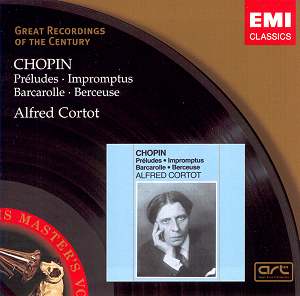
Frédéric CHOPIN (1810-1849)
Twenty-Four Préludesa (1836-38) [34:21]; Prélude
in C sharp minor, Op. 45b (1841) [4:07]; Berceuse
in D flat, Op. 57b (1843/4) [4:08]; Impromptusc (1837-42) – No.
1 in A flat, Op. 29 [3:45]; No. 2 in F sharp minor, Op.
36 [4:27]; No. 3 in G flat, Op. 51 [4:52]; Fantaisie-Impromptu
in C sharp minor, Op. 66c (1835) [4:34]; Barcarolle
in F sharp, Op. 60c (1846) [7:52] Alfred Cortot
(piano)
rec. No. 3 Studio, Abbey Road, London, a 5 July,
20 June 1933; b 4 November 1949; c5
July 1933. ADD EMI CLASSICS
GREAT RECORDINGS OF THE CENTURY 3615412 [68:45]
These are, indeed, classic recordings. The
present GROC begins with Cortot's 1933/4 complete traversal of
the Préludes.
This was his second; there is an earlier version from 1926.
The remastering engineer, Andrew Walter, has (re)produced
a sound of great clarity and yet depth. It is instructive
to compare the present Barcarolle transfer with Mark
Obert-Thorn's on the recent Naxos Cortot 78rpm Recordings,
Volume 3 (8.111052). The piano on the Naxos seems a lot
closer, and more of the hiss is preserved. It is, in fact,
immediately more involving but the more welcoming EMI sound
might well be preferred by some. Great that we have the choice!
The Op. 28 Préludes represent a wonderful statement
of Cortot's art. There are approximate passages, to be sure,
but if ever there was a case for keeping wrong notes in takes,
this is surely it. Cortot plays as if possessed, right from
the very first, turbulent,Prélude. There is
an immediate sense of rightness, a thread that continued
throughout the ever-changing landscape of the ensuing 23
miniatures. The pitch of the transfer is rock-steady for
the A minor's plaintive single lines, while No. 4 is the
essence of dolente - particularly the close. If No. 5 in
D major could possibly be even more off-the-cuff, all doubts
are effectively smashed by the next Prélude's flighty
fingerwork. Cortot seems to have an infinite number of tonal
shades available and can conjure up the most amazing peace
(the F sharp, No. 13) as well as pure cheekiness (No. 10's
right hand!). The so-called 'Raindrop' (No. 15) is marked
by its exquisite textures, while it is the lyric impulse
that so impresses in the A flat, No. 17. The F minor(No.
18)'s play on recitative makes it one of the more purely
dramatic of the cycle. Ironically, it is only the final Prélude that
disappoints. It begins in the darkest nether regions of D
minor, but fails to blaze sufficiently towards the end.
The Berceuse and the Op. 45 Prélude were recorded
on the same day. Both are gloriously dark-toned. The Berceuse's
decorations glisten in the sun, though! The set of Impromptus -
including Cortot's second recordings of Opp. 29 and 36 -
is a miracle in itself. Listen to how Cortot projects the
'chorale' of Op. 29 just enough, without forcing, or how
the intimacy of the G flat comes across - some astonishing
leggiero in the right-hand.
Bryce Morrison's booklet notes are predictably laudatory
but also rather vague – there is little discographical scholarship
here. Cortot's playing is what this disc is about, however,
and while one listens he almost always convinces one that
his is the true way. Superb.
Colin Clarke
Reviews
from previous months Join the mailing list and receive a hyperlinked weekly update on the
discs reviewed. details We welcome feedback on our reviews. Please use the Bulletin
Board
Please paste in the first line of your comments the URL of the review to
which you refer.













 Alfred Cortot
(piano)
Alfred Cortot
(piano)