Editorial Board
MusicWeb International
Founding Editor Rob Barnett Editor in Chief
John Quinn Contributing Editor Ralph Moore Webmaster
David Barker Postmaster
Jonathan Woolf MusicWeb Founder Len Mullenger
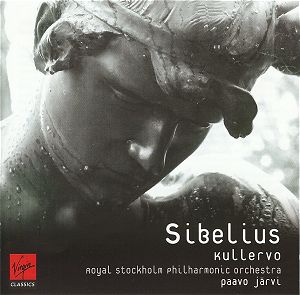
Jean SIBELIUS (1865-1957) Kullervo, symphonic poem for soloists, chorus
and orchestra Op.7 (1892) [78:29]
(I. Introduction: Allegro moderato [14:00] II. Kullervo’s
Youth: Grave [15:56] III. Kullervo and his sister: Allegro
vivace [24:19] IV. Kullervo goes to war: Alla Marcia [9:38]V.
Kullervo’s death: Andante [14:32]) Randi Stene
(mezzo); Peter Mattei (baritone)
National Male Chorus of Estonia
Royal Stockholm Philharmonic Orchestra/Paavo Järvi
rec. Stockholm, 14-19 March 1997 VIRGIN
CLASSICS 3913632 [78:29]
The
Finnish national epic ‘Kalevala’ gave Sibelius many ‘springboards’ from
early days to his last published work.
The
composer used ‘Jean’ rather than ‘Janne’ at the suggestion
of an uncle so as to sound more European at a time when Finland
was a mere Grand Duchy after years of Swedish and Russian
rule. French was the ‘cultured’ language of Russia in the
mid-19th century and since the 18th century
it had been usual to Latinise Finnish surnames. Well, it
made sense when the Finnish language could only be understood
by Finns and Hungarians and the important northern country
was neither Scandinavian nor Slavic. Never make the mistake
of calling a Finn a Scandinavian or you might end up with
a nose bleed!
The
Kalevala stands among the aural traditions of the ancient
Irish cycles and the Icelandic sagas. It has some scant resemblance
to Nordic mythology before it was sanitised but is actually
closer to the myths of the Indus and Ganges. This is no real
surprise when one digs and finds that so-called ‘Celtic’ migration
from the sub-continent split into many strands. It so happened
that the related tribes of modern Hungary and Finland retained
linguistic similarities.
Sibelius
was born in 1865 into a Swedish-speaking family but his parents
were aware of the country’s nationalism so sent Jean to a
Finnish-speaking school. Under the loose control of Russia
(1809-1917) such schools were permitted. In any event the
Russia grip was weakening in Sibelius’s boyhood and Sweden
had long ceased to be imperialistic, preferring trade with
the west and development at home. He had been steeped in
his nation’s history and had a love of the arctic forests
and tundra of his land which he could ‘describe’ with his
gift for orchestration. The student Sibelius was brilliant
but lazy and became an alcoholic in the bohemian intellectual
climate of Helsinki.
What
surprises me so much about this Kullervo with a young
Paavo Järvi, is that the whole work is more ‘Sibelian’ than
the rather later Symphony No.1, which has a bit too much
Tchaikovsky for my liking. Maybe young Sibelius in 1892 was
writing for the home market whereas the symphony was ‘for
export’. In any event the result is Sibelius in his own voice
achieved rather earlier than in the more formal works. A
useful way of seeing this is to refer to Elgar’s ‘Enigma’ of
just a few years later. This also ignored formal structure
but remains a great composer’s first important utterance.
Anthony
Short’s insert notes with this CD explain that Sibelius called Kullervo a ‘symphony’ in
letters to friends. However I go along with Mr Short in thinking
that ‘symphonic cantata’ better fits the bill. Short’s reference
to Tchaikovsky’s ‘Manfred’ is relevant but the obvious difference
is that Kullervo uses soloists and choruses.
Kullervo
is a character featured in Runes 31 to 36 of the epic Kalevala.
He is an unpromising subject because he was doomed to tragedy
and had a ‘big attitude problem’ by latterday standards.
The basic story is that Kullervo is brought up by his uncle,
who has killed the boy’s father. The boy’s behaviour is delinquent
and the uncle sells Kullervo into serfdom, presumably to
be rid of him. Kullervo’s resentment and wish for vengeance
lack the redeeming features of another Sibelius character,
Leminkainnen, who was arrogant but at least heroic. Not so
with Kullervo; he is generally violent and negative. On the
way back to take on his uncle in a vengeful showdown, he
meets a beggar girl whom he seduces (rapes) only to find
that she was his sister who had been lost after their father’s
murder. She kills herself in shame and Kullervo falls on
his sword but only after he has killed the evil uncle and
most of his family. It makes the last scene of Hamlet look
like a small family squabble.
The
first movement of Kullervo, Allegro moderato in
its economy of expression takes us straight to mature Sibelius.
In this it differs from the first two symphonies. It is a
rather compressed exhibition of the spareness of the landscape
and the wandering of Kullervo’s exile but there’s joy there
as well. Through this music are woven, like a toxin, presentiments
of Kullervo’s trail of tragedy. This 14 minute movement could
stand alone and be entirely convincing, especially under
Paavo Järvi’s innate and evident understanding of what is
going on.
The
second movement, ‘Kullervo’s youth’, is a mere 16 minute
matter with a relentless undertone. There’s brilliant string
writing but with tragic interjections over a main theme.
This extends to the rest of the orchestra with an economy
and pace akin to the Third Symphony. This evolves from a
simple signature theme into other subjects of sturm und
drang but tracks the story with very few slips into mere
imitation. This is mature Sibelius and what Constant Lambert
called the ‘music of the future’ in his book ‘Music Ho’.
We are far ahead of the actual year of composition with Tchaikovsky
still alive (for a year).
The
third and longest movement, ‘Kullervo and his sister’ begins
with the upbeat melodies and urgent rhythms heard earlier.
The drawback with this CD is that Virgin/EMI do not supply
texts. Even a reference web link would have helped but none
is supplied.
Given
that Anthony Short’s insert notes (p.4) describe the composer’s
altercation with his mentor Wegelius about references to “items
of clothing” we are left not actually knowing what went on.
Was it consent, seduction or rape. True, troubled and dominant
sounds occur from about four minutes into this ‘mini-opera’ of
24 minutes but without a text we are left in ignorance. I
hope that Virgin will remedy this omission. I should however
stress that the mezzo role – here brilliantly sung by Randi
Stene - is far from weak.
In
the brief fourth movement, ‘Kullervo goes to war’ there is
a lot of bellicose melodic stuff. This reflects both the
anti-hero’s getting even with the family who dumped him and
the primal sin of incest. Sibelius accordingly underpins
the movement with insidious minor harmonies which deserve
more attention than I have ever heard discussed. This is
genius at work.
The
proof is in the last (fifth) movement, ‘Kullervo’s Death’.
Such lonely, wilderness, lost-soul music is full-on in the
literal Greek sense. Again, without a text we have no idea
exactly what is being said, However Sibelius was so good
at conveying meaning without words that we instantly recognise
the dark clouds of hopelessness. They duly arrive about 10
minutes into this extraordinary and relentless movement.
The distorted reprise of Kullervo’s ‘theme’ is not heroic
but brave and terminally tragic.
Everyone
involved in this recording brings the sensitivity needed
to articulate what is ‘Baltic’ music as distinct from Scandinavian.
It is done to perfection.
Engineering
and production are invisible and inaudible just as it should
be. All involved should be congratulated for showing again
that Sibelius had started to plough his own furrow in frozen
soil well before the works that made his name in Europe and
America.
Apart
from there being no manufacturer-supplied text or net access
to Runes 31-36 I recommend this CD as my choice of this summer.
Stephen Hall
Please support our advertisers below by clicking on the logos for further information.

























 Randi Stene
(mezzo); Peter Mattei (baritone)
Randi Stene
(mezzo); Peter Mattei (baritone)