The
Naxos “Deutsche Schubert-Lied-Edition” has now reached volumes
23 (review coming before long) and 24. Ulrich Eisenlohr, the
master-mind behind the project and pianist on most of the issues,
is probably already beginning to see the light at the end of
the tunnel. The last disc should be issued sometime next year.
Along
the way we have encountered a number of good German speaking
singers, some of whom have had very successful careers, and
it is always interesting to listen to new voices. I haven’t
heard all the discs in the series so far but have more than
two thirds of them and my general impression is that Naxos have
been luckier with their male singers than their female.
Julia
Borchert who leads the current issue has distinguished herself
on a number of German stages in Mozart roles as well as Sophie
in Rosenkavalier and Lucia di Lammermoor. Since 2004
she has appeared at the Bayreuth festival as the First Flower
Maiden in Parsifal. A lyrical voice no doubt but
the first song on this disc, the initially stormy Die junge
Nonne, made me temporarily revise this view. Here was a
bright-toned, expressive voice with a somewhat edgy vibrato
and so powerful was she that she even fought a winning battle
with Eisenlohr’s thunderous chords. A voice ready for Tosca,
maybe even Elsa and Elisabeth, I thought, and felt a bit down-hearted
since so young a voice shouldn’t be taking on such heavy things.
Thrilling it certainly was, but for how long? It soon turned
out that she had a fine legato and the capacity scale things
down to a lovely pianissimo with beautiful tone. In Frühlingsglaube
she adopted a girlish sound and the lively Morgenlied
was sung with liberating innocence.
So
many discs in this series have presented “unknown” songs by
Schubert. I say ‘unknown’ in the sense in relation to the very
limited range of what we hear in recitals and on many Schubert
programmes on record. These are often chosen from fifty or so
standard songs. Here we have several from that select company:
the first three, three of the four songs from Op. 59 (tr. 17-19),
the Rosamunde romance and Der Schmetterling from
the cycle “Abendröte”.
When
a young aspiring singer is set against competition from some
of the great names there is a great risk that she comes out
second best. However I very soon warmed to her freshness and
lyrical intimacy and enjoyed large parts of this disc. I couldn’t
help noticing some patches of uneven voice production and some
less than elegant phrasing. When she increased the pressure
on the voice for dramatic power, as in Du liebst mich nicht
(tr. 16) the tone went hard and acidulous with the vibrato widened
uncomfortably. Luckily this didn’t happen too often and her
lyrical singing more than compensated for the unattractive numbers.
If
I wanted to introduce Julia Borchert to someone in the best
possible light I would play Der Fluss (tr. 12) for the
wonderful legato singing. It also happens to include one of
Schubert’s great melodies with the piano accompaniment’s broken
chords illustrating the flowing water. I would also pick Die
Rose (tr. 9) for its beautiful restraint, and from Op. 59
both Dass sie hier gewesen and Du bist die Ruh,
the latter one of Schubert’s greatest songs.
A
few words about Friedrich Schlegel’s cycle “Abendröte”: It consists
of 22 poems, of which Schubert set only 11. He did this at various
times between 1819 and 1823, so it seems that he had no intention
to create a real song-cycle of the Schöne Müllerin or
Winterreise kind. Nevertheless there is a feeling of
unity when hearing them in sequence and it is a pity that most
of them are rarely heard. Elisabeth Schumann made a legendary
recording of Der Schmetterling and that is a version
that is hard to beat. Ms Borchert makes a good stab at it. The
song is charming also through the inventive piano part which
graphically describes the butterfly fluttering from flower to
flower. It should also be pointed out that in Die Berge
(tr. 11) Borchert cleverly adopts a darker tone to match the
heavy piano accompaniment.
As
I have already intimated there is a lot to admire in this programme
and readers who have been following this series should acquire
this disc too. There is so much sensitive phrasing and Julia
Borchert’s soft singing is truly beautiful and expressive. Texts
and translations have to be downloaded from the Naxos
website but Ulrich Eisenlohr’s insightful notes in the booklet
are a valuable read. The recording can’t be faulted.
Göran
Forsling
























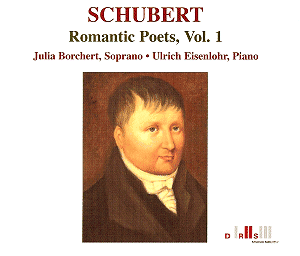

 Julia Borchert
(soprano), Ulrich Eisenlohr (piano)
Julia Borchert
(soprano), Ulrich Eisenlohr (piano)