Of
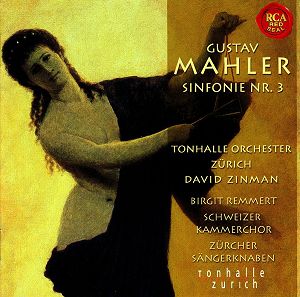
the major Mahler cycles now under way David Zinman's is just
beginning, Roger Norrington’s (Hänssler) is further along and
Pierre Boulez (DG) and Michael Tilson Thomas (Avie) are nearly
done. That means it's much too early to assess Zinman's success
in this repertoire, although his readings of the Mahler 1 (including
the 'Blumine' movement) and the 'Resurrection' are very good
indeed. I would go so far as to say that his Mahler
2 is one of the finest around. Not surprisingly I had high
hopes for No. 3.
What of the competition in this symphony?
Claudio Abbado has recorded this work twice for DG and in many
ways his readings are a class apart. His earlier Wiener Philharmoniker
account - available as part of his complete survey on DG 447023-2
- is simply glorious. The Viennese really do have this music
in their blood but Abbado’s live 1999 recording from the Royal
Festival Hall, this time with the Berliners, is just as special
(DG 471502-2). The latter also has the advantage of a lovely
soloist, Anna Larsson, who makes the most of the Nietzsche setting.
And then there is Jascha Horenstein's pioneering account with
the LSO, more rough-hewn than we’ve grown used to, but unmissable
nonetheless (Unicorn Souvenir Records UKCD 2006-7).
So,
how does Zinman fare in such august company? He has the advantage
of a Super Audio recording, which forensically uncovers the
many details of Mahler's score. It's akin to cleaning up an
Old Master, revealing the brush strokes beneath the grime. But
that doesn't amount to much if the reading itself isn't up to
scratch.
I
remarked on Zinman's ‘too-leisurely Ländler' in the 'Resurrection'
and I have to say the first movement of his Mahler 3 is similarly
afflicted. Whereas Abbado and Horenstein discover the tempo
giusto Zinman' seems curiously leaden, at times even flaccid.
Abbado especially finds an inner tension that sustains the movement’s
ungainly length and propels the music forward. Zinman also misses
the all-important element of parody – banality even. This is
a shame as the playing, while not particularly weighty, is very
polished indeed.
Listening to this
movement I was forcefully reminded of the American critic who
once likened Mahler's symphonies to top-heavy galleons that
capsize soon after leaving port. Zinman, grizzled old salt that
he is, doesn't do that but, goodness, he does come perilously
close.
The gentle pizzicato
opening of the second movement (Tempo di menuetto – Sehr mässig)
is beautifully done. Thankfully Zinman seems to have found a
favourable wind and the symphony is back on course. The luminous
string playing is most beguiling, the phrasing elegant without
being self-consciously moulded. There is a Wunderhorn-like innocence
in this music that really seems to play to Zinman’s strengths.
The opening of the scherzo is also delectably
phrased. Mahler cautions against haste here and Zinman obliges
with a timing of just over 17 minutes to Abbado’s 16:57 (Vienna)
and Horenstein’s even more leisurely 18:14. The posthorn soloist
Heinz Saurer plays with great poise; what’s more he’s ideally
placed in the soundstage. And even though the ‘Red Book’ CD
layer is detailed and atmospheric the extra spatial information
that SACD seems to convey here is even more impressive. The
pliant orchestral responses are also well judged, the soft thuds
of the bass drum thrillingly caught. Only in the wilder moments
at the close did I miss the bite, the vehemence, that Abbado
finds here, but then it seems Zinman is less attuned than some
to the symphony’s changes of mood.
Birgit Remmert is
suitably limpid in ‘O Mensch!’ although her intrusive vibrato
is a distraction. Zinman and his band manage the ‘misterioso’
element of this movement reasonably well, with some lovely ppp
playing from the orchestra. My only quibble is that Zinman allows
his vessel to slip into the doldrums, and the music - which
can so easily falter - loses that all-important momentum. And
it has to be said that Anna Larsson distils something much more
profound from this heartfelt song.
Lively as they are in the fourth movement
the Zürcher Sängerknaben don’t sound quite as ‘lustig’ as their
Viennese counterparts (Abbado) or the Wandsworth Boys (Horenstein),
although they do sing with commendable precision. Once again
I’m inclined to think that for all his steadiness at the helm
Zinman doesn’t always respond the changing currents that steer
this work.
The long final movement
really is the test of a conductor’s navigational skills and
is where many are apt to founder. It is music of great inwardness
and transparency. It is also a long span - more than 20 minutes
- that builds unerringly towards that glorious finale. The Zürich
band certainly play with hushed concentration, but once again
the music, glowingly presented, is in danger of being becalmed.
Perhaps it is unfair to compare them with the Viennese, whose
combination of instrumental blend and orchestral weight is hard
to beat. Even at the climaxes Zinman seems to hold back, so
there is little of the cumulative tension and thrust that Abbado
and Horenstein bring to bear. Not only that but other conductors
sense that landfall is imminent and imbue the last eight minutes
or so with an inexorable momentum. Abbado does it magnificently
(especially in his Vienna account). To be fair Zinman does achieve
a certain majesty in the closing bars – the timps are superb
– but where is the necessary heft? Or the radiance, the joy?
Admittedly the Mahlerian
voyage has only just begun for Zinman and the band he has led
since 1995. Their readings of the composer’s first two symphonies
promised so much that perhaps No. 3 was always destined to be
a disappointment. There are many fine readings of this symphony
– including Michael Gielen’s for Hänssler – so Zinman is up against
some very stiff competition. But he can still surprise us – witness
his Beethoven cycle for Arte Nova – so it would be premature
to write off his Mahler just yet.
Dan Morgan

























 Birgit Remmert
(contralto)
Birgit Remmert
(contralto)  [34:51 + 54:58]