MusicWeb is not a subscription site and it is these advertisers that pay for it. Please visit their sites regularly to see if anything might interest you. Purchasing from them keeps MusicWeb free.

Classical Editor: Rob Barnett                               Founder Len Mullenger


CD REVIEW
Online Count. There are currently : visitors. What this means.
Site Map

More Reviews

How to find a review

Classical CD Review Archive

Book Reviews

Film Music Reviews

Jazz CD Reviews

Nostalgia

Comment

Norman Lebrecht Weekly

Arthur Butterworth Writes

Phil Scowcroft's Garlands

Classical blogs

Reviewers Logs

Announcements

Don't Go Here!

Community

Bulletin Board

Web Ring

Reviewers

Helpers invited!

Resources

Quiz

British Composers

British Light Music Composers

Other composers

Indexes
   Label
   Masterwork

Discographies

On-line Music
[Download sites]

Themed Review pages

Our Classic Classics

Online books
MWI Classical
     Encyclopaedia

Gilder Dictionary of
     Composers

MWI Pop
     Encyclopedia

Other Complete Books

Programme Notes


British Music Society
Performers
The BBC Proms
Musical WWW pages
Classical Music Online

Recording Companies and Retailers
Agents and Marketing
Publishers
Non-Classical Web pages
Orchestra Web Sites
Newsgroups
Web News sites etc


Editorial Board
Classical Editor
   
Rob Barnett
Seen & Heard
Editor and Webmaster
   Bill Kenny
MusicWeb Webmaster
   Len Mullenger
Assistant Webmasters
   Patrick Waller
   David Barker

PotPourri
A pot-pourri of articles

MW Listening Room
MW Office
Helping MusicWeb
Advice to Windows Vista users  
Questionnaire    
Site History  
What they say about us
What we say about us!
Where to get help on the Internet
CD orders By Special Request
Graphics archive
Currency Converter
Dictionary
Magazines
Newsfeed  
Web Ring
Translation Service

Rules for potential reviewers :-)
Do Not Go Here!
April Fools

Would you like a hyperlinked weekly summary of the CDs we have reviewed?
Click for further details

Sample: See what you will get


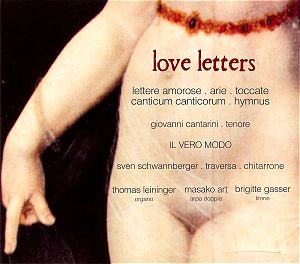
Love Letters
Girolamo FRESCOBALDI (1583-1643) Oscure Selve [2.12]
Giovanni Girolamo KAPSPERGER (1575-1661) Toccata V [1.43]
Claudio MONTEVERDI (1567-1643) Lettera Amorosa: se i languidi miei sguardi [7.24]
Jacopo PERI (1561-1633) Hor che gli augelli [1.31]
Bartolome BARBARINO (1568-1617) Audi dulcis amica mea [4.25]
Bellerofonte CASTALDI (1580-1649) Amorevole corrente [0.46]
Sigismondo D'INDIA (1582- 1629) Lettera Amorosa: Torna, du que, deh torna [7.09]
Claudio MONTEVERDI (1567-1643) Fenice son io [1.26]; Ego flos campi [3.38]
Alessandro PICCININI (1566-1638) Toccata XIII [2.18]
Girolamo FRESCOBALDI (1583-1643) Lettera Amorosa: Vanne, o carta amorosa [2.45]
Stefano LANDI (1587-1639) Augellin [2.15]
Claudio MONTEVERDI (1567-1643) Nigra Sum [3.17]
Giovanni Girolamo KAPSPERGER (1575-1661) Preludio [0.30]
Claudio MONTEVERDI (1567-1643) Lettera Amorosa: Se pur destina [9.04]
Sigismondo D'INDIA (1582- 1629) Torn ail sereno zefiro, e gli augellini garruli [2.19]
Bartolome BARBARINO (1568-1617) Osculetur me [3.55]
Giovanni Girolamo KAPSPERGER (1575-1661) Toccata I [0.54]
Giacomo CARISSIMI (1605-1674) Lettera Amorosa: Scrivete occhi dolente [7.23]
Giovanni Girolamo KAPSPERGER (1575-1661) Augellin [3.02]; Nigra Sum [3.29]
Anon/Codex Chigi Hymnus: Ave Maris Stella [4.08]
Tarquino MERULA (1595-1665) Quando gli uccelli porteranno zoccoli [4.58]
Giovanni Cantarini (tenor)
Sven Schwanngerger (chitarrones, chitarra spagnuola, traversa)
Thomas Leininger (Organo)
Masako Art (Arpa Doppia)
Brigitte Gasser (Lirone)
Il Vero Modo/Giovanni Cantarini
rec. February 2006, Christkatholische kirche, Trimbach, Switzerland. DDD
THOROFON CTH 2538 [80.54]


This new recital, Love Letters, from Giovanni Cantarini and Il Vero Modo requires some explanation. If you glance at the CD contents page the various lettere amorose, toccatas and villanelles are labelled antiphon, psalm, concerto in loco repetitur and so on.

The performers have taken a secular programme of music by Monteverdi and others and structured it like the vespers service. The centre-pieces are five lettre amorose, which are performed in lieu of five psalms. These are each preceded by a toccata, instead of an antiphon, and followed by a villanelle - about birds as messengers of love or companions of lovers - as doxologies. Instead of the repeat of the antiphons, there are concertos based on five motets setting words from ‘The Song of Solomon’.

This sounds arcane and not a little artificial, but it works remarkably well. The recital is given a strong structure and the five lettre amorose are framed beautifully by some rather apt music.

As regards performance style, the group seem to have gone back to first principles. With the increasing generalisation of performers, there are fewer who can be described as early music specialists. Whilst this is, generally, a good thing and horizons are broadened, Il Vero Modo comment on the increasing departure of performers from the performing style as prescribed in contemporary treatises. I can think of a number of recent discs on which singers with a predominantly 19th century technique have made interesting and remarkable forays into period performance. In some instances, such as discs by Ian Bostridge and Rolando Villazon, the results have been illuminating and reflect the singers’ intelligence. But once in a while, you feel the need to return to first principles, and this is what Il Vero Modo aim to do.

Tenor Giovanni Cantarini has a voice with a good sense of line. His timbre has a nice degree of edge to it, which is just what I like in this music. He reminds me at times of Nigel Rogers, which is no bad thing at all. His vocal delivery is a world away from the vibrato-laden 19th century tenor. His delivery is very word-driven, which of course is just what these pieces need. His passion comes from articulation of the words and inflection of the music. He certainly does not sing with that white-toned perfection which I associated with the English school in this music, but he rarely overdoes things. Just occasionally his delivery is a little compromised by some strain at the top and in some of the more virtuoso passages his delivery can be smudged. But these are small faults compared to my generally favourable impression of his delivery.

Cantarini sings the five lettere amorose and the five villanelle. In these he his accompanied by a continuo provided by two chitarroni. These also play the toccatas. For the concertos the group take motets and play them instrumentally, a very common practice. More unusually, the vocal line is taken by a renaissance transverse flute played in a high 4' register. Though not common in this repertoire, this type of playing was a speciality of cornetto players. In fact, the results sound remarkably cornetto-like at times.

There were moments in the concerto, when I did wonder about slight vagaries in the flute's tuning. Generally I found these pieces played in an apposite and moving manner, so I am happy to not worry about these slight tuning irregularities. Additionally, of course, it might simply be that my ears are not accustomed to the tuning used for the performance. The instrumental performers match the singer perfectly and combine in their own pieces to give a real feel of chamber music-making.

Cantarini's performances of the lettere amorose by Monteverdi, Sigismondo d'India, Frescobaldi and Carissimi lie at the heart of this recital. These are pieces which suit the performer’s understated and focused but passionate delivery style. It helps, of course, that Cantarini is singing in his native language.

The booklet includes a helpful article by Sven Schwannberger, detailing what is being performed, why and how. There are texts in Italian/Latin, German and English for all the vocal pieces and for the motets which are given in instrumental transcriptions.

I enjoyed this recital immensely. The combination of scholarship and imagination, have given us a recital which has re-imagined this repertoire without transgressing the contemporary rules of performance; quite a feat.

Robert Hugill



Advertising Rates
Visitor stats
MusicWeb International
has over 21,000 Classical CD reviews on offer


Gerard Hoffnung Concerts &
The Bricklayer Story

Naxos Classical 

Australian Eloquence CDs on Buywell.com


New Releases

Hyperion
New Releases


Guild Music


23rd-27th May


MusicWeb sells the Polish
catalogue CDAccord
£10.50 post free W-W


MusicWeb sells the
Arcodiva catalogue
£12.00 post free W-W


Price Reduction: £11.75
post-free


Bull Horn
Price comparison Website


MusicWeb can now offer you discs from the following catalogues:
Prices include postage

[Acte Préalable £13.50]
[Arcodiva £12.00]
[Ashgate Music Books]
[Avie from £6.25]
[British Music Society £13.49]
[CDACCORD from £10.50 ]
[Hortus £14.99 ]
[Lyrita ONLY £11.75 ]
[Onyx £12.00
]
[REDCLIFFE £11 ]
[Tactus £11.50 ]
[Talent from £12.00 ]
[Toccata Classics £12.50 ]

MusicWeb Recommended Recordings 2007

DISCS OF THE YEAR 2007


Return to Review Index


Reviews from previous months
Join the mailing list and receive a hyperlinked weekly update on the discs reviewed. details
We welcome feedback on our reviews. Please use the Bulletin Board.  Please paste in the first line of your comments the URL of the review to which you refer..


You can purchase CDs and Save around 22% with these retailers: