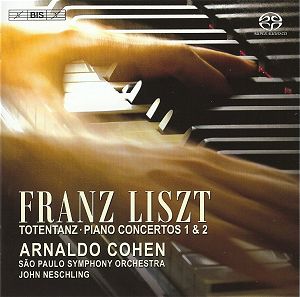
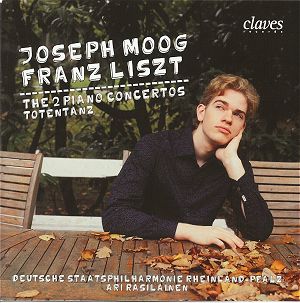
Two Liszt discs comprising identical
programmes. The first, on the BIS was
recorded by established Lisztian soloist
Arnaldo Cohen. The second, from Claves
was recorded by young pianist Joseph
Moog who is making his recording début.
These three scores, warhorses of the
piano and orchestra repertoire, have
proved to be popular choices in the
recording studio and are generously
represented in the record catalogues.
With the two piano concertos and the
Totentanz I have used for comparison
purposes the 1987 Boston versions from
Krystian Zimerman and the Boston Symphony
Orchestra under Seiji Ozawa on Deutsche
Grammophon, regarded by many as the
finest available versions.
Liszt’s most important
works for piano and orchestra are the
two officially known E flat Major
and A major piano concertosAC
and the Totentanz; all conceived
during his virtuoso years. Influential
music writer Edward DannreutherE
expressed the view that these works
"… would rank among the best
concert pieces, were it not for the
lack of weight and beauty in their main
themes. As virtuoso pianoforte
music these efforts are magnificent,
the orchestration superb …"
Liszt made his first
sketches for his E flat major
Concerto in 1830, undertaking
serious work in Rome around 1839-40.
He seems to have completed it around
1849, making revisions in 1853 and more
adjustments in 1856. It was dedicated
to the piano virtuoso and composer Henry
Litolff. It would be hard to imagine
more eminent performers at its 1855
première at the Ducal Palace
in Weimar, Germany than the composer
as soloist and Hector Berlioz as conductor.
Musicologist Jay RosenblattD
described the concerto as, "Dionysian".
Liszt biographer Humphrey SearleB
wrote that it "is not an entirely
successful work" believing
the Concerto No.2 in A major to
be, "very much more successful".
However, this Concerto No.1 proved
to be a more popular work in the recording
studio.
In this work Liszt
provides unity within the sections of
the score by employing several shared
themes in ‘thematic transformation’.
The inclusion of the triangle in the
third section has been the cause of
some ridicule by detractors over the
years and influential Viennese critic
Eduard Hanslick dubbed the score "The
Triangle Concerto" a
nickname now used with affection rather
than sarcasm.
In the opening movement
Allegro maestoso Cohen’s playing
does not sparkle and comes across as
coolly efficient yet with an agitated
character. The accompaniment from the
São Paulo Symphony Orchestra
under John Neschling feels a touch leaden.
Moog in the opening movement provides
robustly spirited and confident playing,
communicating significant style and
character. By comparison Zimerman radiates
assurance and panache with underlying
strength. His fingers sensitively float
across the keys and the playing sparkles.
In the Quasi adagio
one is struck by Cohen’s feather-like
playing combined with splendid orchestral
playing. Moog’s performance is harder-edged,
firm and expressive with a feeling that
each note is crystal clear. The accompaniment
from the Deutsche Staatsphilharmonie
under Ari Rasilainen is outstanding.
One immediately notices Zimerman’s tender
and expressive playing, so achingly
beautiful that it makes the piano glow
with colour. His impressive interpretation
in the contrasting central episode comes
across cleverly like an aggressive tantrum.
Ozawa’s Boston Symphony Orchestra provides
Zimerman with superb support.
In the third movement
Allegretto vivace Cohen is rather
unconvincing, displaying at times jerky
and weighty playing compared to Moog
who conveys a firm, crisp and assertive
performance. Zimerman is in tremendous
form with an assured touch, vigour and
considerable style.
In the fourth movement
Allegretto marziale animato,
with Cohen one is left wanting more
urgency, although he executes the Presto,
finale splendidly. The young
Moog brings authority with an especially
impressive lightness of touch between
1:00-1:21. I particularly enjoyed Moog’s
splendid and exciting interpretation
of the finale. There’s playing
of grandeur from Zimerman and one especially
notices a feather-light touch that just
glides over the keys. This movement
is remarkable and Zimerman brings the
score home to an impressive climax.
Liszt began composing
his A major Concerto in
1839 in Rome, revising the score on
at least two occasions in 1849 and in
1861. The first performance was given
with Liszt conducting his pupil Hans
Bronsart (von Schellendorff) as soloist
at Weimar in 1857. To highlight the
symphonic nature of the score it was
named in the manuscript as a "concerto
symphonique". The A major
Concerto is designed in one single
continuous movement, divided into six
sections, connected by the use of ‘thematic
transformation’. Jay RosenblattD
described the character of the A
major Concerto as "Apollonian".
Humphrey SearleB described
the score as, "remarkable"
and that "the themes are far
more interesting and capable of development"
than its predecessor. Searle thought
the transition into a march in the Finale
was, "the one really weak
passage [with] all the vulgarity
of second-rate military band music".
In the Adagio sostenuto
assai - Allegro agitato assai
Cohen is confident and expressive
with Moog offering a dreamy opening
that he develops with purpose and energy.
Zimerman gives a masterly performance
with equally splendid orchestral accompaniment
from the Bostonians. One is aware of
a real gracefulness in the calmer passages
that contrasts with playing of power
and control in the dramatic and stormy
music.
In the Allegro moderato
Cohen provides calm and relaxed playing,
fluid and controlled. The solo cello
part is divinely performed. Moog’s interpretation
is decisive and tender with a lovely
cello solo. Zimerman offers beautiful
playing combined with a powerful authority.
He is supported by splendid orchestral
accompaniment with an especially marvellously
played cello part.
In the Allegro deciso
Cohen is robust and stately. He
is exciting in the Marziale un poco
meno allegro and calm and relaxed
yet the music is delivered with purpose
in the Un poco meno mosso. The
impressive Moog provides a reading that
is robust, muscular and dramatic. The
changes of mood from Moog are most convincingly
executed. It is hard to fault
Zimerman who plays with a highly convincing
authority throughout.
In the Allegro animato
section that closes the score Cohen
is nimble and brisk with a finale
to bring the house down. Moog provides
vivacious playing that he skilfully
develops into a spirited and highly
dramatic conclusion. Zimerman’s reading
of the concluding section is high voltage
with a great sense of passion.
The Totentanz
(Dance of death or
Danse macabre) was aptly described
by Humphrey SearleB as, "a
work of astonishing dramatic power."
Evidently in 1838 Liszt was inspired
by the magnificent frescoes titled ‘The
Triumph of Death’ on the wall of
the basilica in the Campo Santo at Pisa.
In Liszt’s time the frescoes were attributed
to Andrea Orcagna. Further inspiration
came from a reminiscence of the Dance
of Death at Basle by Holbein. As
a result Liszt felt compelled to compose
a score for piano and orchestra comprising
a series of variations that embodied
the ‘Dies Irae’ plainchant. Totentanz
was first sketched out around 1839
and completed by 1849, undergoing subsequent
revision. It seems that Liszt’s son-in-law,
the pianist and conductor Hans von Bülow,
was soloist at the première given
at The Hague in 1865.
In the Totentanz
one is struck by the immediate sense
of drama and foreboding that Cohen manages
to communicate. In Variation IV Cohen
provides a hymnal and reverential meditation.
From 3:05 (track 5) a hunting tension
just bursts onto the scene that continues
into Variation V. Here from 0:39 (track
6) an extra injection of energy from
Cohen ratchets up the level to one of
thrilling drama. In Variation VI from
0:27 (track 8) the assured Cohen provides
light and fluid playing. From 0:50-1:27
(track 8) Cohen is brisk and hectic
in the zigeuner episode which serves
to lighten the mood. In the Allegro
animato Cohen and his Brazilian
orchestra provide a heroic and splendidly
satisfying conclusion.
In the opening section
to the Totentanz Moog’s playing
has a sharp and almost violent edge,
communicating a macabre quality. In
Variation IV one is aware of the deep
sacred nature of the music and in Variation
V Moog ensures that the drama swirls
around with a great sense of adventure.
From 12:09 (tr. 9) Moog’s brisk playing
does not attain the gypsy character
as much as Cohen. The Allegro animato
conclusion generally feels muscle-bound
with rather choppy and weighty orchestral
accompaniment.
Zimerman projects a
more thrilling and confident reading
than both Cohen and Moog … and, it must
be said, virtually all other interpreters.
One notices Zimerman’s marked and
highly effective use of dynamics throughout.
In Variation IV the hymn-like episode
from 4:03 (track 8) is deeply meditative.
From 6:57 in Variation V and the following
cadenza both Zimerman and the
orchestra provide superb playing, packed
with drama and excitement. From 12:01
in Variation VI the gypsy episode is
highly enjoyable and from 12:37 Zimerman
noticeably and expertly increases the
intensity prior to the second cadenza.
The demonic conclusion to the Totentanz
is thrilling and dramatically performed.
I felt like jumping to my feet and shouting
bravo!
With regard to alternative
recordings of the two concertos and
Totentanz, probably the most
celebrated accounts and those most likely
to be encountered are the exhilarating
and confident performances from Krystian
Zimerman and the Boston Symphony Orchestra
under Seiji Ozawa. Zimerman recorded
the scores at the Symphony Hall, Boston
in 1987 with a warm and clear digital
sound on Deutsche Grammophon 423 571-2.
For versions of each individual score
and specifically with this coupling
I would not look elsewhere than this
marvellously gratifying recording on
Deutsche Grammophon; it provides an
astonishing degree of excitement and
satisfaction.
There are many advocates
for the excellently performed accounts
of the two concertos from Sviatoslav
Richter and the LSO under Kirill Kondrashin
on Philips Classics Solo 446 200-2 c/w
the Liszt Piano Sonata. The
concertos were recorded by Richter in
London in 1961 for Philips by the Mercury
Living Presence team. The recordings
have been remastered from the original
three-track master tapes by the original
Mercury producer, the legendary Wilma
Cozart Fine. Not surprisingly when compared
to many of the modern digital recordings
the Richter analogue sonics, although
acceptable, are not to the same standard
as many of the more recent digital recordings.
Sharing the same programme
as the review discs are the performances
from Jean-Yves Thibaudet with the Orchestre-Symphonique
de Montréal under Charles Dutoit
in Montreal in 1990 on Australian Decca
Eloquence 442 8833. Sadly, despite some
stylish and thoughtful playing Thibaudet
cannot match the sheer scale of the
dramatic contrasts provided by Zimerman.
Worthy of much consideration
is a highly attractive four disc set
of Liszt ‘Works for Piano and Orchestra’
containing fine versions of the concertos
and Totentanz performed Nelson
Freire with the Dresdner Philharmonie
under Michel Plasson. Freire provides
character and presence in performances
recorded in the Lukaskirche, Dresden
in 1994 and originally released on the
Berlin Classics label. I found the sonics
of these digitally recorded accounts
acceptable but not exceptional. The
concertante works on this valuable set
are performed by various soloists, orchestras
and conductors on Brilliant Classics
99936 c/w Wanderer Fantasie,
S.366; Fantasia on Hungarian Folk
Tunes, S.123; Polonaise
Brillante, S.367; Lelio Fantasy,
S.120; Ruinen von Athen, S.389;
Malédiction, S121; De
profundis, S.691 and Piano Concerto
No. 3 in E flat major, Op. posth.
(reconstructed by J. Rosenblatt).
A highly desirable
recording of the First Concerto is the
recently released 2006 Watford Colosseum
recording from young Chinese soloist
Yundi Li and the Philharmonia Orchestra
under Andrew Davis. Yundi Li does a
magnificent job with Liszt’s contrasting
demands, displaying assured and exciting
playing that blends drama with considerable
poetry. It’s on Deutsche Grammophon
477 640-2 c/w Chopin Piano Concerto
No.1. There are many supporters for
the exciting and resolute 1968 Walthamstow
Town Hall, London analogue account of
the First Concerto from Martha Argerich
with the London Symphony Orchestra under
Claudio Abbado. I have the Argerich
version as part of a two disc Franz
Liszt compilation set on Deutsche Grammophon
‘Panorama’ 469 151-2.
I still have fond memories
of my 1982 vinyl recording of the Piano
Concerto No.1 in the sparkling and stylish
performance from French soloist Cécile
Ousset with the CBSO under Simon Rattle
on EMI ASD 4307 c/w Saint-Saëns
Piano Concerto No.2. I understand that
this Ousset recording, with the same
coupling, has been released on compact
disc on EMI CDC 7 47221 2 but as yet
I have not tracked down a copy for my
collection.
Returning to the two
discs under consideration: These are
well played versions but the competition
is extremely fierce and it is hard to
look elsewhere than the distinguished
Zimerman performances on DG. I am aware
that the Cohen recording has received
considerable acclaim in some quarters
but despite a fine legato and
without any fear of technical strain
I was often left wanting more spontaneity
and additional dynamic emphasis. The
SACD from Cohen on BIS, played on my
standard players, was warm, well-balanced
and reasonably clear. The BIS booklet
notes contain an interesting and informative
essay from Jean-Pascal Vachon. The promising
Moog is a powerful and fiery player
whose emphasis on broad dynamic contrasts
seem to permeate his interpretations.
His musical lines are frequently boldly
projected yet one senses that over time
a growth in confidence and sensitivity
will overshadow a certain tendency towards
the impulsive. Moog on Claves is reasonably
closely recorded with the sound a touch
bright in the forte passages.
I did not find the Claves booklet notes
especially helpful or interesting.
Michael Cookson
Notes:
A There is also a Piano Concerto
No. 3 in E flat major, op. posth. Evidently
it was composed around 1839, but it
seems not to have been performed and
subsequently ignored. In 1988 Musicologist
Dr. Jay Rosenblatt of the University
of Arizona discovered various fragments
of the score during research and made
a reconstruction. Also see noteD
B ‘The
Music of Liszt’ by Humphrey Searle,
Dover Publications, second revised edition
(1966)
C On-line
article: New York Times, Archives
Thursday, 16 August 2007, ‘Rediscovered
Liszt Work in Premiere’ by Allan Kozzin
D Jay Rosenblatt,
Article on ‘Piano and Orchestra’
in the ‘The Liszt Companion’,
Greenwood Press ed. Ben Arnold. ISBN:
0313306893
E Oxford
History of Music, Vol. VI, ‘The Romantic
Period’ by Edward Dannreuther, Clarendon
Press, Oxford (1905)

























 for details
 Arnaldo Cohen (piano)