Editorial Board
MusicWeb International
Founding Editor Rob Barnett Editor in Chief
John Quinn Contributing Editor Ralph Moore Webmaster
David Barker Postmaster
Jonathan Woolf MusicWeb Founder Len Mullenger
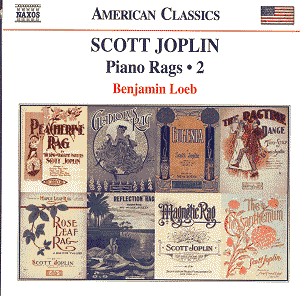
Scott JOPLIN (1868-1917) Piano Rags Vol. 2 Rag-Time Dance, A Stop-Time Two Step (1899)[3:05] A Breeze from Alabama, March and Two Step (1902)[4:19]
The Chrysanthemum, An Afro-American Intermezzo (1904) [4:42] Peacherine Rag (1902)[3:47] The Cascades, A Rag (1904)[3:14] Weeping Willow, A Rag-Time Two Step (1903)[4:22]
Gladiolus Rag (1907) [4:26] Eugenia (1905)[4:40] The Crush Collision March (1896)[4:52] Reflection Rag, Syncopated Musings (1917)[4:51] Magnetic Rag (1914)[5:21] Swipesy – Cake Walk (1900)[3:22]
Scott Joplin's New Rag (1912) [4:03] Rose Leaf Rag, A Rag-Time Two Step (1907)[4:04] The Rosebud March (1905)[2:49] Stoptime Rag (1910)[2:51] Benjamin
Loeb (piano)
rec. 5-8 August 2005, Performing Arts Centre, The Country
Day School, Ontario, Canada. DDD NAXOS AMERICAN
CLASSICS 8.559277 [64:48]
It’s
not often that Hollywood can take the credit for rediscovering
music but George Roy Hill’s 1973 film The Sting certainly
brought the works of Scott Joplin to a wider audience. But
there is so much more to Joplin than the ubiquitous Entertainer – he
wrote three operas, a ballet and two orchestral works – and
one can only hope that Naxos will explore his works in their
entirety as part of their enterprising American Classics
series (see reviews of Volume 1 of his piano rags). A new
recording of Treemonisha would
be especially welcome.
Joplin
referred to the syncopations that characterise ragtime as ‘weird
and intoxicating’ and in the right hands this music is heady
indeed. Perhaps one of the best exponents of Joplin’s oeuvre
is Joshua Rifkin, whose disc The Entertainer (Nonesuch
7669 79449 2) has been a long-time favourite. Texas-born
pianist Benjamin Loeb – associate conductor of the El Paso
Symphony Orchestra, teacher, accompanist and soloist – may
be unfamiliar to most listeners but his foray into ‘ragged
time’ ought to change that.
The
earliest item on this recording is the Crush Collision
March of 1896, a graphic, silent-film-style depiction
of a train crash replete with whistle effects and colliding
chords. It is a fun piece but it’s hardly vintage Joplin.
The composer also went on to depict the waterfall in the
Cascade Gardens at the 1904 World Fair in St. Louis.
The
score of the energetic Rag-Time Dance (1899) instructs
the pianist to stamp as directed, filling in the silent beats.
The pianist is also urged not to ‘raise the toe from the
floor while stamping’. Loeb catches the slightly frenetic
mood of this two-step with nicely articulated syncopations
in the right hand and suitably rhythmic thumps when required.
Swipesy – Cake Walk is a collaborative effort with Arthur Marshall
(1881-1968). It has a certain elegance and Loeb makes the
most of its rather repetitive material.. No such reservations
about the Peacherine Rag of 1901, with its ear-catching
accompaniment in the left hand. Thankfully the Naxos recording
is clear and not too closely miked, which means no brittleness
in the treble and a pleasing weight in the bass. The Nonesuch
sound is warmer and weightier, though less analytical.
A
Breeze from Alabama dates from
the same year as The Entertainer (1902), with
which it has more than a passing resemblance. It was a
relatively happy and productive time in Joplin’s life and
there is a real fluency to this and The Weeping Willow of
1903, the latter of which adds a certain wistfulness to
its list of charms. Loeb seems to be alive to the subtle
changes of mood in music which, in lesser hands, is apt
to sound rather unvaried.
The
good times didn’t last. Joplin’s marriage failed in 1904
and his second wife died of pneumonia just 10 weeks after
the ceremony. In spite of these personal tragedies he carried
on writing. The Cascades and The Chrysanthemum date
from this period. Neither shows much sign of inner sadness,
though the latter seems a little more introspective than
usual. Fortunately, elegance and invention aren’t in short
supply and Loeb finds a lovely spring to the melody of The
Chrysanthemum (1:02 onwards).
Eugenia and The Rosebud March (both 1905) are very different. Eugenia,
which Loeb launches with disarming ease, has several scale-like
passages before returning to its original melody. The start
of The Rosebud March is just as mellifluous, quickly
turning into one of the most infectious pieces on this disc.
Loeb really finds the sparkle and humour in its catchy melodies.
An absolute tonic.
The Rose
Leaf and Gladiolus rags date from Joplin’s move
to New York in 1907. The latter, buoyant as always, seems
a little more subdued than usual, but Rose Leaf is
altogether more sprightly, with brighter melodies in the
right hand and lighter accompaniment in the left. Technically
it is more complex, florid even, and shows Joplin very
much in control of his material. Once again Loeb has the
measure of its rhythms and has no difficulties with the
more virtuoso writing.
Stoptime
Rag (1910) is equally spirited, with its right-hand
pyrotechnics and foot-stompin’ accompaniment, but Joplin’s
problems with his opera Treemonisha and his deteriorating mental
health blighted his last years. One would hardly know it
from the New Rag of 1912, although it does have
a hint of melancholy in its little repeated melody in the
left hand. No such ambiguity with the Magnetic Rag of
1914, which Loeb treats as the darker-hued piece that it
undoubtedly is. All the usual Joplin trademarks are there
but the repeated phrases seem even more haunting than before.
Astonishingly, Rifkin races through the New Rag in
just over three minutes to Loeb’s four. He simply ignores
Joplin’s dictum that ragtime must never be played too fast
and pays the price in terms of detail and general articulation.
A rare lapse in what is otherwise a sophisticated and satisfying
collection.
Reflections (1917) is indeed a summing up, a taking stock. Treemonisha had
been a disaster and Joplin was soon to succumb to the ravages
of syphilis, but despite this the music has a lucidity and
grace – not to mention some brilliant touches, especially
the Gottschalk-style banjo figures – that Loeb captures to
perfection.
All
in all a winning compilation, sympathetically played by Benjamin
Loeb. The Naxos engineers have done a pretty good job too,
and the booklet notes are both informative and interesting.
Compared with the Rifkin disc, which contains many of the
items here, Loeb’s readings come across as delightfully fresh
and spontaneous. In many ways his playing is even more revealing
and characterful than Rifkin’s, and that’s praise indeed.

























 Benjamin
Loeb (piano)
Benjamin
Loeb (piano)