The premature death
of Gustav Mahler in 1911 has retrospectively provoked a great
deal of discussion regarding the possible influence that he
would have had upon musical development in the early twentieth
century. Much of this hinges upon the enigmatic, uncompleted
Tenth Symphony which appears, emotionally at least, to
have marked a radical departure from the world-weary, desperate
Ninth Symphony. Then there was his championing of the
early works of Schoenberg. The younger composer is, of course,
now regarded as one of the key figures in the history of twentieth
century music; to what extent he would have gained this status
were it not for Mahler’s advocacy is debatable, but it is certainly
tantalising to think that the entire course of musical development
could have been very different had Mahler not been around.
I mention this only
because, had he have lived longer, Mahler may well have given
the (then) largely unknown Charles Ives the same kind of exposure.
It is well known that Ives was a successful businessman who
simply composed in his free time, and that by the turn of the
twentieth century he had already dabbled with the ‘innovations’
that a decade or two later would become the calling cards of
composers such as Schoenberg and Stravinsky. In what is, quite
possibly, one of the most important defining factors in the
development of music in the last century - in the sense that
it had absolutely no discernable effect - Mahler, shortly before
leaving New York, picked up a manuscript copy of Ives’ Third
Symphony, fully intending to perform it in Europe. Alas
fate dealt its third hammer-blow and Ives had to wait a further
five decades for his premiere. But imagine what may have happened
had Mahler championed this work; an immediate interest in Ives’
works? World-wide exposure to new ‘avant-garde’ techniques?
All before Stravinsky even considered composing The Rite
of Spring. Indeed, that notorious premiere may have been
slightly less rowdy had the audience already spent a couple
of years digesting Ives’ more adventurous output.
So, you see, the
premature death of Gustav Mahler in 1911 actually had a much
greater impact upon musical life in the twentieth century than
most people realise. These days Ives’ music is less shocking;
his overdue ‘boom’ in the 1960s has influenced so many composers
that there is a cosy sense of familiarity about his more outrageous
work. Personally, I find his Second Symphony one of his
most challenging works; it is possibly one of the most beautiful
and touching things ever written by an American composer, achingly
naïve in its attempt to depict small-town life yet aware that
his rose-tinted view of an apparently innocent age was rapidly
becoming a thing of the past. But the juxtaposition of quotations
from central European classics (Brahms, Wagner, Dvorak, Beethoven,
Bach) and quintessentially American folk-tunes in such a conservative,
tonal context does prove, for this listener at least, something
of a stumbling block.
In my view, the
Third Symphony suffers not at all from similar problems.
It is the shortest, most intimate of his essays in the genre.
It is also, paradoxically, perhaps the most frequently recorded
- perhaps because of its modest orchestration - and most critically
overlooked. But given due consideration it emerges as Ives’
only bona fide symphonic masterpiece. Yes, it is still
influenced by the European classics; yes, there is a discernable
‘American’ness’ to it. Here, though, Ives is simply being himself.
It is one of the few American works (one of the others being
Barber’s Violin Concerto) that sums up the perhaps clichéd
image of a golden American evening, sitting on the porch with
a lemonade … If you’re thinking Harper Lee rather than Tennessee
Williams you’re probably along the right lines. A bit like the
American equivalent of sitting outside a country pub watching
the local cricket team and sipping a nice real Ale.
For those who may
have found the opening paragraphs of this review somewhat hard
to stomach - could Mahler really have been interested in Ives?
- it is perhaps important to realise just how similar they were
as composers. The net effect of their works may be entirely
different, but the elements, the ‘building blocks’ are remarkably
similar; namely, they both took elements from popular music,
folk music, and their own feverish imaginations to convey what
they believed to be human experience. ‘The Symphony must convey
everything; it must embrace the world’ Mahler may or may not
have said to Sibelius. With Mahler’s symphonies you get the
impression that he probably meant what he said but, at the end
of the day, there are limits. Ives takes this dictum to extremes,
in certain works seemingly attempting to embrace the entire
universe - well, in the Universe Symphony at least -
albeit only those elements that could be viewed from his Connecticut
backyard. And so alongside the references to the Europeans,
the sly quotations from American folk-music, there are frequent
examples of Ives recycling his own music. Much of the Third
Symphony is based upon the composer’s earlier organ works
… and before anyone starts laying charges of compositional laziness,
let us remember that Mahler managed to compose at least four
symphonies from a previous song cycle. That said, it is certainly
Ives’ most cogent symphonic work and receives a beautiful performance
here.
What I missed in
this performance can loosely be summed up by the word ‘Bernstein’.
I am not one to claim that Bernstein was a faultless conductor
of Ives. Both of his commercial recordings of the Second
Symphony must be rated as classics; the second, and my personal
favourite, forms part of an Ives anthology that must be the
ultimate Ives ‘starter pack’ on DG 429 229-2. But, aside from
the small matter of cutting quite sizable chunks from the final
movement and paying scant regard to Ives’ tempo indications,
Bernstein also developed his own way of interpreting the final
few notes - and I’m choosing my words here very carefully so
as not to spoil the surprise for the uninitiated - that rather
changes the effect that Ives probably had in mind. Bernstein’s
only - as far as I’m aware - recording of the Third Symphony
was made for CBS in 1965 and is available at mid-price coupled
with his first recording of the Second Symphony and an
illuminating, thirteen minute lecture about Ives (Sony SMK 60202).
Bernstein had at his disposal the New York Philharmonic. Michael
Stern’s Saarbrucken Radio Orchestra do an exemplary job, displaying
a high level of virtuosity and a really weighty sonority when
needed. But the sense of discovery in that NYPO recording is
lacking. Make no mistake, this is certainly a very fine performance;
it is just that Ives’ vision is so personal, so uniquely ‘American’
that very few can contend.
The couplings are
also very fine. The ‘Robert Browning Overture’ is a seminal
classic; it has been recorded dozens of times, mostly to very
high standards, and comes across particularly well here. Had
this work been performed in place of The Rite of Spring
at that famous 1913 concert, I fear that there would have been
few left alive to riot. For me, the Ragtime Dances are
the main attraction of this disc. They were, it must be admitted,
completely new to me. And what a surprise they were, mixing
jazz, bitonality and neoclassicism. But then you look at the
composition dates (1899-1904) and realise that Jazz hadn’t really
been invented, Ragtime was still in its infancy, neo-classicism
as a school of thought wouldn’t rear its head for a couple of
decades and bitonality was simply something that happened when
an orchestra couldn’t decide upon a unanimous tuning system.
It is simply astonishing to think that someone who languished
in obscurity until the 1950s was composing such music in the
nineteenth century. The nearest comparison that comes to mind
is George Antheil’s Jazz Symphony; Ives isn’t quite as
off-the-wall as Antheil, but he was operating a few decades
earlier. Nevertheless, the combination of spiky, rhythmic passages
with a sickly and somewhat parodical sentimentality pretty much
lays the foundations for Antheil’s seminal masterpiece. Although
he had probably never heard any Ives.
Collecting Ives
recordings is problematic; so often conductors and record labels
fixate upon the symphonies - which can be bought in pretty much
any combination now - and so general Ives compilations are scarce.
The aforementioned Bernstein/DG disc is without a doubt the
finest Ives record ever made. If you can find it then I’d thoroughly
recommend Morton Gould’s premiere recording of the First
Symphony (composed 1895-98, first performed 1946, first
recorded 1965!), coupled with various Ives works including the
ubiquitous ‘Robert Browning Overture’ (BMG Navigator 74321 292462).
Alongside those two records, I would thoroughly recommend the
present issue; sound quality is finely balanced and the annotation
more than adequate. Any of these three make for a perfect introduction
to Ives’ unique genius, representing as they do both his conservative
- in the case of the symphonies - and more radical styles.
Given the huge number
of short pieces by Ives, it does seem a shame that Col Legno only
give us an hour of music; surely there was space for those two
other seminal Ives classics ‘Central Park in the Dark’ and ‘The
Unanswered Question’? But then we’d be back in Bernstein territory
…
Owen E. Walton
























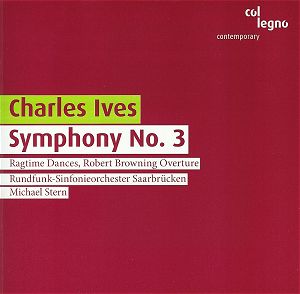

 Rundfunk-Sinfonieorchester
Saarbrücken/Michael Stern
Rundfunk-Sinfonieorchester
Saarbrücken/Michael Stern