Editorial Board
MusicWeb International
Founding Editor Rob Barnett Editor in Chief
John Quinn Contributing Editor Ralph Moore Webmaster
David Barker Postmaster
Jonathan Woolf MusicWeb Founder Len Mullenger
Francesco GEMINIANI (1687-1762) Violin Sonatas op. 5
Sonata, Op. 5 No. IV in D major [6:12]
Sonata, Op. 5 No. I in A major [9:04]
Sonata, Op. 5 No. III in C major [11:46]
Sonata, Op. 5 No. II in F sharp minor [9:14]
Sonata for violin solo in B flat major [8:42]
Sonata, Op. 5 No. V in B flat major [7:02]
Sonata, Op. 5 No. VI in D minor [7:54] Anton Steck
(violin); Christian Rieger (harpsichord); Markus Möllenbeck
(cello)
rec. 5-7 January, 2005, WDR Klaus-von-Bismarck-Saal Cologne,
Germany. DDD CPO 777
225-2 [59:59]
Britain
was the beneficiary of Geminiani’s exile from Italy: born
in Lucca, he was one of the several pupils of Corelli who
left Rome on the latter’s death in 1713. By 1714 Geminiani
was living in London - where it is certain he played alongside
Handel. There his expertise and familiarity with Italian
violin techniques and developments in string writing and
playing were passed on to English players, and to audiences
eager to enjoy such new, fashionable styles.
Geminiani’s
output was relatively small – especially if judged by that
of such contemporaries as Vivaldi, Telemann and Handel. Yet
he saw his role more as an arbiter of taste and a distiller
of compositions that shunned excessive virtuosity and extraneous
show. Not for Geminiani the wholesale ‘borrowing’ and repurposing
of Handel. He saw himself as writing in a more rarefied sphere
and developing a specific genre for connoisseurs and specialists.
Nor did the fact that Geminiani’s music never achieved the
following that Handel’s did worry him too much: he had a ‘second
career’ as an art dealer, mounter of exhibitions; he owned
his own concert hall in Dublin.
But
neither are these Opus 5 sonatas - nor, for that matter,
any other of Geminiani’s works - the work of a part-time
dilettante. They command concentration and a good degree
of understanding in order to be appreciated to the full.
By the latter stages of his career, the composer seems to
have known that his work was drifting away from popular taste;
he concentrated instead on his theoretical writings – and
on composing, as is the case with these later pieces, as
he wanted to.
In
fact these sonatas, Opus 5, were first published – in 1746,
in Paris and The Hague – for cello; although violin versions
appeared the same year. The London versions (for cello, then
violin) appeared a year later and it’s the latter that’s
used in this recording. They’re in the sonata da chiesa four
movement format: slow – fast – slow – fast and from the (very
short) first movement of the first track on this CD (Opus
5 Number IV), it’s plain that this is a banquet of meticulously
conceived and prepared delicacies, not a quick ‘take-away’.
The writing, for example, of the next movement – although
a fast one - in the same sonata is pensive, intricate and
written in such a way as to insist on active listening as
themes are developed and textures exchanged, especially between
solo violin and the three instruments together.
You’ll
also notice that the harpsichord has a more active role than
that of continuo - although it’s also that. Indeed, when
taken together with the huge variety of tempi - often within
one movement - the music may strike you as having a tinge
of romanticism when the rest of the musical world was heading
for Classical order. But these are employed by Geminiani
to ensure that there is always momentum, interest, contrast.
It’s music redolent of C.P.E. Bach in that respect – and,
frankly, every bit as inventive and satisfying.
Four
aspects of the playing of Steck, Rieger and Möllenbeck strike
you: first, a crystalline freshness and superb confidence.
Listen to the way the ensemble passages of the final, allegro,
movement of Number I in A major (tr.8) and the second, presto,
movement of Number II in F sharp minor (tr.14) dance, swirl,
unfold, return and yet stay completely within your ‘angle
of vision’… the flourishes are restrained yet full of life;
the balance and unison playing excellent and the attention
to nuances of tempi perfect.
Then
their consummate playing both distances musicians and music
just as far as it’s necessary to see its structure and intended
impact. At the same time it draws them into its intricacies.
The result is that they are compelled to reveal and caress
every nuance. This is clear, for example, in the peroration
of Number VI (tr.28). A sense of deep satisfaction ensues.
Over
and above the manifest professionalism and musicianship of
these three players, their approach so finely and expertly
attuned to detail must also be traced to Geminiani’s own
intentions: “I do not wish to please the ears only. It is
essential to express emotions, to rouse the imagination,
inspire thought and curb the passions.” And it is precisely
to that wonderful Enlightenment ideal that – through
perceptive and expressive playing at every corner – that
Steck, Rieger and Möllenbeck so admirably adhere. This is
stimulating, rewarding, highly enjoyable music beautifully
assembled and presented and can be safely and warmly recommended
for anyone who will trust themself to Geminiani’s sure hands.
The
solo sonata in B flat major is of somewhat doubtful provenance
but makes yet another contrast as included here and can be
enjoyed in its own right.
Two of the instruments were made in the eighteenth century:
Steck’s violin is by Alessandro Gagliano (1701, Naples) and Möllenbeck’s
cello is by Simon Gilbert (1756, Metz); Rieger plays a modern
harpsichord by David Sutherland after Christian
Zell (1724, Hamburg).
Markus
Möllenbeck’s liner notes are informative, although the English
translation is a little laboured. The recording is well balanced
and mellow; the quantity of music – an hour - reasonably
generous.
Mark Sealey
Please support our advertisers below by clicking on the logos for further information.
























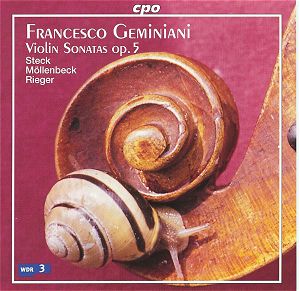

 Anton Steck
(violin); Christian Rieger (harpsichord); Markus Möllenbeck
(cello)
Anton Steck
(violin); Christian Rieger (harpsichord); Markus Möllenbeck
(cello)