Editorial Board
MusicWeb International
Founding Editor Rob Barnett Editor in Chief
John Quinn Contributing Editor Ralph Moore Webmaster
David Barker Postmaster
Jonathan Woolf MusicWeb Founder Len Mullenger
Giovanni Battista
FONTANA (d. c.1630)
Sonata No.1 (1641) [3:46]
Sonata No.2 (1641) [6:17]
Sonata No.3 (1641) [4:41]
Sonata No.4 (1641) [5:14]
Sonata No.5 (1641) [5:03]
Sonata No.6 (1641) [6:06]
Sonata No.7 (1641) [5:28]
Sonata No.8 (1641) [7:55]
Sonata No.9 (1641) [5:36]
Sonata No.10 (1641) [6:35]
Sonata No.11 (1641) [5:02]
Sonata No.12 (1641) [5:24]
Sonata No.13 (1641) [5:18]
Sonata No.14 (1641) [6:04]
Sonata No.15 (1641) [4:44]
Sonata No.16 (1641) [5:15]
Sonata No.17 (1641) [5:15]
Sonata No.18 (1641) [5:56] Giovanni Paolo CIMA (c.1570-1630)
Sonata a 2 (1610) [4:22]
Sonata a 2 (1610) [4:07]
Sonata a 3 (1610) [3:24]
Sonata a 4 (1610) [3:54] Andrea CIMA (fl.1606-1627)
Capriccio a 2 (1610) [4:00]
Capriccio a 4 (1610) [3:44] Francesco TURINI (c.1589-1656)
Sonata a 2 violini (1624) [4:29]
Sonata a 3, ‘Il Corosino’ (1624) [4:08]
Sonata a 3, ‘E tanto tempo hormai’ (1624) [3:47]
Somata a 3 (1624) [5:57]
Sinfonia a 3 (1624) [2:21]
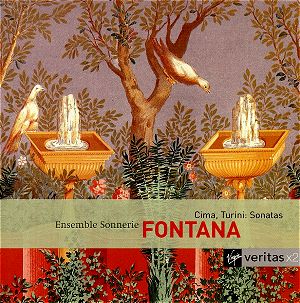
Galiarda a 3 (1624) [1:44] Ensemble Sonnerie:
Monica Huggett (violin); Bruce Dickey (cornetto); Sarah Cunningham
(cello); Gary Cooper (harpsichord;
3-stop organ; virginals); Pavlo Beznosiuk (violin); Emilia
Benjamin (viola); Doron David Shwerwin (cornetto); Frances
Eustace (gedackt dulcian); Stephen Saunders (sackbut); Elizabeth
Kenny (chitaronne; baroque guitar); Erin Headley (lirione);
Siobhán Armstrong (arpia doppia)
rec. 17-19, 21-23 August 1995, St. Jude-on-the-Hill, Hampstead,
London VIRGIN
VERITAS 3 87002 2 [72:42 + 73:17]
This
delightful pair of CDs contains music from three collections
published in northern Italy between 1610 and 1641. The earliest
is a volume published in Milan in 1610, Concerti ecclesiastici,
which is made up of music by the two brothers Giovanni Paolo
Cima and Andrea Cima and contains the ‘Sei sonate, per instrumenti à due,
tre equarto’ recorded here; the next, chronologically
speaking, is the Madrigali, libro II of Francesco
Turini, published in Venice in 1624, from which six sonatas
for two violins and continuo have here been extracted. The
last is another Venetian publication (of 1641) the Sonate
a 12.2.3. per il violono or cornetto, fagotto, chitarone,
violoncino o simile altro istrumento of Giovanni Battista
Fontana.
The
two Cimas were both organists in their native Milan, composing
both sacred music and instrumental music. Giovanni’s work,
more clearly than that of his brother, registers that crucial
development in the early baroque music if northern Italy,
the movement away from polyphonic textures towards solo (or
due) melodies supported rhythmically and harmonically by
a continuo bass, or to put it another way, the movement in
which the usually polyphonic canzona gradually lost
ground to the sonata. Eleanor Selfridge-Field (Early Music,
February 1991) has shown that most organist-composers of
the period were largely given to the composition of canzone rather
than sonatas, but Giovanni Paolo Cima is an exception. The
published scores of Cima’s sonatas are quite specific as
to instrumentation, foregrounding the cornet and the violin
as soloists. Andrea Cima’s instrumental music included in
the 1610 collection is closer in structure and method to
the declining form of the canzona, and the presentation
on this CD of work by both brothers enables one to see (or
rather hear) the nature of the transition which was taking
place.
Turini’s
sonatas belong very much to the new development of the sonata;
indeed they are amongst the earliest examples of the trio
sonata. Turini is an interesting figure, a an innovative
and accomplished composer. Of Italian stock, he was born
in Prague and became court organist there at the early age
of 12; he was sent to Italy to study, returned to Prague
at least briefly, and then from the late 1610s made his living
in Italy. From 1620 he held the post of organist at the cathedral
in Brescia. His publications included three volumes of madrigals – with
parts for violins - in 1621, 1624 and 1629; his other publications
included volumes of motets (1629 and 1640) and a set of masses
(1643). The sonatas included here are fine works. The Sonata
a 2 violini, which opens the second CD, is a piece of exquisite
beauty, subtle melodic twists and changes of direction, quiet
yet vivacious; the use of chitarrone alongside the harpsichord
to provide the continuo, a practice which Turini himself
advocated, produces some beautiful effects. Turini’s set
of variations on the song ‘E tanto tempo hornai’ is thoroughly
engaging, inventive and delightfully varied in instrumental
colouring in this excellent performance by Ensemble Sonnerie.
The
greater part of this set is given over to all eighteen sonatas
printed in Giovanni Battista Fontana’s 1641 posthumous collection – born
in Brescia, Fontana had died around 1630, possibly a victim
of the dreadful plague which affected northern Italy between
1629 and 1631 and which claimed the life of so many musicians
(including Giovanni Paolo Cima). We cannot know whether the
designation of these sonatas as for il violono or cornetto,
fagotto, chitarone, violoncino o simile altro istrumento is
Fontana’s ownor was the work of a later editor or
publisher. According to Selfridge-Field this was the earliest
such volume to specify the use of the violoncello as part
of the continuo instrumentation. Fontana’s sonatas are here
played so as to make use of the kind of variety of instrumentation
which the 1641 title page allows, perhaps even encourages.
No.1, for example, is played by cornet and organ alone, while
no.2 uses violin, harp, chitarrone, lirone and virginals;
no.9 is played by cornet, dulcian and organ, no.18 by violin,
cornet, dulcian, organ, harp and chitarrone. The resulting
variety of colours and dynamics is a constant source of aural
pleasure; the performers’ choice never seem merely wilful
or eccentric, but to respond to the nature of the music in
each particular sonata (which isn’t to say that other choices
might not be made by other performers or, indeed, by the
same group on different occasions).
Ensemble
Sonnerie’s playing throughout is the height of sensitivity
and aptness; while based on sound historical scholarship
it is never remotely pedantic. The performances, by soloists
such as Monica Huggett and Bruce Dickey, and by the ensemble
as a whole, are full of an obvious, but never indulgent,
love of the music. The whole project has a distinctive air
of Lombardy and Venice about it – the relishing of instrumental
colours, the evident sophistication, the sensuality, remind
one irresistibly of north Italian painting of the same (and
slightly earlier) generations.
These
CDs provide an exemplary illustration of the north Italian
emergence of chamber music. But to say that runs the risk
of making them sound merely like worthy historical documents.
But they are so much more than just that – the first adjective
I used at the beginning of this review was “delightful”.
It deserves to be one of the last, too; these CDs will be
a source of great pleasure to anybody with an interest in
the instrumental music of the early seventeenth century.
Glyn Pursglove
Please support our advertisers below by clicking on the logos for further information.

























 Ensemble Sonnerie:
Monica Huggett (violin); Bruce Dickey (cornetto); Sarah Cunningham
(cello); Gary Cooper (harpsichord;
3-stop organ; virginals); Pavlo Beznosiuk (violin); Emilia
Benjamin (viola); Doron David Shwerwin (cornetto); Frances
Eustace (gedackt dulcian); Stephen Saunders (sackbut); Elizabeth
Kenny (chitaronne; baroque guitar); Erin Headley (lirione);
Siobhán Armstrong (arpia doppia)
Ensemble Sonnerie:
Monica Huggett (violin); Bruce Dickey (cornetto); Sarah Cunningham
(cello); Gary Cooper (harpsichord;
3-stop organ; virginals); Pavlo Beznosiuk (violin); Emilia
Benjamin (viola); Doron David Shwerwin (cornetto); Frances
Eustace (gedackt dulcian); Stephen Saunders (sackbut); Elizabeth
Kenny (chitaronne; baroque guitar); Erin Headley (lirione);
Siobhán Armstrong (arpia doppia)