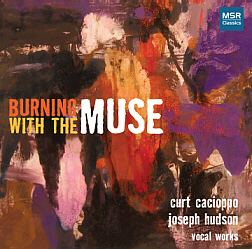
For anyone who happens
to recognise the allusion, the title
of this CD perhaps gives out the wrong
signals in some ways. The phrase comes
from a poem by Robert Louis Stevenson,
written in September 1886 in response
to a request from Frederick Locker-Lampson,
Victorian author of nicely turned light
verse. Stevenson excuses himself (in
verse!) as unfitted to write any verses
for Locker-Lampson, suggesting that
the most appropriate poets for such
a task are long dead and gone:
NOT roses to the rose, I trow,
The thistle sends, nor to the
bee
Do wasps bring honey. Wherefore
now
Should Locker ask a verse from
me?
Martial, perchance, - but he is
dead,
And Herrick now must rhyme no
more;
Still burning with the muse, they
tread
(And arm in arm) the shadowy shore.
The associations with
light verse, and for collaboration with
the long dead, are not wholly appropriate
for a CD which actually contains some
passionate settings of some passionate
and profound poems, poems, on the whole
very far from light verse, and much
of it written by the living.
This is a CD which
should be of interest to any listener
who enjoys modern song, ‘modern’ here
implying work within a largely tonal
idiom, but with contemporary inflections,
work which, broadly speaking, belongs
in the distinguished American continuation
of the German tradition of lieder.
Curt Cacioppo is Professor
of Music at Haverford College, Philadelphia;
he’s an accomplished pianist (as the
first of these CDs would itself be sufficient
to demonstrate), whose work as a composer
included organ pieces such as Visione
delle Crociate (which Hans Fagius
premiered in 2002) and the string quartet
(his second) Impressioni venexiane
(2004), as well as a sizeable repertoire
for piano. Of his contributions to the
present set, the bulk takes the form
of settings of work by contemporary
poets, Friedrich Thiel and Christopher
Scaife, both of them friends ("arm
in arm"?) of the composer. Friedrich
Thiel’s seven brief lyrics (the longest
consists of sixteen short lines and
most are rather briefer) are, for the
most part, evocations of melancholy
and pain. They win from Cacioppo simple,
but eloquent settings, profoundly sympathetic
to the imagery and rhythms of the original
texts, and Cacioppo’s settings, in turn,
benefit from an assured and expressive
performance by Michael Riley. The first
CD begins with a performance of these
settings and ends with a reprise, with
the composer’s settings this time interleaved
by the poet reading his texts – a nice
idea which works well and illuminatingly
on a well-filled disc. In between, one
of the things we get to hear is Cacioppo’s
setting of two poems (‘Poems from Paternina’)
by the English poet Christopher Scaife
(1900-1988), who will be known to some
readers as the author of the text for
John Gardner’s 1962 choral composition
A Latter Day Athenian Speaks
and who published several collections
of verse from the 1920s onwards. Scaife’s
two poems, in between which appear lines
from Adonais, Shelley’s elegy
for Keats, are full of images of loss
and death, of "ghosts of old desires"
and "ashes, in their urn / still
loved". (Here one might, indeed,
argue for the relevance of Stevenson’s
lines alluded to in the album’s title,
with their talk of "the shadowy
shore"). Again, Cacioppo’s understanding
of his texts is very evident, his setting
perceptive and sensitive, with a certain
anguished aggression giving an edge
to the poetry’s language of loss. Soprano
Leah Inger, though she gives a committed
and competent performance of what is
certainly a difficult sing, doesn’t
quite manage to sustain some of the
slower passages here and is occasionally
put under strain by some of the large
leaps required of her; she isn’t helped
by a slightly over-resonant recorded
sound.
The booklet notes describe
‘Franciscan Prayer’ as a scena pastorale,
which is fair enough. In it Cacioppo
sets the familiar prayer of St. Francis
(English readers may remember its abuse
by Margaret Thatcher), for voice and
piano, with offstage trumpet and percussion
(chimes, suspended cymbal, Tibetan monastery
bell); it is perhaps the least fully
convincing of Cacioppo’s works to be
heard here; the simplicity of the means
employed makes it rather less than memorable
some of the other pieces, and I wasn’t
convinced that the setting did very
much to enhance the words, although
its close has a pleasing poise and quiet
power. Overall, however, this is a valuable
opportunity to hear one aspect of the
work of an interesting American composer,
work not otherwise readily accessible
this side of the Atlantic.
The same can be said
for the music of New York composer Joseph
Hudson. Certainly there is no kind of
‘light verse’ to be heard in his settings
of Rilke and Dylan Thomas (‘I have longed
to move away’) and even the three Campion
songs ("So tyr’d are all my thoughts",
"When to her lute Corinna sings"
and "Rose-Cheekt Lawra, come")
have more to offer than the sort of
refinement claimed by the title Lyra
Elegantiarum which Locker Lampson
gave to an anthology "of some of
the best specimens of vers de société
and vers d’occasion" which
he published in 1867. Rilke, represented
here by ‘Einsamkeit’, ‘Eingang’, ‘Klage’
and ‘Herbst’, is about as far removed
from such social verse as might very
well be imagined. Rilke’s own verse
approaches the quality of music, in
the way it communicates, more than most
poetry does. Rilke himself didn’t much
approve of musical settings of his work;
but it lends itself beautifully to sensitive
setting – as demonstrated by, amongst
many others, Schoenberg, Hindemith,
Paul von Klenau, Frank Martin, Bernstein,
Knussen, Lauridsen, Rolf Wallin, George
Perl and Peter Lieberson. Hudson, then,
is keeping formidable company and, while
I wouldn’t put these four settings at
the very head of any league table of
Rilke settings, his work deserves respect
for the seriousness and intelligence
with which it responds to Rilke’s words.
Melodic phrases and piano accompaniment
are unflashy but responsive to word
and implication; there is some minor,
apt word-painting, but never in the
service of an over-literal response
to the text and the loosely tonal harmonies
are well-judged to evoke Rilke’s ambiguous
atmospheres. Elizabeth Farnum gives
an assured, nicely pointed performance,
articulating the unforced rhetoric of
both words and music very convincingly.
She is very ably complemented by Margaret
Kampmeier at the piano.
The three Campion lyrics
which Hudson chooses to set create an
attractive pattern of transformation,
from the "tyr’d thoughts"
of the first, in which "sence and
spirits faile", through the possibility
(but not certainty) of renewal through
the power of music in the second ("When
to her lute Corinna sings, / Her voice
revives the leaden strings") to
the resolution of the third poem’s closing
lines:
These dull notes we sing
Discords neede for helps to
grace them;
Only beawty purely loving
Knowes no discord:
But still moves delight,
Like cleare springs renu’d
by flowing,
Ever perfect, ever in themselves
eternall.
Were there but world
enough and time, it would be fascinating
to compare Campion the composer’s treatment
of his own words with their treatment
at the hands of Joseph Hudson. But it
has to suffice simply to say that Hudson
comprehensively escapes the temptations
of Elizabethan pastiche, without ever
making one feel that he is straining
after mere stylistic difference. He
creates a quite un-Campion-like idiom
which is yet thoroughly convincing.
Some musical threads run through the
three songs, very much conceived of
as a sequence, in which Hudson treats
Campion’s words and sentiments with
all the seriousness they deserve (he’s
still an underrated poet). Initially
disturbed and pained, Hudon’s music
moves through to a fitly radiant and
affirmative conclusion. A set of songs
I was delighted to discover, and one
to which I shall certainly return with
some frequency.
The programme ends
with Hudson’s setting of Dylan Thomas’s
‘I have longed to move away’, a 1933
draft of which can be found in one of
Thomas’s notebooks and which was first
published in the periodical New Verse
in 1935. Again Hudson finds a persuasive
musical idiom which responds to the
text, and the use of tenor and string
quartet allows for some attractive variety
of musical texture. Hudson was a new
name to me, and it is one which, on
the strength of his contribution to
this pair of CDs, shall certainly look
out for in future.
Glyn Pursglove
























 for details
 1 Michael Riley (bass-baritone),
Curt Cacioppo (piano); 2 Leah
Inger (soprano), Curt Cacioppo (piano);
3 Michael Riley (bass-baritone),
David Bilger (trumpet), Anthony Orlando
(percussion), Curt Cacioppo (piano); 4
Friedrich Thiel (spoken voice), Michael
Riley (bass-baritone), Curt Cacioppo (piano);
5,6 Elizabeth Farnum (soprano),
Margaret Kampmeier (piano); 7
Constantine Cassolas (tenor), Steven Hart
(clarinet), Benjamin Hudson (violin),
Lois Martin (violin), Joshua Gordon (cello)
1 Michael Riley (bass-baritone),
Curt Cacioppo (piano); 2 Leah
Inger (soprano), Curt Cacioppo (piano);
3 Michael Riley (bass-baritone),
David Bilger (trumpet), Anthony Orlando
(percussion), Curt Cacioppo (piano); 4
Friedrich Thiel (spoken voice), Michael
Riley (bass-baritone), Curt Cacioppo (piano);
5,6 Elizabeth Farnum (soprano),
Margaret Kampmeier (piano); 7
Constantine Cassolas (tenor), Steven Hart
(clarinet), Benjamin Hudson (violin),
Lois Martin (violin), Joshua Gordon (cello)