Editorial Board
MusicWeb International
Founding Editor Rob Barnett Editor in Chief
John Quinn Contributing Editor Ralph Moore Webmaster
David Barker Postmaster
Jonathan Woolf MusicWeb Founder Len Mullenger
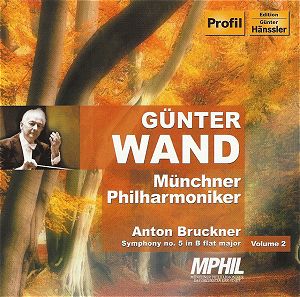
Anton BRUCKNER (1824-1896)
Symphony No. 5 in B flat major (1875-7) [75:41] Munich Philharmonic Orchestra/Günter
Wand
rec. 29 November-1 December 1995, Munich PROFIL HÄNSSLER PH06012[75:41]
The Symphony No. 5 provides us with
the essence of Bruckner.
The fact that the composer never heard
the music in performance is an indication
of his pioneering and very personal
approach to the symphony as an art form.
The work was composed between February
1875 and August 1877, and although it
was eventually performed at Graz in
1894, Bruckner was by that time too
ill to undertake the journey from his
home in Vienna. His career as a composer
developed late and enjoyed all too few
triumphs, with the result that he was
often persuaded by well meaning friends
to rework his symphonies. In this respect
the Fifth was lucky; since it lay unperformed
for years, revisions by the composer
himself were hardly possible.
However, an indication of the nature
of the problems Bruckner faced during
his lifetime can be understood from
what happened at the first performance.
The conductor was Franz Schalk, who
was a great supporter of the composer.
Even so, he made severe cuts in the
finale, and deployed additional brass
players in the closing stage in order
to make a huge effect. In the light
of these difficulties it is no wonder
that Bruckner regularly suffered from
depression, brought on also by financial
hardship as well as the failure of so
many of his contemporaries to comprehend
his artistic aims and achievements.
It was not until 1932 that the Fifth
Symphony received a performance in the
version in which it had originally been
written.
However, some of the great Bruckner
conductors, and most notably Hans
Knappertsbusch, performed the Schalk
revision. As for Günter Wand, he described
it as ‘an abomination’.
The Fifth contains two features by which
it differs from the remainder of Bruckner’s
symphonies, and which are therefore
crucial to an understanding of it. Both
the first movement and the finale have
slow introductions. The structure of
the finale is a synthesis of sonata
form and fugue, while employing also
a powerful choral theme. There is eventually
a rousing apotheosis built upon the
return of the first movement’s principal
theme.
Günter Wand is one of the legendary
Bruckner conductors, and his many recordings
have rightly achieved a classic status.
In the Fifth Symphony, for example,
there are also splendid recordings that
he made in good sound with both the
Cologne
Radio Symphony Orchestra and the
North
German Radio Symphony Orchestra.
The latter is perhaps the finest of
the three alternatives - counting this
one also. To be fair each of them will
give enormous pleasure to the sensitive
listener and will serve Bruckner’s cause
well.
The slow introduction with which the
symphony begins is some fifty bars long.
It includes several fragments relating
to material that will reach its full
potential in the Allegro which
comprises the first movement proper.
In this Munich version, which was taken
from two live performances, the introduction
builds to a most impressive climax,
before suddenly falling back to an atmospheric
string tremolando. Shimmering violins
provide the background as the cellos
and violas present the principal theme
in unison. When the movement culminates
there is a triumphant restatement of
this theme, with trombones to the fore,
and at this compelling point it is hard
to choose between Wand’s three recordings.
In the present version, for instance,
the playing of the Munich Philharmonic
is magnificent.
The slow movement has a less complex
design, and contains the emotional core
of the symphony. Wand phrases the melodic
lines with due care and attention, but
it is his Hamburg (North German) performance
which radiates the greatest warmth and
the most compelling atmosphere. The
highlight of the slow movement is the
release of eloquent string music that
envelops the principal theme, in which
regard the Munich orchestra does not
disappoint. Wand, like most conductors,
keeps the music moving with careful
sensitivity in the phrasing. But it
is interesting to note that whereas
he takes some fifteen minutes over the
movement, Herbert von Karajan in his
DG recording (415 985 2) with the Berlin
Philharmonic, spans a full twenty-one
minutes; and it works, too.
Bruckner hailed from rural Upper Austria,
and this is readily apparent in his
scherzo movements, which have their
origins in peasant dances. The lively
opening theme for woodwinds is nicely
pointed here, and the delicate textures
provide a foil to the more massive textures
elsewhere.
The tradition of the post-Beethoven
symphony demanded that the finale should
attempt to resolve the issues presented
during the course of the earlier movements,
and in the Fifth Symphony Bruckner decided
upon making his point with an intellectual
show of strength. Thus the first three
movements become an extended prelude
to the finale, which begins with a slow
introduction, as the first movement
had done. Then Bruckner presents the
ambitious combination of sonata, chorale
and double fugue. The motto theme is
transformed into the first fugue subject,
and Wand characterises it with the utmost
skill and understanding. The same is
true of the second subject group or
Gesangsperiode, and of the third too,
which leads into an impressive chorale
for the brass. At the conclusion the
orchestra blazes forth with the chorale,
above the rhythmic background of the
motto, and the principal theme of the
first movement returns to bring the
symphony to its conclusion. In Wand’s
performance the effect is simply galvanising.
Terry Barfoot
Please support our advertisers below by clicking on the logos for further information.

























 Munich Philharmonic Orchestra/Günter
Wand
Munich Philharmonic Orchestra/Günter
Wand