Editorial Board
MusicWeb International
Founding Editor Rob Barnett Editor in Chief
John Quinn Contributing Editor Ralph Moore Webmaster
David Barker Postmaster
Jonathan Woolf MusicWeb Founder Len Mullenger
Heinrich Ignaz
Franz BIBER (1644-1704) Die Rosenkranz-sonaten – The Mystery Sonatas (1670-75?) CD1
The Annunciation [6:03]
The Visitation [4:55]
The Nativity [6:49]
The Presentation in the Temple [7:47]
The Finding in the Temple [7:40]
The Agony in the Garden [7:47]
The Scourging of Jesus [9:30]
The Crowning with Thorns [6:24] CD2
The Carrying of the Cross [7:40]
The Crucifixion [10:00]
The Resurrection [7:40]
The Ascension [7:13]
The Descent of the Holy Spirit [7:30]
The Assumption of the Virgin [8:51]
The Coronation of the Virgin [11:49]
The Guardian Angel : Passacaglia [9:20] Camerata Kilkenny/Maya
Homburger (baroque violin)
rec. Propstei St Gerold, Austria, 16-23 July 2006. DDD. MAYA RECORDINGS
MCD0603 [57:07 + 70:23]
My first thought
on seeing this set was that it was up against some very strong
competition, not only at full price on Avie
AV0038, recommended by Jonathan Woolf, or Signum
SIGCD021, also available as an inexpensive download and
strongly recommended by Gary Higginson, but also on an outstanding
Virgin Veritas super-bargain-price set with John Holloway
(5 62062 2). The Signum version – or another version by the
same artists, Cordaria/William Reiter – has recently resurfaced
at super-bargain price on Brilliant Classics 93563. For a
comparison of the sets by Monica Huggett (CDGAU350-1) and
Andrew Manze (HMU90 7321-2), see Jonathan Woolf’s 2004 review.
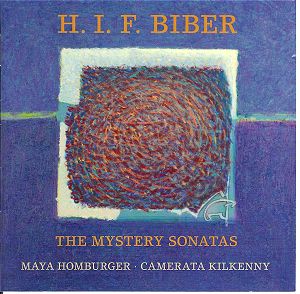
These rival sets are also more attractively packaged, with
art-work more likely to catch the eye of the casual purchaser,
than the cover of this Maya set.
Camerata Kilkenny
is not exactly a household name, though some of its members,
not least Maya Homburger herself, are well known in their
own right. One might have expected a comparatively unknown
group on a self-financed independent label to have chosen
a less hotly-contested area of the baroque repertoire. In
fact, Homburger’s earlier recordings have mostly been of
more out-of-the-way repertoire: a well-received ECM CD on
which she performs the opening Biber Mystery Sonata with
a quirky rendering of the continuo by Barry Guy and some
works by Guy himself; another ECM disc where she plays some
more Barry Guy with the Munich Chamber Orchestra, and a third
ECM re-interpretation of works by John Dowland. Her excellent
recording of Telemann’s unaccompanied Violin Sonatas on her
own label appears to have been deleted.
It was, therefore,
with mixed expectations – and in less than favourable circumstances – that
I played the first disc. Having woken up at 1.00 a.m., unable
to get back to sleep, I decided to try what I expected to
be the most soothing recording in the pile awaiting review.
At that time in the morning the last thought in my mind was
to find my copy of the Virgin Veritas set for comparison,
much less make critical notes, so I simply sat there to enjoy.
More than two hours later I had played the whole of the two
CDs and thoroughly enjoyed what I had heard. In the context
of a live concert performance or a radio broadcast, then,
with no comparisons to hand, these performances would prove
enjoyable and more than satisfactory.
But the competition
is there and, in the case of the Virgin set, available at
about a third of the price of this new set, an important
consideration for those of us born north of Watford. It is
with this set that I shall be comparing the Maya CDs. Scores
of the opening Sonata, The Annunciation, and the closing
Passacaglia are available from the Icking music archive, so
it is appropriate to begin my comparison with the beginning
of the first CD and the end of the second.
Of Homburger’s
own expertise and virtuosity there can be no doubt. Though
ostensibly written as meditative music to illuminate the ‘mysteries’ of
the rosary – five joyful mysteries, five sorrowful and five
glorious – it is mostly only the opening prelude in each
case which is really linked to the mystery in question, with
the violin showing its virtuosity in the remaining movements.
Biber was probably the greatest violin virtuoso of his age,
as well as a composer: Dr Burney called his music and playing “the
most difficult and most fanciful of any music I have seen
of the same period.” Only Sonata I and the closing Passacaglia
are written for a normally-tuned violin; the remainder make
use of different forms of scordatura, whereby the
strings are re-tuned. In Sonata XI, the Resurrection, the
middle strings are even symbolically crossed over. The notes
explain this practice and give details of the tuning for
each of the sonatas.
In the opening
sonata the fluttering demisemiquavers (thirty-second notes)
of the violin represent the wings of the angel Gabriel over
a passive bass, possibly representing the stillness of Mary – for
the first nine-and-a-half bars and again in bars 13 to 17
and 20 to 24 the continuo is a single repeated note. Both
Homburger and Holloway succeed very well in achieving the
ethereal effect - think of Crivelli’s Annunciation in
the National Gallery for a visual parallel.
After a short Variatio for
continuo the violin is allowed to show off in the ensuing Aria, Variatio and Adagio and
Homburger takes full advantage of the opportunity. Her playing
here is at least as virtuosic as Holloway’s, if not more
so. The continuo is more prominent than on the Holloway recording.
I originally wrote ‘more imaginative’: that was my first
impression, then I changed my mind for reasons which will
be apparent later.
The Virgin
notes tell us what instruments were employed for the continuo
in each sonata – in this case organ, lirone, harp and lute.
The Maya notes do not do so for individual sonatas, but the
booklet names the overall ensemble and contains two photographs
of the performers with their instruments, including Barry
Guy, apparently ubiquitous on Homburger’s recordings, on
double bass. Well aware of the incongruity of this instrument
amongst a period ensemble – the booklet gives the provenance
and dates of these instruments – Homburger seeks to justify
its “extra depth and earth-bound dimension which balances
the moments when the music seems to soar weightlessly into
heaven.” Apparently she has given a number of successful
concert performances with Guy’s double-bass as the sole continuo
instrument.
Be that as
it may, my initial reaction, even before I spotted the double-bass
in the line-up, was to find the continuo heavy by comparison
with that on the Holloway recording. Then again, that is
exactly what Homburger says she wants, and, stickler though
I usually am for authenticity, I have to admit that the 16-foot
tone works surprisingly well for a time. Much as I
hate Bach on the piano, Glenn Gould is the exception. At
first I thought the double bass here could be another Gould-type
exception, illogical as this is. Not long ago I criticised
the use of 16-foot tone in Bach’s organ music. One of the
photographs in the booklet shows Homburger standing well
forward from the continuo instruments but the rather forward
recording makes them sound too prominent, with plucked strings
sometimes more to the fore than the violin. This prominence,
adding spice at first, eventually produces a degree of listener
fatigue; the spice ultimately making the meal somewhat unvaried
and indigestible.
How to realise
the continuo is a vexed question: the score merely offers
a figured bass, with no indication of instrumentation, the
performers using whatever was to hand. Some time ago, reviewing
Corelli’s Op.5 Violin Sonatas, I discussed the issue of how
many instruments should be employed for the continuo. The
Naxos recording which I was reviewing employed the harpsichord
only, dispensing with the gamba or cello which is often used,
and I found the result refreshing. Andrew Manze’s recording
of these Biber sonatas uses keyboard continuo only, with
an additional cello in the Ascension sonata alone. Given
a choice, I prefer the minimalist approach: Camerata Kilkenny’s
continuo is rather too much of a good thing and the deep
bass rather tiring after the initial novelty has worn off.
Not only is the continuo less prominent on the Virgin recording,
it is also more varied – eight instruments in varied combinations
as against six on the Maya CDs.
No worries
about continuo in the concluding Passacaglia, which is for
solo violin; Homburger gives an impassioned performance,
making the music sound fully the equal of Bach’s solo violin
sonatas and partitas … and how about a recording of those
works from her? At 9:20 she is a little slower than Holloway’s
8:50, though the recording, more forward on the Maya disc,
actually makes her sound less meditative than Holloway. Both
tackle the ferocious difficulties of this piece with effortless
virtuosity.
If, in the
end, I come down in favour of the Virgin set, the slightly
more recessed recording (1989, DDD) is an important factor
in my decision. Otherwise, it’s swings and roundabouts between
the two versions. Tempi for the opening sections are broadly
similar – occasionally to within seconds of each other – though
Homburger is sometimes faster, sometimes slower in the following
movements. Homburger is usually the more immediate and dramatic,
for example in her charged account of Sonata X, the Crucifixion
which really makes the listener sit up. Holloway stresses
the staccato notes which represent the hammering of the nails
but otherwise his version of the Crucifixion is rather more
in accord with Andrew Manze’s belief that Biber did not intend
these sonatas to sound too dramatic but wished them to be
effective at a deeper level. That said, Biber did write improvvisata or
descriptive music: his Sonata representativa contains
striking evocations of different kinds of bird-song and other
sonatas represent battles, the night-watchman and peasants’ merrymaking.
The Virgin
set ends the first CD with the Crucifixion sonata, beginning
CD2 with the Resurrection, which makes a neater division
than the Maya arrangement.
Honours are
about even as far as the notes in the booklets are concerned.
Virgin name the continuo instruments for each sonata, Maya
do not; Maya specify the scordatura tuning for each
sonata, Virgin do not. Manze’s set includes an appendix in
which he explains scordatura and gives several examples.
The Virgin booklet is, as usual, minimalist, though promising
more detailed notes at their website. If such notes
exist, I was unable to find them. I recently found the same
problem on the website of the parent company, EMI, trying
to find the promised libretto for the Haitink Rosenkavalier:
EMI need to do something to make their websites more user-friendly.
What it says on the label should be easily found in the tin.
The Maya booklet is very thick – taking it in and out of
the case has already begun to produce signs of wear and tear – but
I could gladly have dispensed with Father Nathanael’s discursive
notes on the rosary in exchange for more information about
the music. No-one buying this Maya CD on impulse is likely
to feel serious regrets – and I’d love to be able fully to
commend Maya Homburger’s enterprise in founding and maintaining
her own label – but the competition in these works is just
too fierce.
Whichever version
you choose, you are likely to want to explore Biber further.
A good place to start would be with another even more virtuosic
set of violin sonatas (1681), an award-winning performance
from Romanesca on Harmonia Mundi HMX290 7344-5, 2 CDs for
the price of one. You could buy this and the Virgin set of
the Mystery Sonatas for not much more than the Maya CD.
Brian Wilson
Please support our advertisers below by clicking on the logos for further information.
























 Camerata Kilkenny/Maya
Homburger (baroque violin)
Camerata Kilkenny/Maya
Homburger (baroque violin)