Editorial Board
MusicWeb International
Founding Editor Rob Barnett Editor in Chief
John Quinn Contributing Editor Ralph Moore Webmaster
David Barker Postmaster
Jonathan Woolf MusicWeb Founder Len Mullenger
Sir Edward
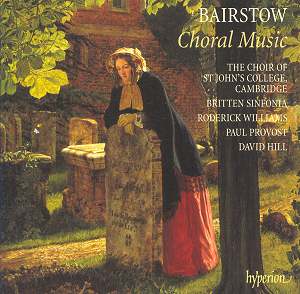
BAIRSTOW (1874-1946)
Jesu, the very thought of thee (1925) [2:37]
Blessed city, heavenly Salem* [8:11]
Evening Service in D (1906)* [8:20]: Magnificat [4:53] Nunc
dimittis [3:22]
Lord, thou hast been our refuge (1916)* [7:59]
If the Lord had not helped me (1910?)* [6:20]
Let all mortal flesh keep silence (1906) [3:15]
Evening Service in G (1940)* [5:54]: Magnificat [3:38] Nunc
dimittis [2:11]
Five Poems of the Spirit (1944)** [14:02]
Save us, O Lord (1900)* [5:12] Paul Provost
(organ)*, Roderick Williams (baritone)**
Britten Sinfonia**
Choir of St. John’s College, Cambridge/David Hill
rec. 13-14 January 2007, St. John’s College Chapel, Cambridge.
DDD
English texts included HYPERION
CDA67497 [62:47]
Sir
Edward Bairstow was appointed organist and Master of the
Music of York Minster in 1913 and remained there until his
death. From 1929 he combined the post with the Chair of Music
at Durham University. Prior to his arrival at York he had
been successively organist and choirmaster firstly of Wigan
Parish Church (1899-1906) and then of Leeds Parish Church
(1906-1913). Today he is largely remembered for his church
and organ music and this new CD offers a good selection from
his ecclesiastical output together with one work, Five
Poems of the Spirit, which is really a concert work,
though the texts that Bairstow uses in it are definitely
spiritual in nature.
Some
of the anthems that David Hill has selected are pretty familiar,
especially Blessed city, heavenly Salem and Let
all mortal flesh keep silence. It might have been expected
that the former, a confident, outgoing piece in many ways,
would start this programme off. However, in a thoughtful
piece of programme planning, it’s actually Jesu, the very
thought of thee that we hear first. That’s an excellent
decision on someone’s part for this gently devotional setting
serves perfectly as a meditative introit, after which Blessed
city, heavenly Salem is perfectly placed. Similarly the
recital closes with the Compline antiphon Save us, O Lord.
Though that has a relatively vigorous short fugal section
in the middle it’s also primarily a contemplative setting
and, as such, it makes a suitably serene end to the disc.
All
the anthems here are very well worthwhile listening. Without
exception they are expertly crafted and show a discriminating
ability on Bairstow’s part to respond to texts. More than
that, in a piece such as If the Lord had not helped me Bairstow’s
selection of verses from the Psalms brings with it several
changes of mood and his music unerringly reflects these different
moods. Also, as will be seen from the composition dates in
the track listing, the choice of pieces is good in that it
gives the listener a flavour of Bairstow’s output and style
at different stages in his career. One thing that is unchanging,
it seems to me, is a sure sense of faith, which underpins
the music.
The
two sets of evening canticles are well chosen for contrast.
The earlier set, in D major, is the more outgoing and confident
in tone, especially in the Magnificat, which concludes with
a majestically affirmative doxology. The companion Nunc dimittis
radiates calm assurance and rises to a warm climax at “To
be a light to lighten the gentiles.” Interestingly this setting
has a different doxology to the Magnificat and incorporates
a fugue on “As it was in the beginning.” The G major canticles
represent a stated intention on Bairstow’s part to write
a set of canticles that were essentially prayerful and contemplative
in nature. In this he succeeded, though his ambition did
not prevent him from expressing confidence in the doxology.
Perhaps
of greatest interest, because least familiar, is Five
Poems of the Spirit. Though not claimed as such by Hyperion,
this may well be the first recording of this work. The work
comes from the end of Bairstow’s life and, indeed, the last
three of the pieces were orchestrated after his death by
Sir Ernest Bullock. It was Bullock who arranged for the publication
of Five Poems in 1954. In the process he discarded
a sixth setting on the grounds that the text, The Veteran
of Heaven by Francis Thompson, did not sit well with
the other poems, all of which were by sixteenth- or seventeenth-century
English poets.
The
work is a good one, I think, and I’m glad that it’s been
recorded for it deserves wider currency. And what luxury
to have a soloist of the calibre of Roderick Williams! He
sings splendidly throughout – though he’s not involved in
the third Poem, which is for chorus alone. Particularly satisfying
are the last two movements. ‘Purse and Scrip, a poem by Sir
Walter Raleigh (1552-1618), is a noble setting, mainly for
the baritone, with the chorus joining in near the end. The
music has a dignified eloquence, a description that applies
equally to the singing of Roderick Williams. That’s followed
by ‘L’Envoy’, a stanza by George Herbert (1593-1633). This
is a lovely, serene piece of music that fades away to nothing. Five
Poems of the Spirit has a gentle eloquence that I find
most affecting and I’m delighted that it’s been recorded.
The
whole standard of this disc is excellent. The choir sings
splendidly throughout and the organ accompaniments by Paul
Provost enhance the proceedings significantly. David Hill
has evidently trained the choir superbly – one would expect
nothing less. In the Five Poems the Britten Sinfonia
play very responsively. The performances have been well recorded
in the resonant acoustic of St. John’s Chapel. The disc is
accompanied by good notes by the current occupant of Bairstow’s
old post at York Minster, Philip Moore.
Unless
there is something else “in the can”, this presumably will
be the last CD from the surprisingly short-lived partnership
of David Hill and the St. John’s Choir. I’ve heard and greatly
enjoyed all of the previous ones, except for their Mendelssohn
disc, which has not come my way. I’m happy to confirm that
this latest release is fully up to the standards we have
come to expect from Hill and his choir. If this is to be
the last disc by David Hill and the St. John’s choir then
the partnership has ended on a high note and Bairstow has
been well served.
John Quinn
Please support our advertisers below by clicking on the logos for further information.
























 Paul Provost
(organ)*, Roderick Williams (baritone)**
Paul Provost
(organ)*, Roderick Williams (baritone)**