Editorial Board
MusicWeb International
Founding Editor Rob Barnett Editor in Chief
John Quinn Contributing Editor Ralph Moore Webmaster
David Barker Postmaster
Jonathan Woolf MusicWeb Founder Len Mullenger
Johann Sebastian BACH (1685–1739)
Concerto in F minor for Oboe and Strings, after BWV 169/49 [18.15]
Double Concerto in C major for Oboe and Violin and Strings,
after BWV 1055 [13.32]
Concerto in A minor for Oboe and Strings, after BWV 1055
[14.23]
Concerto for G major Oboe and Strings, after BWV 1041 (BWV
1058) [13.29]
Concerto movement in D major for Oboe and Strings, after
BWV 35 [5.53]
Concerto in G major for Oboe and Strings, after BWV 1065
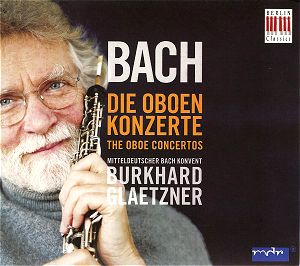
[9.42] Burkhard Glaetzner
(oboe and direction)
Andreas Hartmann (violin)
Mitteldeutscher Bach Konvent
rec. 10-13 April, 19-21 June 2006, Orchestersaal Augustusplatz
Leipzig. BERLIN
CLASSICS 0016092BC [75.19]
18th century
commentators refer to Bach’s concertos for diverse instruments
but all that has come down to us are the violin concertos
and harpsichord concertos. Ironically, one of Bach’s most
commonly used obbligato instruments was the oboe, so it is
tempting for practitioners to ascribe some of these missing
concertos to the oboe.
Of
course, not all the concertos are quite missing. Bach was
a great re-user so that a concerto in E flat (or F) for oboe
(or perhaps viola) was re-used in his cantatas BWV169 and
BWV49 and re-written for harpsichord in BWV1053. In this
way the original concerto can be re-constructed with some
confidence. On stylistic grounds, this concerto was probably
written in the earlier part of his Leipzig period.
On
this new disc, distinguished German oboist Burkhard Glaetzner
plays five conjectural re-constructions, plus the double
concerto. Though I have described the concerti as conjectural,
this should not worry us unduly. Bach re-arranged Vivaldi
concertos for new forces and was, as we have seen, a re-user
of his own music. So the adaptations necessary to create
these concertos would not have worried him.
My
only complaint, is that the extensive CD booklet does not
seem to credit who did the adaptations in the first place.
The
double concerto for Violin and Oboe, BWV1060, has long been
in existence based on its surviving incarnation for two harpsichords.
This harpsichord version was created in the mid-1730s for
his Collegium Musicum; a group who practised on the premises
of café owner Gottfried Zimmerman and for whom Bach made
many of his harpsichord concerto transcriptions.
Harpsichord
concerto BWV1055 was created slightly later, but the surviving
parts indicate that the work was based on a lost original
in the same key. The instrument in question was probably
an oboe d’amore, an instrument newly invented in the 1720s.
There is good reason to think that the concerto was originally
composed in the 1720s for the new instrument.
Bach’s
own Violin concerto BWV 1041 also exists in a transcription
for harpsichord, so we can forgive Glaetzner for appropriating
it for oboe as well.
For
the next concerto, only the opening movement survives, in
a version for obbligato organ. The remaining movements are
conjectural and are not included here.
The
final concerto is based on the harpsichord concerto BWV1056,
again a work where concurrency can be shown with various
other of Bach’s works.
Glaetzner
is accompanied by the MittelDeutscher Bach Konvent with a
string group of some thirteen players. Glaetzner has an admirably
warm sound with a good flexibility in playing Bach’s solo
lines. He also doubles as director.
Occasionally
speeds are a little fast. I felt that the opening movement
of BWV 1055 was rather gabbled. But technically, Glaetzmer
the oboist has no problems with the speeds set by Glaetzner
the director.
Playing
on what sound to be modern instruments, the Mitteldeutscher
Bach Konvent make a strong sound but prove fine accompanists.
The performance is, to some extent, period aware. The string
sound in particular is crisp and lively, with none of the
luxuriance and over-reliance on vibrato which comes with
some older performances.
I
enjoyed this disc, despite being a convinced lover of the
sound of the baroque oboe. Glaetzner’s intelligence and technique
make a good case for these pieces, even when you are aware
of more well known versions in the background.
The
disc includes an informative article by Manfred Fechner which
explores the origins of the various concertos.
This
is probably not a library choice, but certainly should be
a disc that anyone with an interest in Bach’s concertos should
explore.
Robert Hugill
Please support our advertisers below by clicking on the logos for further information.

























 Burkhard Glaetzner
(oboe and direction)
Burkhard Glaetzner
(oboe and direction)