Arnell may be a British
composer but he has had little truck
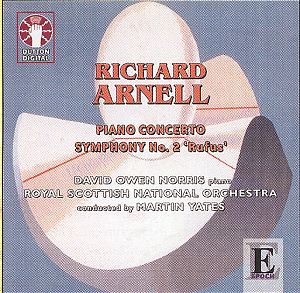
with pastoralism. His Piano Concerto
was written towards the end of his New
York wartime exile. It was premiered
by Vera Brodsky with the CBS Symphony
Orchestra conducted by Arnell's chief
supporter of the time Bernard Herrmann.
It's a work in three movements with
a dark and even ruthless mien in the
outer movements, sometimes lightened
by a very mildly astringent romanticism.
The style is akin to early Rawsthorne
with the edges softened and made yet
more eloquent by Kabalevsky. His massive
Third Symphony bore the Shostakovich
impress and that can be heard here as
well. The Arnell concerto would go rather
well with Shostakovich's Second Piano
Concerto or Kabalevsky 2 and 3. At times
when Arnell reaches for romance as he
does at 9:01 in the first movement,
and in the Andante, he can sound like
Malcolm Arnold at his most dreamy and
tranced. The concerto has not been widely
played despite spells when it was championed
by Moura Lympany and by the Canadian
pianist Ross Pratt. Interest just fizzled
out in the 1950s. It is good to welcome
such a fine work back into availability.
The Second Symphony
was also unlucky. Having been written
under the pseudonym ‘Rufus’ for a competition
it had to wait until September 1988
for its first performance - Edward Downes
and the BBCPO. It was written before
the symphony we now know as No. 1 and
was dedicated, with permission, to Aldous
Huxley. Its style reflects the turbulence
of the times and of an America just
entering the war after Pearl Harbour.
There's a determined Allegro quasi
presto in a thorny lyrical style
close to late 1940s Alwyn. The orchestration
is transparently structured and everything
strikes with the utmost clarity - no
doubt in part due to the evident artistry
of the RSNO and Martin Yates. This is
music in emotional turmoil with strong
rhythmic impetus and brass emphasis.
The second movement is an allegretto
- a sort of night patrol in music
that is uncertain, fragmented, haunted
and elegiac. Nonetheless it rises in
impressive brass-called romantic wreckage
at 7:30. A typically yearning Alwyn-style
theme sings out the movement but the
music it resembles Alwyn was not to
write until 1949. The finale has the
gritty determination of Copland's Third
Symphony without its brutal over-emphasis
but again there are other familiarities
here especially in the concert music
of Alan Rawsthorne.
Two eloquent and exciting
works with tragic grandeur in their
sights both written in exile. Finely
documented by Lewis Foreman, full-throatedly
performed and recorded to match.
-------------------------------------
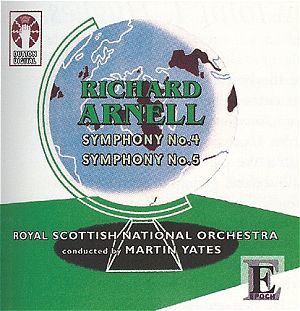
Arnell's Fourth Symphony
started life during his New York wartime
exile but was finished in London in
1948. While shorter than the monumental
Shostakovich-indebted Third it has the
gritty determination of that composer
though the style is Arnell's alone.
The work is dedicated to the conductor
Leon Barzin who was one of Arnell's
supporters in the USA. In fact Barzin
gave the premiere with the NYPO in 1949.
Once again it is clear that Arnell sees
the symphony as a vehicle for the expression
of great emotions and traumas. There
is some pawky humour, often from the
bassoon (as in the Second Symphony),
but the passion of this work is in its
laying bare of tragedy and heroism.
Not perhaps as brassy as Boris Tchaikovsky's
First, it certainly tracks territory
similar to the Alwyn Fourth Symphony.
Also in the mix there’s a dash of 1940s
Rawsthorne and symphonic Copland and
some of the bleakness in climax or in
desolating quiet music of Vaughan Williams'
Sixth Symphony. The brief and brass-clamant
Allegro vivace finale touches
on the obstreperously triumphant manner
of Copland, William Schuamn, Roy Harris,
Alwyn and Shostakovich. When we get
to hear the symphonies of John Veale
I suspect we will hear similar influences.
The Fifth Symphony
- there are six in total of which Dutton
have so far issued four - is not without
tension. This time the accent is on
a haunting and regal celebratory mood.
As Lewis Foreman points out, the Fifth
is perhaps Arnell's most approachable
and potentially popular symphony. It
was completed in 1957 and the formal
premiere with corrections was given
by the composer conducting the RPO in
London on 22 March 1966. I came to know
it through the BBC broadcast in 1977
by the BBCNSO conducted by John Carewe.
It is dedicated to the composer's father
whose predilection for the music-hall
song Dear Old Pals, Jolly Old Pals
is honoured by a quote in the middle
and final movements. The music differs
in heat and temperament from the Second,
Third and Fourth symphonies. This does
not mean that there are not some witheringly
Shostakovich-like passages in the first
movement because there are. The mood
overall though can be likened to the
imperial splendour of Glazunov's Eighth
Symphony or Bax's Seventh as against
the comparative extremes of emotion
in Glazunov 4 or 5 or Bax 6. After a
sober prelude the middle movement develops
some vital and lively music at 3.09
typical of the grandiloquent moments
in Roy Harris 7, Schuman 3 and Randall
Thompson 2. This is music implacably
alive with the life force. Waltonian
birdsong joyously chirps preparing the
ground for some romping and rampant
brass but the movement ends in Copland-like
peace. The third and final movement
is an Andante e serioso. This
has some wondrously lambent and beatific
writing for the woodwind and a pervasive
sense of cresting sanguine uplift. The
atmosphere is fuelled and further enhanced
by the singable melody at 3:12, warmly
and flowingly projected at 4:00 and
5:16 and rising to frank and unclouded
majesty at 8:45. It was at this point
that a perhaps more pertinent parallel
in British music came into focus: Malcolm
Arnold's Fifth Symphony lying three
or so years in the future when Arnell
finished this symphony.
Good liner notes by
Lewis Foreman - that doyen and begetter
of the British musical renaissance since
the early 1970s. The recording quality
is excellent with especially good stereo
spread rather than separation - that
tangible sense of a wide-span soundstage.
Two fine symphonies
embracing the extremes of emotion and
one devastatingly likeable and radiantly
strong.
Rob Barnett
see also Profile
of Richard Arnell
Richard
Arnell at 88
























 David Owen Norris (piano)